
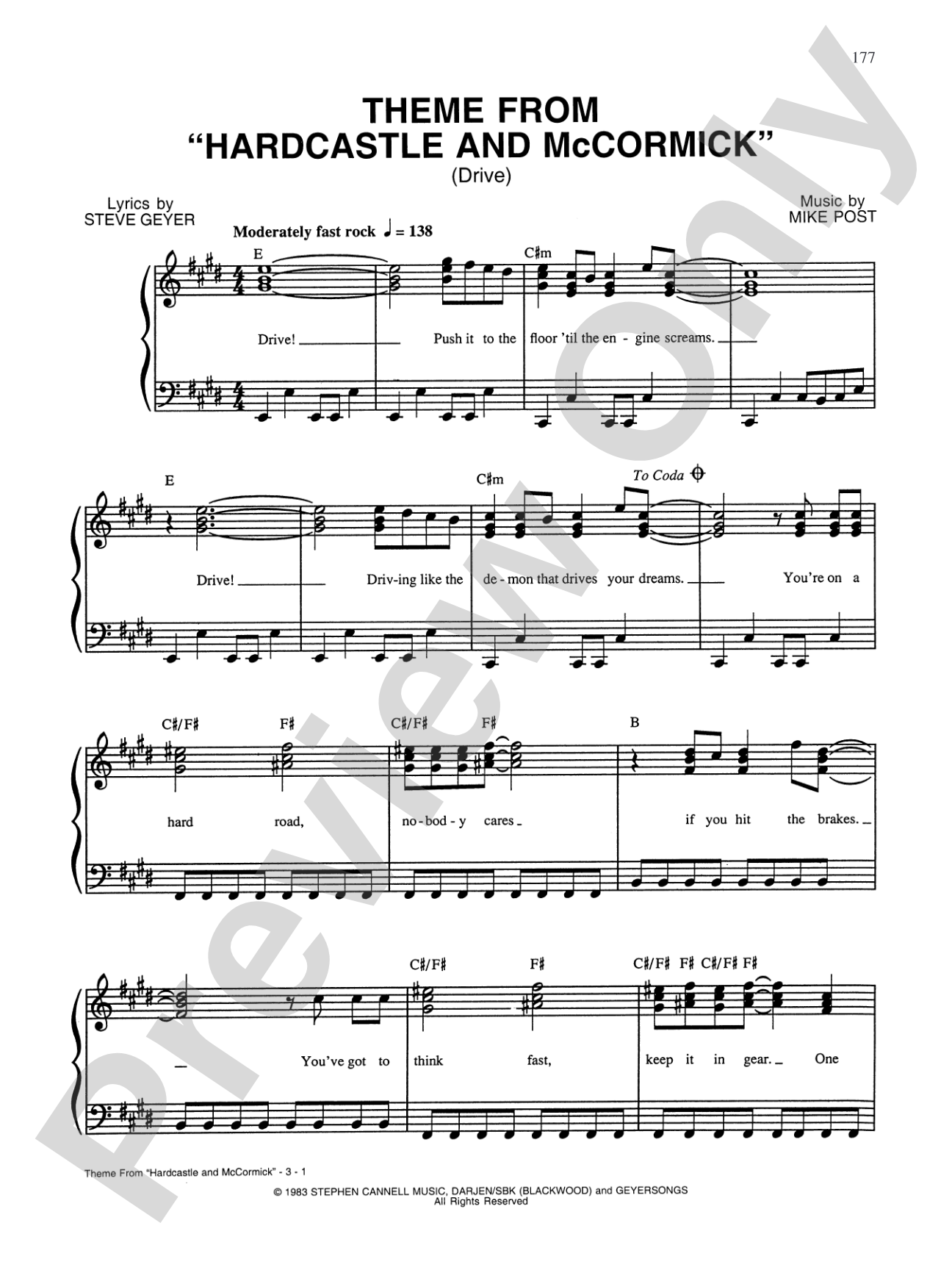

Hardcastle & McCormick (Cues): Piano/Vocal/Chords
Item: 00-PSP-000428
$4.99
One moment…
Related Items
(Meet) The Flintstones: Piano/Vocal/Chords |
$4.99
|
View | |
Anywhere the Heart Goes (From "The Thorn Birds"): Piano/Vocal/Chords |
$4.99
|
View | |
As Long As We Got Each Other (From "Growing Pains"): Piano/Vocal/Chords |
$4.99
|
View | |
Best Friend (From "The Courtship of Eddie's Father"): Piano/Vocal/Chords |
$4.99
|
View | |
California: Piano/Vocal/Chords |
$4.99
|
View | |
Charlie's Angels (Main Theme): Piano/Vocal/Chords |
$4.99
|
View | |
Dallas (Main Title): Piano/Vocal/Chords |
$4.99
|
View | |
Daniel Boone (Main Theme): Piano/Vocal/Chords |
$4.99
|
View | |
E.R. (Main Theme): Piano/Vocal/Chords |
$4.99
|
View | |
Free Willy (Main Title): Piano/Vocal/Chords |
$4.99
|
View | |
Go Go Power Rangers: Piano/Vocal/Chords |
$5.99
|
View | |
Huckleberry Hound: Piano/Vocal/Chords |
$4.99
|
View | |
In the Heat of the Night: Piano/Vocal/Chords |
$4.99
|
View | |
It's A Jungle Out There (From "Monk"): Piano/Vocal/Chords |
$4.99
|
View | |
Josie (from "Josie and the Pussycats"): Piano/Vocal/Chords |
$4.99
|
View | |
L.A. Law (Main Title): Piano/Vocal/Chords |
$4.99
|
View | |
Late Show Theme: Piano/Vocal/Chords |
$4.99
|
View | |
Moon Over Parma (From "The Drew Carey Show"): Piano/Vocal/Chords |
$4.99
|
View | |
Road Runner Theme: Piano/Vocal/Chords |
$4.99
|
View | |
Scooby Doo, Where Are You?: Piano/Vocal/Chords |
$4.99
|
View | |
Thank God for a Friend Like You (From "Hope & Gloria"): Piano/Vocal/Chords |
$4.99
|
View | |
The A-Team (Main Theme): Piano/Vocal/Chords |
$4.99
|
View | |
The Ballad of Gilligan's Isle: Piano/Vocal/Chords |
$4.99
|
View | |
The Greatest American Hero (Theme): Piano/Vocal/Chords |
$4.99
|
View | |
The Green Hornet Theme: Piano/Vocal/Chords |
$4.99
|
View | |
The Jetsons (Main Theme): Piano/Vocal/Chords |
$4.99
|
View | |
The Rosie O'Donnell Show (Opening Theme): Piano/Vocal/Chords |
$4.99
|
View | |
The Syncopated Clock (Vocal): Piano/Vocal/Chords |
$4.99
|
View | |
Fantasy Island Theme: Piano/Vocal/Chords |
$4.99
|
View | |
F-Troop Theme: Piano/Vocal/Chords |
$4.99
|
View | |
Hunter Theme: Piano/Vocal/Chords |
$4.99
|
View | |
Peyton Place Theme: Piano/Vocal/Chords |
$4.99
|
View | |
Time for You (From "Jesse"): Piano/Vocal/Chords |
$4.99
|
View | |
Yogi Bear Song: Piano/Vocal/Chords |
$4.99
|
View |
Description
Each songbook in the Big Book series provides musicians of all ability levels with a big list---usually 40 or more titles per book---of the very best songs from a favorite musical genre.
Songs include As Long as We Got Each Other (Growing Pains) * Bad Boys (Cops) * Batman Theme (Batman) * California (The O.C.) * (Meet) The Flintstones (The Flintstones) * Good Ol' Boys (The Dukes of Hazzard) * I'll Be There for You (Friends) * Movin' On Up (The Jeffersons) * The Pink Panther (The Pink Panther) * Scooby-Doo (Main Title) (Scooby-Doo) * Song from M*A*S*H (M*A*S*H) * This Is It! (The Bugs Bunny Show) * Yogi Bear Song (Yogi Bear) * and many more.


Songs include As Long as We Got Each Other (Growing Pains) * Bad Boys (Cops) * Batman Theme (Batman) * California (The O.C.) * (Meet) The Flintstones (The Flintstones) * Good Ol' Boys (The Dukes of Hazzard) * I'll Be There for You (Friends) * Movin' On Up (The Jeffersons) * The Pink Panther (The Pink Panther) * Scooby-Doo (Main Title) (Scooby-Doo) * Song from M*A*S*H (M*A*S*H) * This Is It! (The Bugs Bunny Show) * Yogi Bear Song (Yogi Bear) * and many more.
Hardcastle & McCormick (Cues): Piano/Vocal/Chords isn't in MakeMusic Cloud just yet...but it could be. Let us know you'd like to see it, and you'll help shape what comes next. In the meantime, start a free trial and dive into thousands of interactive titles your students can play along with today.
Request This Title
Tell us you want it.
Start Your Free Trial
Explore everything that's ready to play right now.
Sample Audio
No sample audio found.
Sample Video
No sample videos found.
Additional Details
Series:
The Big Book Series
Publisher:
Alfred Music
Page Count:
256
SKU:
00-PSP-000428
More about this title
About the Composer: Mike Post
Mike Post is a composer and television music specialist whose work defined the sound of American television from the 1970s onward. His theme compositions for shows like Hill Street Blues, Law & Order, and NYPD Blue became instantly recognizable to millions of viewers and earned him multiple Emmy nominations. Post's ability to distill a show's identity into a memorable, concise musical statement made him one of the most prolific and influential TV composers in the medium's history.
Why we love this
This collection captures the exact melodies that shaped American popular culture across decades of television. Piano players and singers get access to the iconic themes they recognize instantly, making learning feel rewarding from the first page. The variety ensures every rehearsal or practice session can include something that resonates with both performer and audience.
What to expect
These are the musical snapshots that announce a show before the first word of dialogue. You'll find themes that are instantly hummable, driving, uplifting, mysterious, or comedic—each one a tiny masterpiece of functional composition designed to stick in your memory forever.
Who it's for
Piano and voice students who want to learn music they actually hear on screen, and music teachers looking for repertoire that connects classical skill-building to contemporary culture. Pianists developing chord reading and accompaniment skills will find clear harmony notation throughout, while singers gain material that builds melodic confidence through familiar material.
How to get the most out of it
- Study the original TV recordings to nail the exact character and orchestration of each theme; the written arrangement should serve as a blueprint, but the recorded version is your reference point for phrasing and energy.
- Treat these themes as complete musical statements. Resist the urge to add flourishes or extend sections; the original writers crafted them for immediate impact and clarity.
- Balance the vocal line with the chord changes so the harmony supports the melody without overwhelming it. Many of these themes work best when the vocal remains front and center.
- Experiment with tempo flexibility in longer themes; slight rubato can enhance dramatic moments without losing the recognizable shape of the tune.
How to use it
Feature a TV theme medley in a pops concert or end-of-year showcase where students perform pieces that mean something to their generation and their audiences. Mix themes with different moods and tempos to create natural programming variety and sustain energy across the set.
Skills your students will build
- Reading chord symbols and functional harmony
- Vocal independence from harmonic accompaniment
- Phrasing and expression in contemporary idioms
- Sight-reading skills across a wide range of rhythmic and melodic styles
- Understanding how melody, harmony, and rhythm combine to create memorable musical identity