
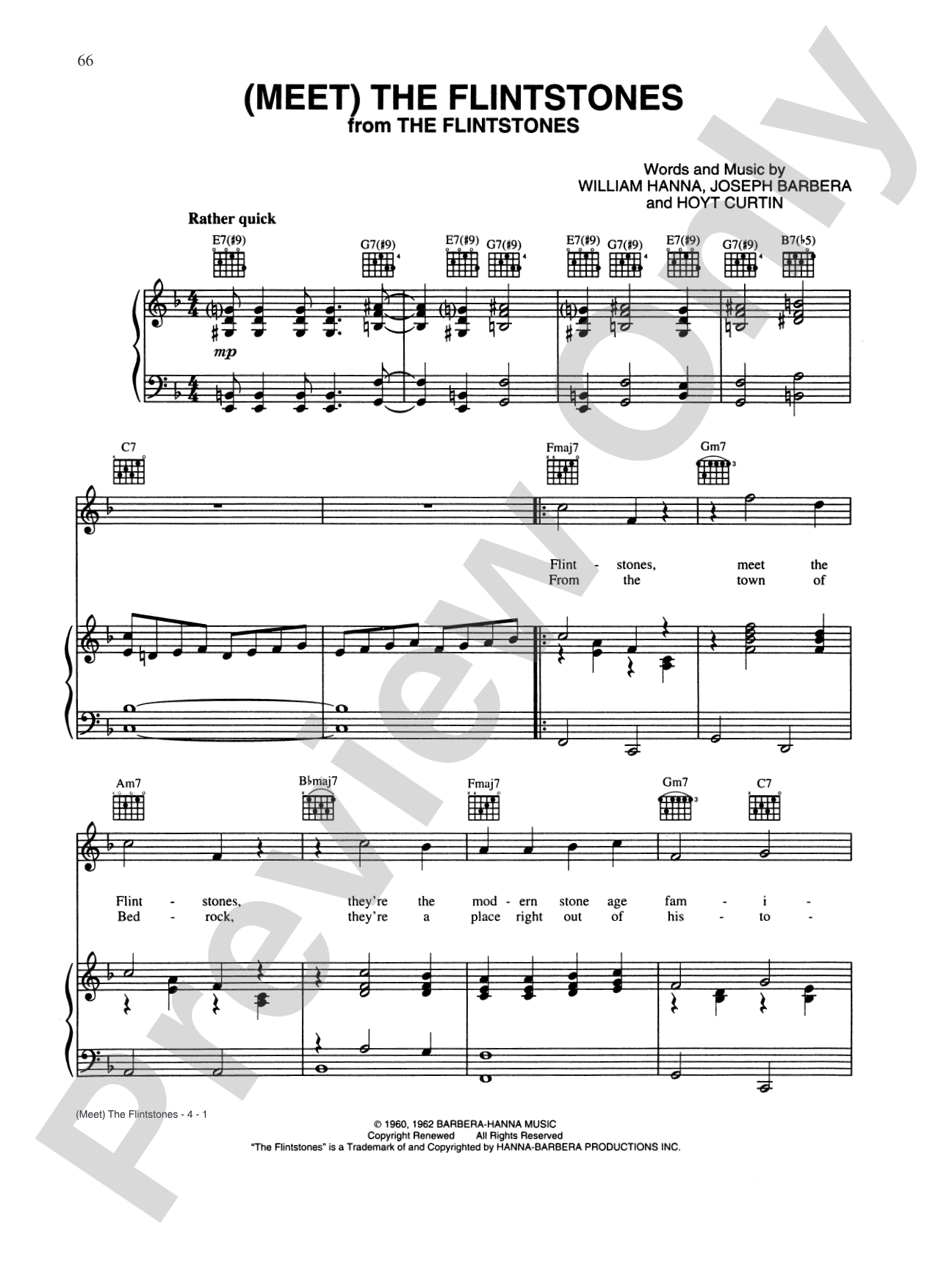

(Meet) The Flintstones: Piano/Vocal/Chords
Item: 00-PSP-000357
$4.99
One moment…
Related Items
Anywhere the Heart Goes (From "The Thorn Birds"): Piano/Vocal/Chords |
$4.99
|
View | |
As Long As We Got Each Other (From "Growing Pains"): Piano/Vocal/Chords |
$4.99
|
View | |
Best Friend (From "The Courtship of Eddie's Father"): Piano/Vocal/Chords |
$4.99
|
View | |
California: Piano/Vocal/Chords |
$4.99
|
View | |
Charlie's Angels (Main Theme): Piano/Vocal/Chords |
$4.99
|
View | |
Dallas (Main Title): Piano/Vocal/Chords |
$4.99
|
View | |
Daniel Boone (Main Theme): Piano/Vocal/Chords |
$4.99
|
View | |
E.R. (Main Theme): Piano/Vocal/Chords |
$4.99
|
View | |
Free Willy (Main Title): Piano/Vocal/Chords |
$4.99
|
View | |
Go Go Power Rangers: Piano/Vocal/Chords |
$5.99
|
View | |
Hardcastle & McCormick (Cues): Piano/Vocal/Chords |
$4.99
|
View | |
Huckleberry Hound: Piano/Vocal/Chords |
$4.99
|
View | |
In the Heat of the Night: Piano/Vocal/Chords |
$4.99
|
View | |
It's A Jungle Out There (From "Monk"): Piano/Vocal/Chords |
$4.99
|
View | |
Josie (from "Josie and the Pussycats"): Piano/Vocal/Chords |
$4.99
|
View | |
L.A. Law (Main Title): Piano/Vocal/Chords |
$4.99
|
View | |
Late Show Theme: Piano/Vocal/Chords |
$4.99
|
View | |
Moon Over Parma (From "The Drew Carey Show"): Piano/Vocal/Chords |
$4.99
|
View | |
Road Runner Theme: Piano/Vocal/Chords |
$4.99
|
View | |
Scooby Doo, Where Are You?: Piano/Vocal/Chords |
$4.99
|
View | |
Thank God for a Friend Like You (From "Hope & Gloria"): Piano/Vocal/Chords |
$4.99
|
View | |
The A-Team (Main Theme): Piano/Vocal/Chords |
$4.99
|
View | |
The Ballad of Gilligan's Isle: Piano/Vocal/Chords |
$4.99
|
View | |
The Greatest American Hero (Theme): Piano/Vocal/Chords |
$4.99
|
View | |
The Green Hornet Theme: Piano/Vocal/Chords |
$4.99
|
View | |
The Jetsons (Main Theme): Piano/Vocal/Chords |
$4.99
|
View | |
The Rosie O'Donnell Show (Opening Theme): Piano/Vocal/Chords |
$4.99
|
View | |
The Syncopated Clock (Vocal): Piano/Vocal/Chords |
$4.99
|
View | |
Fantasy Island Theme: Piano/Vocal/Chords |
$4.99
|
View | |
F-Troop Theme: Piano/Vocal/Chords |
$4.99
|
View | |
Hunter Theme: Piano/Vocal/Chords |
$4.99
|
View | |
Peyton Place Theme: Piano/Vocal/Chords |
$4.99
|
View | |
Time for You (From "Jesse"): Piano/Vocal/Chords |
$4.99
|
View | |
Yogi Bear Song: Piano/Vocal/Chords |
$4.99
|
View |
Description
Each songbook in the Big Book series provides musicians of all ability levels with a big list---usually 40 or more titles per book---of the very best songs from a favorite musical genre.
Songs include As Long as We Got Each Other (Growing Pains) * Bad Boys (Cops) * Batman Theme (Batman) * California (The O.C.) * (Meet) The Flintstones (The Flintstones) * Good Ol' Boys (The Dukes of Hazzard) * I'll Be There for You (Friends) * Movin' On Up (The Jeffersons) * The Pink Panther (The Pink Panther) * Scooby-Doo (Main Title) (Scooby-Doo) * Song from M*A*S*H (M*A*S*H) * This Is It! (The Bugs Bunny Show) * Yogi Bear Song (Yogi Bear) * and many more.


Songs include As Long as We Got Each Other (Growing Pains) * Bad Boys (Cops) * Batman Theme (Batman) * California (The O.C.) * (Meet) The Flintstones (The Flintstones) * Good Ol' Boys (The Dukes of Hazzard) * I'll Be There for You (Friends) * Movin' On Up (The Jeffersons) * The Pink Panther (The Pink Panther) * Scooby-Doo (Main Title) (Scooby-Doo) * Song from M*A*S*H (M*A*S*H) * This Is It! (The Bugs Bunny Show) * Yogi Bear Song (Yogi Bear) * and many more.
(Meet) The Flintstones: Piano/Vocal/Chords isn't in MakeMusic Cloud just yet...but it could be. Let us know you'd like to see it, and you'll help shape what comes next. In the meantime, start a free trial and dive into thousands of interactive titles your students can play along with today.
Request This Title
Tell us you want it.
Start Your Free Trial
Explore everything that's ready to play right now.
Sample Audio
No sample audio found.
Sample Video
No sample videos found.
Additional Details
Series:
The Big Book Series
Publisher:
Alfred Music
Page Count:
256
SKU:
00-PSP-000357
More about this title
About the Composer: William Hanna
William Hanna and Joseph Barbera founded one of animation's most influential studios, creating characters and worlds that shaped American popular culture for generations. Their collaborations with composer Hoyt Curtin produced some of the most recognizable television themes in history, blending jazz sensibilities with accessible melodies that worked equally well for mass audiences and trained musicians.
Hanna-Barbera's approach to scoring relied on memorable, singable hooks that could anchor a story in seconds. Curtin's arrangements became templates for television composition: economical orchestrations that conveyed personality and mood without overwhelming the narrative. For music educators, these pieces represent a crucial bridge between pop culture and musical literacy.
Why we love this
This collection captures themes that students actually recognize and want to play, which means engagement happens before technique does. The songs span decades of television history, giving you programming flexibility across decades and styles while maintaining consistent accessibility. Arranging for piano, vocal, and chord symbols means any pianist can accompany a singer, and any ensemble can pull material for special programs.
What to expect
Nostalgic and playful, with the kind of immediate melodic pull that made these themes stick in listeners' heads the moment they aired. The arrangements honor the original broadcast feel while translating them cleanly for voice and piano, preserving the wit and charm that made each show memorable.
Who it's for
Pianists and vocalists at all levels who want to explore recognizable material without diving into complicated original scores. Music teachers looking for songs that motivate student singers and build repertoire quickly. Accompanists who need a reliable, broad source of songs for recitals, studio lessons, and casual performances.
How to get the most out of it
- Study the specific show's theme arrangement before settling into the transcribed version. Visual memory of the original melody often helps singers and players nail the phrasing faster than reading alone.
- Balance the piano part against the vocal line carefully. Many of these themes use active accompaniment patterns that can overshadow a gentle vocal delivery.
- Use the chord symbols to explore harmonic substitutions or reharmonization if you're working with advanced pianists or jazz ensemble arrangements.
- Keep tempo and groove consistent with the show's opening sequence. The original broadcast tempo is often the reference point singers expect.
How to use it
Pull individual songs for faculty-student recitals or student showcases where singers want familiar material that audiences will recognize instantly. Mix selections from different decades to demonstrate how television theme writing evolved across generations, or build a program around a single theme and variations at different tempos and styles.
Skills your students will build
- Reading and interpreting chord symbols for improvisation and accompaniment
- Matching vocal phrasing to the rhythmic patterns of familiar melodies
- Balancing melody and accompaniment in duet performance
- Sight-reading across multiple staves (vocal line with piano part and chord changes)