
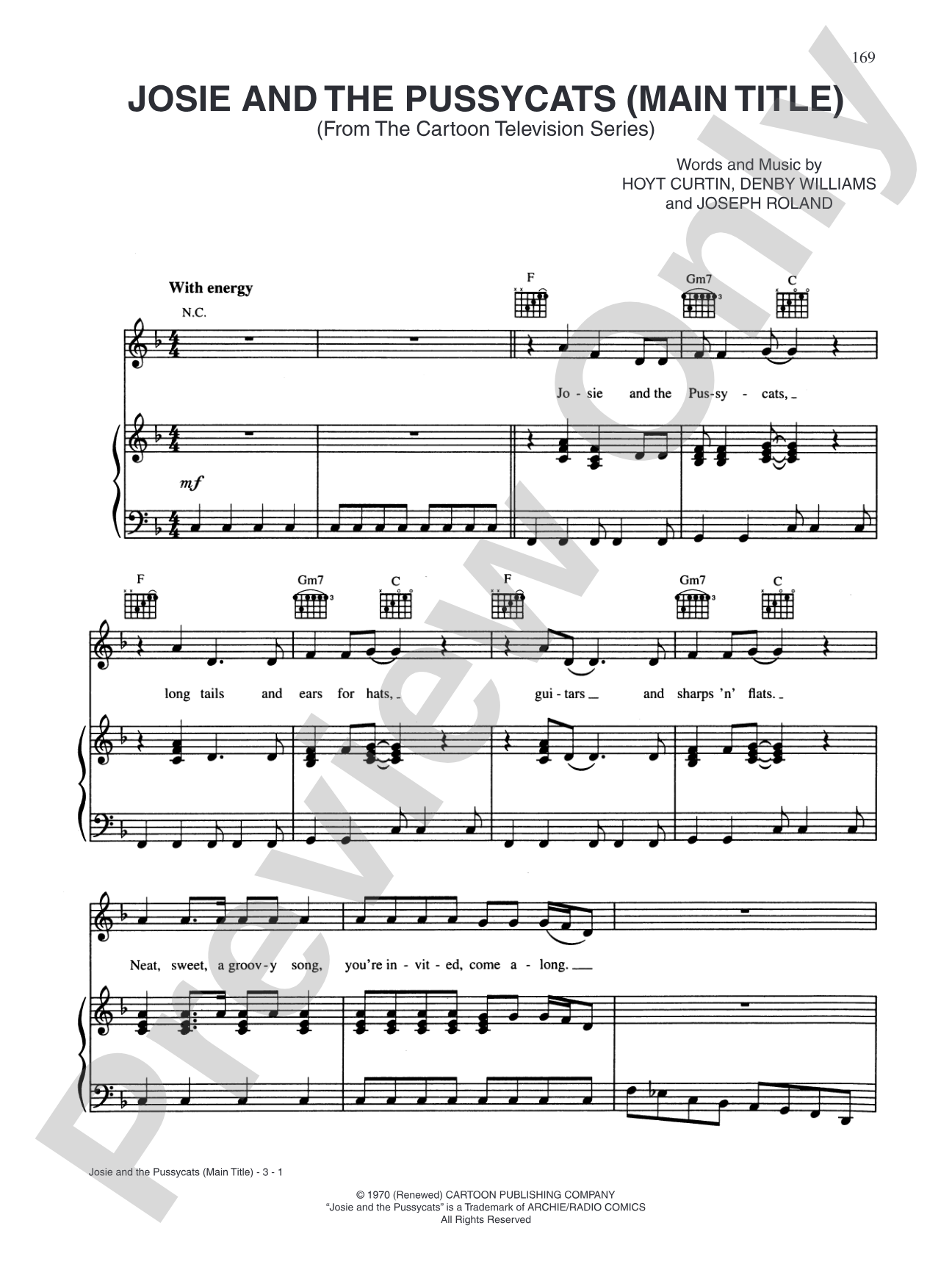

Josie (from "Josie and the Pussycats"): Piano/Vocal/Chords
Item: 00-PSP-000460
$4.99
One moment…
Related Items
(Meet) The Flintstones: Piano/Vocal/Chords |
$4.99
|
View | |
Anywhere the Heart Goes (From "The Thorn Birds"): Piano/Vocal/Chords |
$4.99
|
View | |
As Long As We Got Each Other (From "Growing Pains"): Piano/Vocal/Chords |
$4.99
|
View | |
Best Friend (From "The Courtship of Eddie's Father"): Piano/Vocal/Chords |
$4.99
|
View | |
California: Piano/Vocal/Chords |
$4.99
|
View | |
Charlie's Angels (Main Theme): Piano/Vocal/Chords |
$4.99
|
View | |
Dallas (Main Title): Piano/Vocal/Chords |
$4.99
|
View | |
Daniel Boone (Main Theme): Piano/Vocal/Chords |
$4.99
|
View | |
E.R. (Main Theme): Piano/Vocal/Chords |
$4.99
|
View | |
Free Willy (Main Title): Piano/Vocal/Chords |
$4.99
|
View | |
Go Go Power Rangers: Piano/Vocal/Chords |
$5.99
|
View | |
Hardcastle & McCormick (Cues): Piano/Vocal/Chords |
$4.99
|
View | |
Huckleberry Hound: Piano/Vocal/Chords |
$4.99
|
View | |
In the Heat of the Night: Piano/Vocal/Chords |
$4.99
|
View | |
It's A Jungle Out There (From "Monk"): Piano/Vocal/Chords |
$4.99
|
View | |
L.A. Law (Main Title): Piano/Vocal/Chords |
$4.99
|
View | |
Late Show Theme: Piano/Vocal/Chords |
$4.99
|
View | |
Moon Over Parma (From "The Drew Carey Show"): Piano/Vocal/Chords |
$4.99
|
View | |
Road Runner Theme: Piano/Vocal/Chords |
$4.99
|
View | |
Scooby Doo, Where Are You?: Piano/Vocal/Chords |
$4.99
|
View | |
Thank God for a Friend Like You (From "Hope & Gloria"): Piano/Vocal/Chords |
$4.99
|
View | |
The A-Team (Main Theme): Piano/Vocal/Chords |
$4.99
|
View | |
The Ballad of Gilligan's Isle: Piano/Vocal/Chords |
$4.99
|
View | |
The Greatest American Hero (Theme): Piano/Vocal/Chords |
$4.99
|
View | |
The Green Hornet Theme: Piano/Vocal/Chords |
$4.99
|
View | |
The Jetsons (Main Theme): Piano/Vocal/Chords |
$4.99
|
View | |
The Rosie O'Donnell Show (Opening Theme): Piano/Vocal/Chords |
$4.99
|
View | |
The Syncopated Clock (Vocal): Piano/Vocal/Chords |
$4.99
|
View | |
Fantasy Island Theme: Piano/Vocal/Chords |
$4.99
|
View | |
F-Troop Theme: Piano/Vocal/Chords |
$4.99
|
View | |
Hunter Theme: Piano/Vocal/Chords |
$4.99
|
View | |
Peyton Place Theme: Piano/Vocal/Chords |
$4.99
|
View | |
Time for You (From "Jesse"): Piano/Vocal/Chords |
$4.99
|
View | |
Yogi Bear Song: Piano/Vocal/Chords |
$4.99
|
View |
Description
Each songbook in the Big Book series provides musicians of all ability levels with a big list---usually 40 or more titles per book---of the very best songs from a favorite musical genre.
Songs include As Long as We Got Each Other (Growing Pains) * Bad Boys (Cops) * Batman Theme (Batman) * California (The O.C.) * (Meet) The Flintstones (The Flintstones) * Good Ol' Boys (The Dukes of Hazzard) * I'll Be There for You (Friends) * Movin' On Up (The Jeffersons) * The Pink Panther (The Pink Panther) * Scooby-Doo (Main Title) (Scooby-Doo) * Song from M*A*S*H (M*A*S*H) * This Is It! (The Bugs Bunny Show) * Yogi Bear Song (Yogi Bear) * and many more.


Songs include As Long as We Got Each Other (Growing Pains) * Bad Boys (Cops) * Batman Theme (Batman) * California (The O.C.) * (Meet) The Flintstones (The Flintstones) * Good Ol' Boys (The Dukes of Hazzard) * I'll Be There for You (Friends) * Movin' On Up (The Jeffersons) * The Pink Panther (The Pink Panther) * Scooby-Doo (Main Title) (Scooby-Doo) * Song from M*A*S*H (M*A*S*H) * This Is It! (The Bugs Bunny Show) * Yogi Bear Song (Yogi Bear) * and many more.
Josie (from "Josie and the Pussycats"): Piano/Vocal/Chords isn't in MakeMusic Cloud just yet...but it could be. Let us know you'd like to see it, and you'll help shape what comes next. In the meantime, start a free trial and dive into thousands of interactive titles your students can play along with today.
Request This Title
Tell us you want it.
Start Your Free Trial
Explore everything that's ready to play right now.
Sample Audio
No sample audio found.
Sample Video
No sample videos found.
Additional Details
Series:
The Big Book Series
Publisher:
Alfred Music
Page Count:
256
SKU:
00-PSP-000460
More about this title
About the Composer: Hoyt Curtin
Hoyt Curtin (1922-2000) was a composer and arranger whose work defined the sound of American television animation from the 1960s onward. Best known for his scores for Hanna-Barbera productions, Curtin developed a sophisticated approach to cartoon music that blended jazz harmonies, orchestral color, and memorable melodic hooks. His ability to capture character and mood through music made him essential to the success of series like "The Jetsons," "Scooby-Doo," and "Jonny Quest."
Curtin's compositional legacy extends beyond animation; his work demonstrates how effective scoring enhances storytelling and creates instant recognition. For music educators, his catalog offers accessible yet musically rich material that engages students while introducing them to professional-level arranging and orchestration.
Why we love this
This folio captures some of television's most instantly recognizable themes and bridges themes alongside contemporary TV show music. Singers and pianists will find familiar material that's both fun to perform and grounded in solid arranging; the guitar chords make it flexible for ensemble or coffeehouse performance. The breadth of the Big Book means you're getting 40+ singable titles in one collection rather than hunting down individual sheets.
What to expect
Opening this book feels like stepping into a time machine of American pop culture, where every page carries the warmth of a beloved show's opening credits. The melodies are instantly singable and emotionally direct, designed to land immediately with an audience. There's a playfulness running through these pieces that invites both earnest interpretation and lighthearted fun.
Who it's for
Singers performing at cabarets, open-mic nights, or informal concerts will find this collection endlessly useful for creating nostalgic, crowd-pleasing sets. Piano-vocal performers building a repertoire of accessible, recognizable material will appreciate having dozens of options in one book. Music directors programming variety shows or retrospective concerts benefit from having a large selection of television themes and songs at hand.
How to get the most out of it
- Keep the tempo conversational and rhythmically relaxed; these themes work best when they feel natural rather than rigid. Let the accompaniment breathe between phrases.
- Balance the vocal line prominently so the melody registers clearly, especially with familiar material where audiences expect to hear the tune they recognize.
- Use the chord symbols to adapt the arrangement to your ensemble's instrumentation; the voicings are flexible enough to work with keyboard, guitar, or small group support.
- Pay attention to the original TV themes for phrasing and character; a quick listen to the source material will inform your interpretation and unlock the intended mood.
How to use it
Program selections from this collection as lighter fare balancing a concert of heavier classical or contemporary material. Feature a medley of TV themes from different eras as an audience sing-along or novelty spot that builds instant connection. Use individual titles as warm-ups or teaching tools when introducing students to lead sheet notation and chord symbols.
Skills your students will build
- Reading chord symbols and lead sheets
- Singing from a vocal line with instrumental accompaniment
- Interpreting familiar melodies with stylistic intention
- Adapting arrangements for different instrumental combinations
- Building repertoire efficiently through mixed-genre collections