
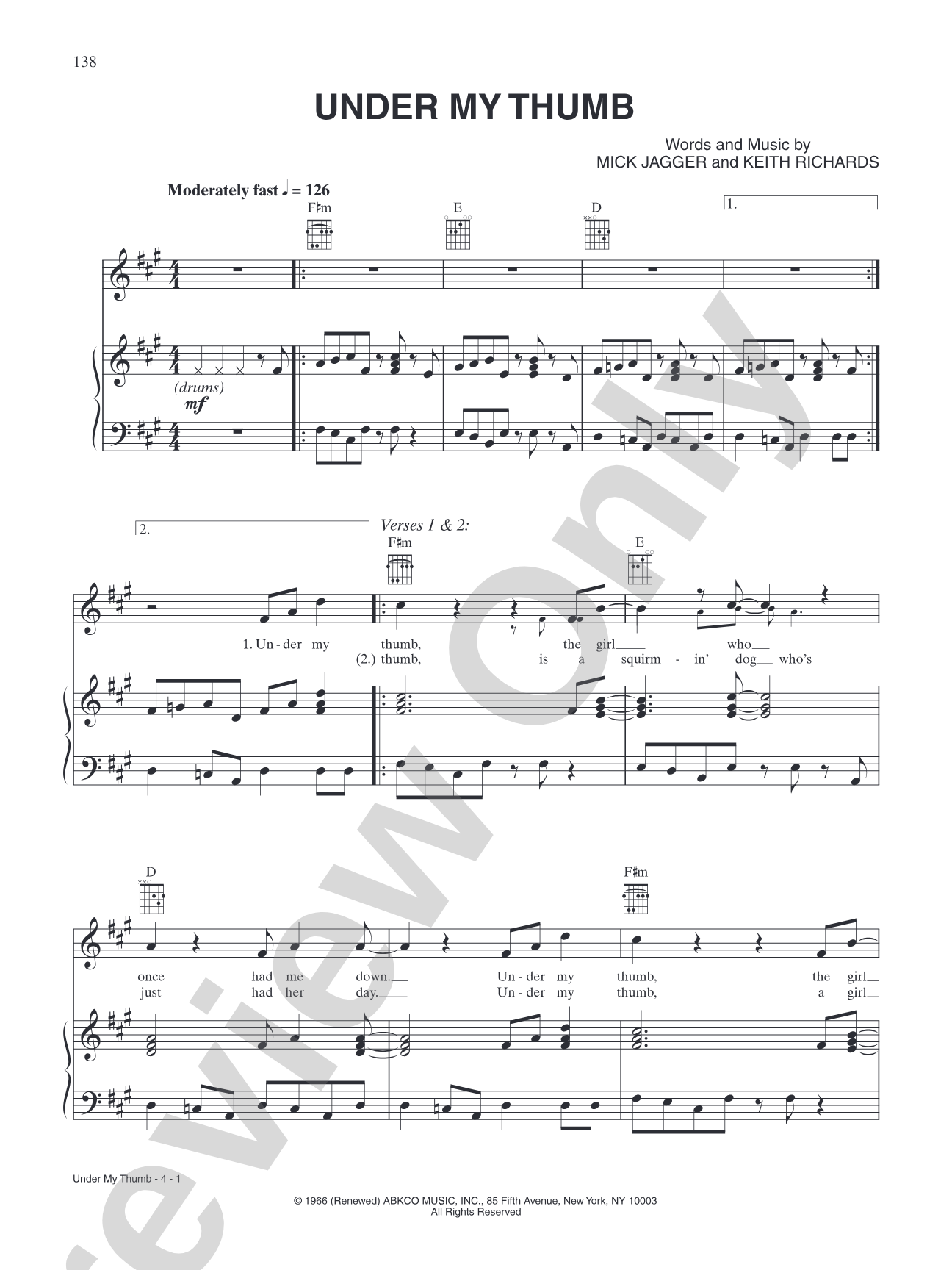

Under My Thumb: Piano/Vocal/Chords
The Rolling Stones
Item: 00-PS-0012154
$4.99
Pickup currently not available
Related Items
Paint It, Black: Piano/Vocal/Chords |
$5.99
|
View | |
Dandelion: Piano/Vocal/Chords |
$4.99
|
View | |
(I Can't Get No) Satisfaction: Piano/Vocal/Chords |
$4.99
|
View | |
Lady Jane: Piano/Vocal/Chords |
$4.99
|
View | |
The Last Time: Piano/Vocal/Chords |
$5.99
|
View | |
Heart of Stone: Piano/Vocal/Chords |
$4.99
|
View | |
19th Nervous Breakdown: Piano/Vocal/Chords |
$5.99
|
View | |
Play With Fire: Piano/Vocal/Chords |
$4.99
|
View | |
I'm Free: Piano/Vocal/Chords |
$4.99
|
View | |
Mother's Little Helper: Piano/Vocal/Chords |
$4.99
|
View | |
Honky Tonk Women: Piano/Vocal/Chords |
$5.99
|
View | |
You Can't Always Get What You Want: Piano/Vocal/Chords |
$9.99
|
View | |
As Tears Go By: Piano/Vocal/Chords |
$4.99
|
View | |
It's All Over Now: Piano/Vocal/Chords |
$5.99
|
View | |
Out of Time: Piano/Vocal/Chords |
$4.99
|
View | |
Ruby Tuesday: Piano/Vocal/Chords |
$4.99
|
View | |
2000 Light Years From Home: Piano/Vocal/Chords |
$5.99
|
View | |
She's a Rainbow: Piano/Vocal/Chords |
$5.99
|
View | |
Let's Spend the Night Together: Piano/Vocal/Chords |
$5.99
|
View | |
Gimme Shelter: Piano/Vocal/Chords |
$5.99
|
View | |
Let It Bleed: Piano/Vocal/Chords |
$5.99
|
View | |
Monkey Man: Piano/Vocal/Chords |
$5.99
|
View | |
No Expectations: Piano/Vocal/Chords |
$4.99
|
View | |
She Smiled Sweetly: Piano/Vocal/Chords |
$4.99
|
View | |
Wild Horses: Piano/Vocal/Chords |
$4.99
|
View | |
The Rolling Stones: Sheet Music Anthology: Piano/Vocal/Chords Book |
$19.99
|
View |
Description
The Rolling Stones Sheet Music Anthology contains 27 piano/vocal/chord arrangements of the legendary British group's greatest hits. Many of the band's most memorable melodies are included, such as "She's a Rainbow," "Lady Jane," and "Ruby Tuesday." Titles: As Tears Go By * Dandelion * Gimme Shelter * Heart of Stone * I'm Free * Honky Tonk Women * It's All Over Now * The Last Time * Let's Spend the Night Together * Let It Bleed * Monkey Man * Mother's Little Helper * 19th Nervous Breakdown * Out of Time * No Expectations * Play with Fire * Paint It, Black * (I Can't Get No) Satisfaction * Sympathy for the Devil * She Smiled Sweetly * 2000 Light Years from Home * Under My Thumb * Wild Horses * You Can't Always Get What You Want.


Under My Thumb: Piano/Vocal/Chords isn't in MakeMusic Cloud just yet...but it could be. Let us know you'd like to see it, and you'll help shape what comes next. In the meantime, start a free trial and dive into thousands of interactive titles your students can play along with today.
Request This Title
Tell us you want it.
Start Your Free Trial
Explore everything that's ready to play right now.
Sample Audio
No sample audio found.
Sample Video
No sample videos found.
Additional Details
Series:
Sheet Music Anthology
Publisher:
Alfred Music
Page Count:
156
SKU:
00-PS-0012154
More about this title
About the Composer: Mick Jagger
Mick Jagger co-wrote the majority of The Rolling Stones' catalog alongside Keith Richards, creating some of rock music's most enduring songs across five decades. His approach to songwriting balanced raw, blues-influenced melodies with sophisticated harmonic structures and clever lyrical storytelling, establishing a template for rock composition that influenced generations of musicians.
Jagger's ability to craft memorable vocal lines that sit naturally over guitar-driven arrangements makes his songs particularly valuable for pianists learning to adapt rock composition to keyboard settings. His work demonstrates how strong melodic writing can translate across instruments and arrangements without losing its essential character.
Why we love this
This anthology captures Stones classics in an arrangement that respects the original melodies while making them accessible to pianists and vocalists at various levels. The chord notation allows guitarists and keyboard players to comp or improvise, opening these arrangements to different performance contexts beyond strictly adhering to written-out piano parts. Teaching singers to own these iconic vocal lines while working with a live pianist gives students insight into how great rock songs sustain their power across different instrumentation.
What to expect
These songs carry the swagger and sophistication of the Stones at their peak, mixing bluesy grit with surprising melodic craft. From the dark, hypnotic energy of "Sympathy for the Devil" to the tender introspection of "Wild Horses," the anthology spans emotional territory that rewards performers willing to find nuance within rock song structures.
Who it's for
This book serves singers preparing rock repertoire for auditions, recitals, or rock-focused performance ensembles, as well as pianists looking to expand beyond classical accompaniment into contemporary popular song. Keyboard players seeking to understand how to voice and comp from chord symbols in a rock idiom will find solid models across these 27 arrangements.
How to get the most out of it
- Anchor the vocal phrasing to the natural speech rhythm of the lyrics rather than mechanically subdividing the beat; Jagger's melodies gain their character from rhythmic pushes and lags that sit slightly outside a metronomic grid.
- Use the chord symbols to find colorful voicings on piano that complement rather than double the vocal line, especially on songs with sparse original arrangements like "Ruby Tuesday" or "Let It Bleed."
- Study the original recordings to understand the baseline groove and energy level of each song, then decide whether your arrangement should match that feel or take a deliberate departure.
- Pay close attention to the form and section breaks in these arrangements; many Stones songs use unconventional structures that might catch unprepared musicians off guard in performance.
How to use it
Feature a Stones song as a novelty or crossover piece in a classical recital, or build an entire rock-focused concert around contrasting selections from this collection. These arrangements also work well in educational settings where you want to teach students about song form, lyric interpretation, and keyboard voicing using repertoire they already know and care about.
Skills your students will build
- Singing with rhythmic flexibility and conversational phrasing over metronomic accompaniment
- Reading and performing from chord symbols alongside a written melody
- Adapting original rock arrangements to piano voicings and accompaniment patterns
- Understanding song form in popular music (verse, chorus, bridge structures)
- Balancing vocal delivery between serving the lyric and respecting the original melodic character