
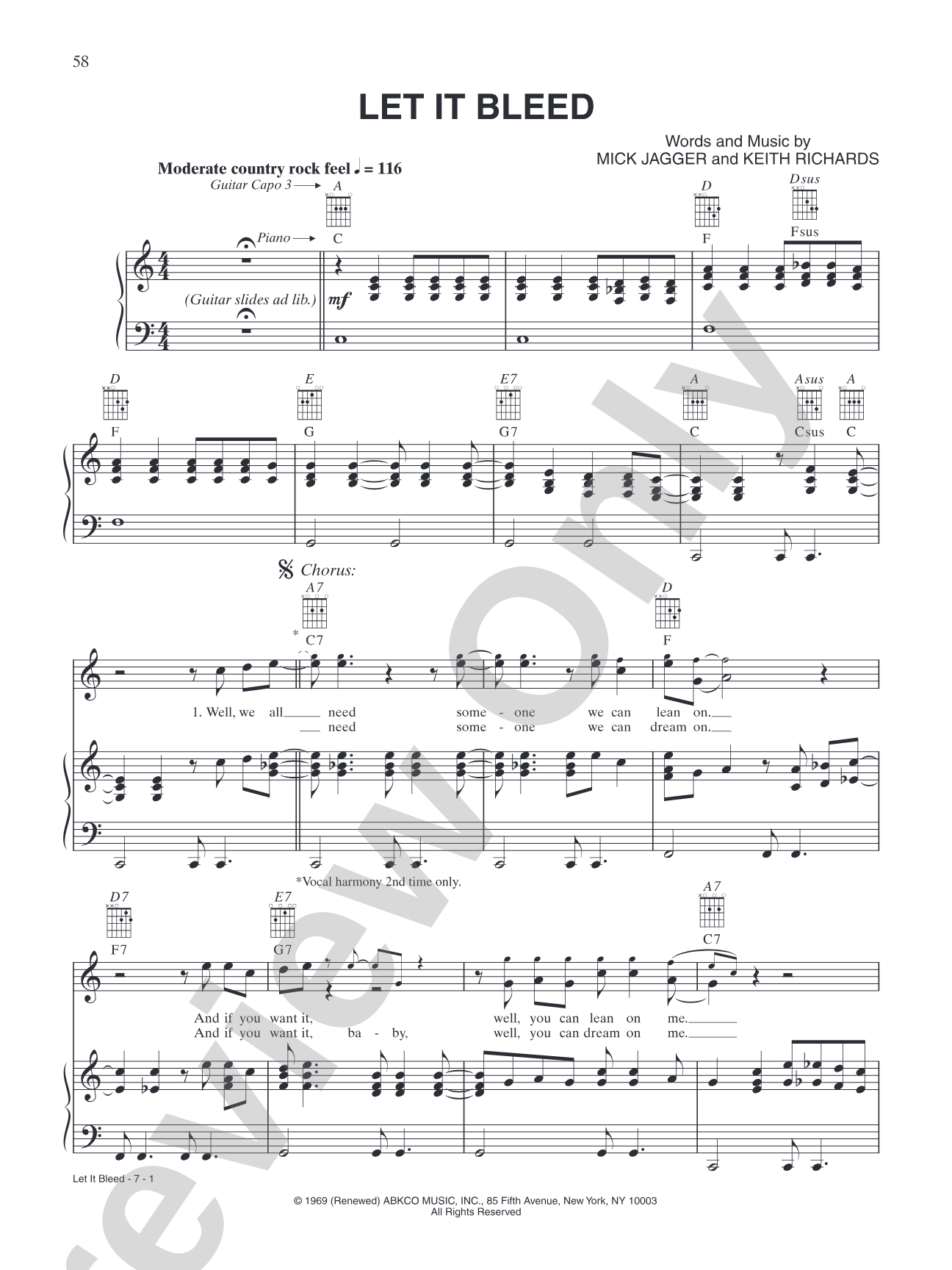
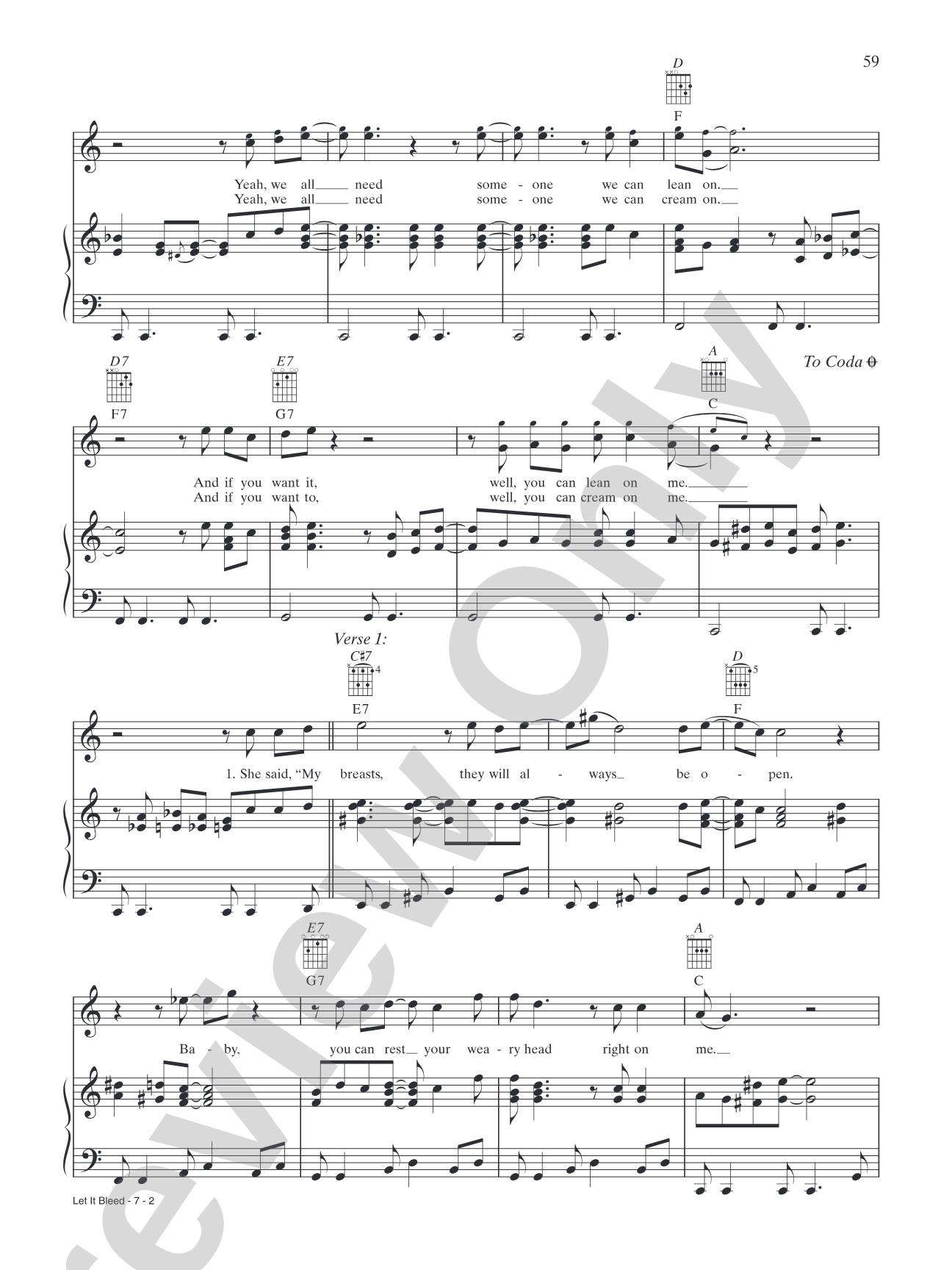

Let It Bleed: Piano/Vocal/Chords
The Rolling Stones
Item: 00-PS-0012166
$5.99
Pickup currently not available
Related Items
Paint It, Black: Piano/Vocal/Chords |
$5.99
|
View | |
Dandelion: Piano/Vocal/Chords |
$4.99
|
View | |
(I Can't Get No) Satisfaction: Piano/Vocal/Chords |
$4.99
|
View | |
Lady Jane: Piano/Vocal/Chords |
$4.99
|
View | |
The Last Time: Piano/Vocal/Chords |
$5.99
|
View | |
Heart of Stone: Piano/Vocal/Chords |
$4.99
|
View | |
19th Nervous Breakdown: Piano/Vocal/Chords |
$5.99
|
View | |
Play With Fire: Piano/Vocal/Chords |
$4.99
|
View | |
I'm Free: Piano/Vocal/Chords |
$4.99
|
View | |
Mother's Little Helper: Piano/Vocal/Chords |
$4.99
|
View | |
Honky Tonk Women: Piano/Vocal/Chords |
$5.99
|
View | |
You Can't Always Get What You Want: Piano/Vocal/Chords |
$9.99
|
View | |
As Tears Go By: Piano/Vocal/Chords |
$4.99
|
View | |
It's All Over Now: Piano/Vocal/Chords |
$5.99
|
View | |
Out of Time: Piano/Vocal/Chords |
$4.99
|
View | |
Ruby Tuesday: Piano/Vocal/Chords |
$4.99
|
View | |
2000 Light Years From Home: Piano/Vocal/Chords |
$5.99
|
View | |
She's a Rainbow: Piano/Vocal/Chords |
$5.99
|
View | |
Let's Spend the Night Together: Piano/Vocal/Chords |
$5.99
|
View | |
Under My Thumb: Piano/Vocal/Chords |
$4.99
|
View | |
Gimme Shelter: Piano/Vocal/Chords |
$5.99
|
View | |
Monkey Man: Piano/Vocal/Chords |
$5.99
|
View | |
No Expectations: Piano/Vocal/Chords |
$4.99
|
View | |
She Smiled Sweetly: Piano/Vocal/Chords |
$4.99
|
View | |
Wild Horses: Piano/Vocal/Chords |
$4.99
|
View | |
The Rolling Stones: Sheet Music Anthology: Piano/Vocal/Chords Book |
$19.99
|
View |
Description
The Rolling Stones Sheet Music Anthology contains 27 piano/vocal/chord arrangements of the legendary British group's greatest hits. Many of the band's most memorable melodies are included, such as "She's a Rainbow," "Lady Jane," and "Ruby Tuesday." Titles: As Tears Go By * Dandelion * Gimme Shelter * Heart of Stone * I'm Free * Honky Tonk Women * It's All Over Now * The Last Time * Let's Spend the Night Together * Let It Bleed * Monkey Man * Mother's Little Helper * 19th Nervous Breakdown * Out of Time * No Expectations * Play with Fire * Paint It, Black * (I Can't Get No) Satisfaction * Sympathy for the Devil * She Smiled Sweetly * 2000 Light Years from Home * Under My Thumb * Wild Horses * You Can't Always Get What You Want.


Discover MakeMusic Cloud: thousands of interactive titles your students can play along with today.
Sample Audio
No sample audio found.
Sample Video
No sample videos found.
Additional Details
Series:
Sheet Music Anthology
Publisher:
Alfred Music
Page Count:
156
SKU:
00-PS-0012166
More about this title
About the Composer: Mick Jagger
Mick Jagger co-wrote the vast majority of The Rolling Stones' catalog alongside Keith Richards, establishing one of rock music's most prolific songwriting partnerships. His compositions span five decades and define the sound of British rock, from blues-inflected early work to sophisticated pop arrangements that earned respect across genres. As a music educator considers how to expose students to meaningful songwriting craft, Jagger's economy of lyrical language and melodic structure offer concrete lessons in how constraints breed creativity.
Jagger's vocal phrasing and rhythmic sensibility shaped not just his own delivery but influenced how rock singers approach storytelling. Teachers and pianists examining these arrangements encounter the architectural choices behind songs that have remained in cultural memory since the 1960s and 1970s. His work demonstrates how strong melodies transcend their original arrangements, adapting successfully to piano/vocal settings where the harmonic and melodic bones become visible.
Why we love this
This anthology spans the Stones' essential catalog with enough variety to serve multiple musical contexts. The 27 songs represent different eras and moods, so singers and pianists can construct meaningful recitals without feeling locked into a single style. The piano arrangements reveal harmonic sophistication that often gets buried in the full band recordings, making these transcriptions genuinely educational for musicians studying how rock songwriting works.
What to expect
These songs carry the swagger and swagger of 1960s and 1970s British rock, but in piano/vocal form they reveal something more introspective. The stripped-down setting exposes the emotional core beneath the swagger—bittersweet melodies, complex harmonies, and lyrics that cut deeper when you're not surrounded by electric guitars and drums.
Who it's for
Singers preparing rock repertoire for auditions, recitals, or jam sessions will find reliable, singable arrangements here. Pianists expanding beyond classical repertoire can study how rock melodies and chord progressions function, then use that knowledge to improvise or create original accompaniments.
How to get the most out of it
- Balance vocal phrasing against rhythmic precision in the piano part; these songs swing even in written tempo, so avoid metronomic playing.
- Treat the chord symbols as a framework rather than a prescription. Experiment with inversions and voicings that sit well under your vocalist's range.
- Pay attention to dynamic shape across long phrases. Many of these songs build their impact through gradual intensification rather than sudden shifts.
- Listen to the original recordings to understand where the arrangement sits in the song's history, then decide what stays and what you'll reinterpret for your performance context.
How to use it
Program individual songs alongside standards in a mixed-repertoire recital to show how rock songwriting sits in broader musical conversation. A single song works as an encore after a classical set, or cluster three to five Stones songs into a thematic program exploring how the band's style evolved. These arrangements also serve well in voice studios, jazz ensembles, or piano labs exploring interpretation across genres.
Skills your students will build
- Reading chord symbols and realizing them on piano
- Balancing vocal melody against accompaniment texture
- Understanding how rock melodies and harmonies function
- Adapting arrangements to suit a singer's range and style
- Recognizing the relationship between original recordings and transcribed scores