
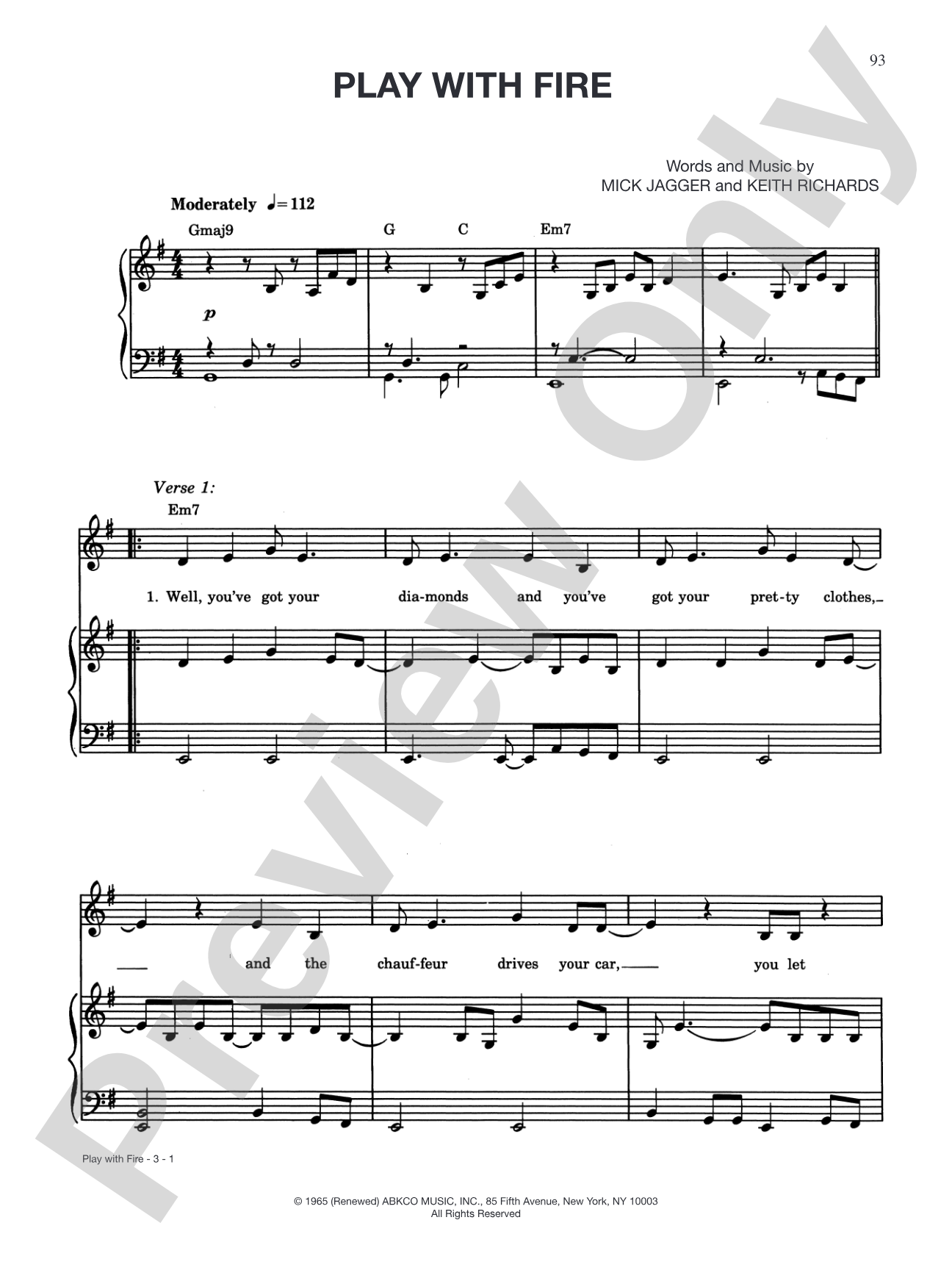

Play With Fire: Piano/Vocal/Chords
The Rolling Stones
Item: 00-PS-0012122
$4.99
Pickup currently not available
Related Items
Paint It, Black: Piano/Vocal/Chords |
$5.99
|
View | |
Dandelion: Piano/Vocal/Chords |
$4.99
|
View | |
(I Can't Get No) Satisfaction: Piano/Vocal/Chords |
$4.99
|
View | |
Lady Jane: Piano/Vocal/Chords |
$4.99
|
View | |
The Last Time: Piano/Vocal/Chords |
$5.99
|
View | |
Heart of Stone: Piano/Vocal/Chords |
$4.99
|
View | |
19th Nervous Breakdown: Piano/Vocal/Chords |
$5.99
|
View | |
I'm Free: Piano/Vocal/Chords |
$4.99
|
View | |
Mother's Little Helper: Piano/Vocal/Chords |
$4.99
|
View | |
Honky Tonk Women: Piano/Vocal/Chords |
$5.99
|
View | |
You Can't Always Get What You Want: Piano/Vocal/Chords |
$9.99
|
View | |
As Tears Go By: Piano/Vocal/Chords |
$4.99
|
View | |
It's All Over Now: Piano/Vocal/Chords |
$5.99
|
View | |
Out of Time: Piano/Vocal/Chords |
$4.99
|
View | |
Ruby Tuesday: Piano/Vocal/Chords |
$4.99
|
View | |
2000 Light Years From Home: Piano/Vocal/Chords |
$5.99
|
View | |
She's a Rainbow: Piano/Vocal/Chords |
$5.99
|
View | |
Let's Spend the Night Together: Piano/Vocal/Chords |
$5.99
|
View | |
Under My Thumb: Piano/Vocal/Chords |
$4.99
|
View | |
Gimme Shelter: Piano/Vocal/Chords |
$5.99
|
View | |
Let It Bleed: Piano/Vocal/Chords |
$5.99
|
View | |
Monkey Man: Piano/Vocal/Chords |
$5.99
|
View | |
No Expectations: Piano/Vocal/Chords |
$4.99
|
View | |
She Smiled Sweetly: Piano/Vocal/Chords |
$4.99
|
View | |
Wild Horses: Piano/Vocal/Chords |
$4.99
|
View | |
The Rolling Stones: Sheet Music Anthology: Piano/Vocal/Chords Book |
$19.99
|
View |
Description
The Rolling Stones Sheet Music Anthology contains 27 piano/vocal/chord arrangements of the legendary British group's greatest hits. Many of the band's most memorable melodies are included, such as "She's a Rainbow," "Lady Jane," and "Ruby Tuesday." Titles: As Tears Go By * Dandelion * Gimme Shelter * Heart of Stone * I'm Free * Honky Tonk Women * It's All Over Now * The Last Time * Let's Spend the Night Together * Let It Bleed * Monkey Man * Mother's Little Helper * 19th Nervous Breakdown * Out of Time * No Expectations * Play with Fire * Paint It, Black * (I Can't Get No) Satisfaction * Sympathy for the Devil * She Smiled Sweetly * 2000 Light Years from Home * Under My Thumb * Wild Horses * You Can't Always Get What You Want.


Discover MakeMusic Cloud: thousands of interactive titles your students can play along with today.
Sample Audio
No sample audio found.
Sample Video
No sample videos found.
Additional Details
Series:
Sheet Music Anthology
Publisher:
Alfred Music
Page Count:
156
SKU:
00-PS-0012122
More about this title
About the Composer: Mick Jagger
Mick Jagger, frontman of The Rolling Stones, shaped rock music across five decades with his distinctive vocal phrasing, stage presence, and songwriting partnership with Keith Richards. Together they crafted some of the most enduring rock compositions of the 20th century, from blues-influenced early hits to increasingly sophisticated arrangements that drew on multiple genres. Their work remains a cornerstone of popular music education and performance.
For pianists and singers, Jagger's vocal melodies present specific pedagogical opportunities: they sit in accessible ranges, employ memorable hooks and blue notes, and sit naturally over chord progressions that balance simplicity with harmonic interest. His lyrics, though sometimes raw, capture storytelling clarity that helps students understand how melody and text interlock.
Why we love this
This anthology gives pianists and vocalists direct access to rock songs that shaped modern music without oversimplifying the harmonic content. The chord voicings and melodic lines remain recognizable while staying singable and playable at intermediate levels, making these standards genuinely useful in recitals, ensemble settings, or solo practice rather than merely nostalgic.
What to expect
These songs pulse with the blues-rooted swagger that made the Stones legendary, yet they translate onto the page and keyboard with remarkable clarity. You'll find driving rhythms beside introspective ballads, minor-key menace alongside lyrical tenderness, all of it immediate and alive when sung and played.
Who it's for
Pianists and vocalists at the intermediate level and above who want repertoire beyond classical standards and contemporary pop ballads. This collection serves singers preparing for recitals or jam sessions, pianists looking for rock-era material with substance, and music teachers seeking genre diversity without sacrificing musicianship.
How to get the most out of it
- Honor the swagger in the vocal line. Rolling Stones melodies often sit slightly behind or ahead of the beat intentionally. Work toward control of that phrasing rather than fighting it.
- Let the piano part support the groove, not just accompany it. Feel the rhythmic pocket of each song rather than playing chords mechanically.
- Pay attention to dynamics within phrases. Many of these songs build tension through repetition and small dynamic shifts rather than big volume jumps.
- Check the chord symbols for jazz voicings and color tones. These arrangements often include 7ths, sus chords, and extensions that create the Stones' characteristic sound.
How to use it
Feature a single track as an encore or concert opener when you want to shift energy toward contemporary rock while keeping the musicianship intact. Use selections from this anthology alongside jazz standards or art songs to show students how melody and harmony operate across genres. Solo singers can build a recital around 3-4 contrasting selections here, pairing them with classical art songs to create genuinely diverse programming.
Skills your students will build
- Reading chord symbols and jazz voicings in contemporary harmonic contexts
- Interpreting rhythmic phrasing and groove-based accompaniment figures
- Singing and playing in styles that blend blues, rock, and pop idioms
- Adjusting vocal interpretation to match song character within a consistent style
- Understanding how melody and lyrical text reinforce dramatic intent