
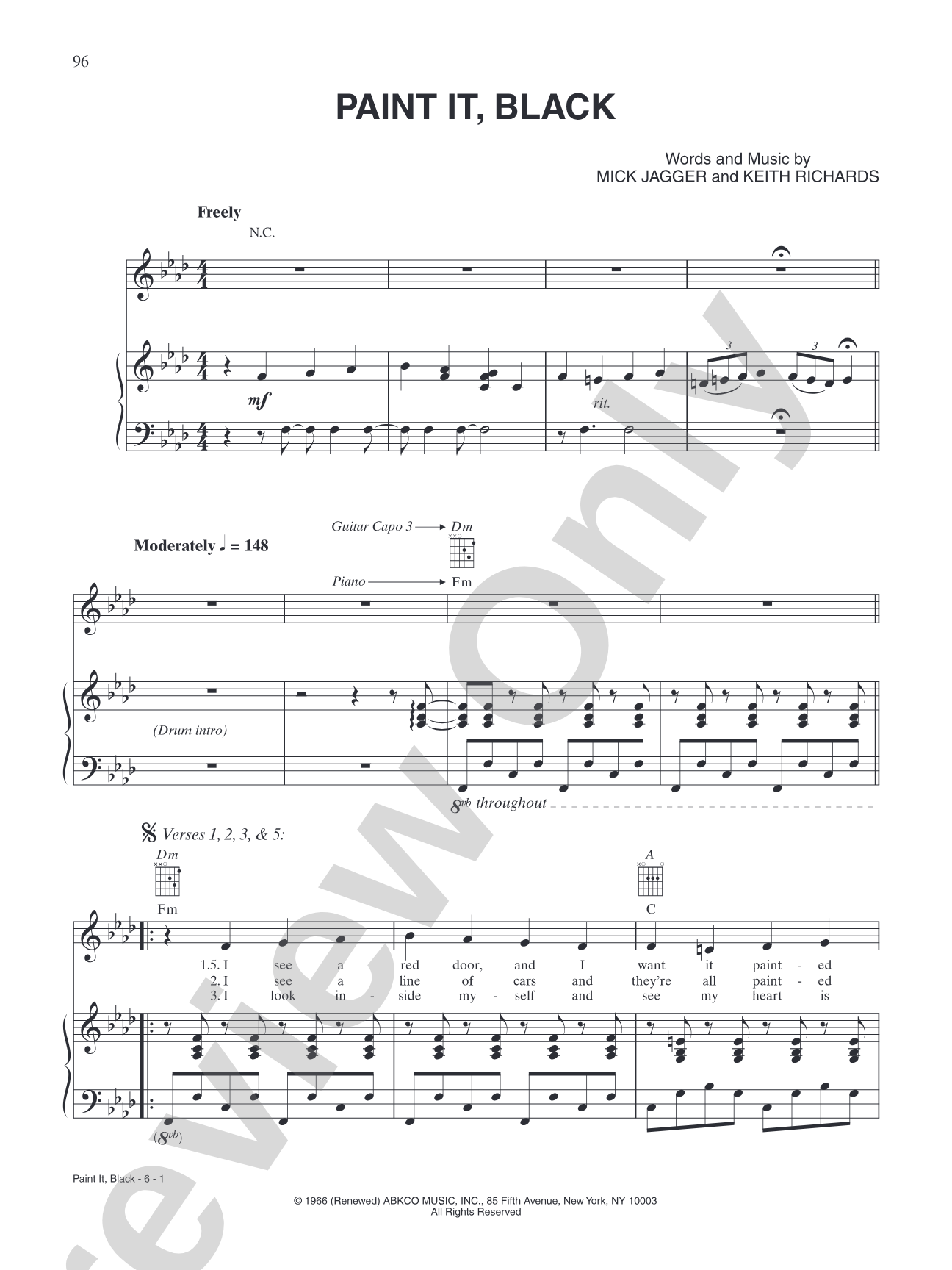
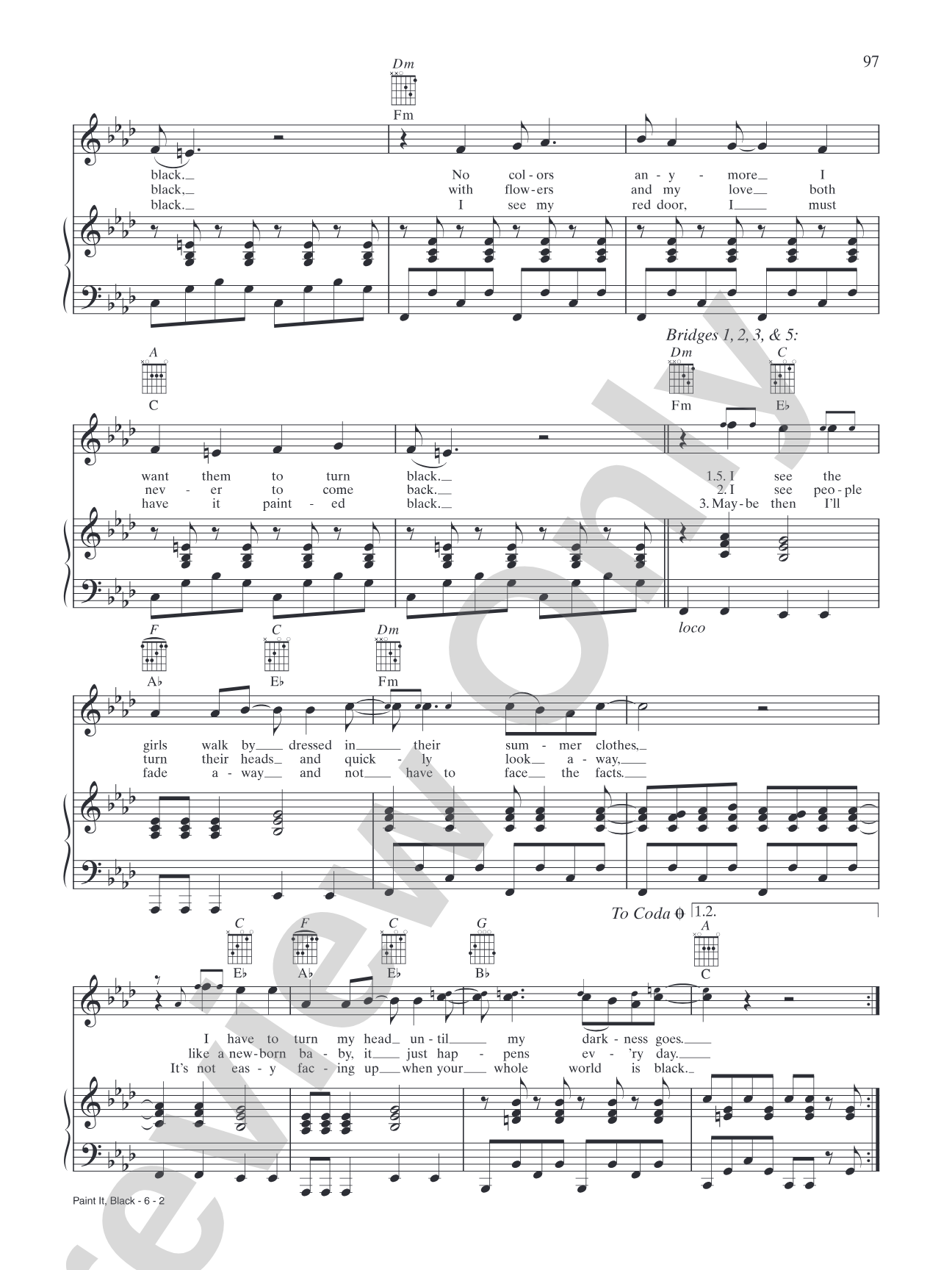

Paint It, Black: Piano/Vocal/Chords
The Rolling Stones
Item: 00-PS-0012099
$5.99
Pickup currently not available
Related Items
Dandelion: Piano/Vocal/Chords |
$4.99
|
View | |
(I Can't Get No) Satisfaction: Piano/Vocal/Chords |
$4.99
|
View | |
Lady Jane: Piano/Vocal/Chords |
$4.99
|
View | |
The Last Time: Piano/Vocal/Chords |
$5.99
|
View | |
Heart of Stone: Piano/Vocal/Chords |
$4.99
|
View | |
19th Nervous Breakdown: Piano/Vocal/Chords |
$5.99
|
View | |
Play With Fire: Piano/Vocal/Chords |
$4.99
|
View | |
I'm Free: Piano/Vocal/Chords |
$4.99
|
View | |
Mother's Little Helper: Piano/Vocal/Chords |
$4.99
|
View | |
Honky Tonk Women: Piano/Vocal/Chords |
$5.99
|
View | |
You Can't Always Get What You Want: Piano/Vocal/Chords |
$9.99
|
View | |
As Tears Go By: Piano/Vocal/Chords |
$4.99
|
View | |
It's All Over Now: Piano/Vocal/Chords |
$5.99
|
View | |
Out of Time: Piano/Vocal/Chords |
$4.99
|
View | |
Ruby Tuesday: Piano/Vocal/Chords |
$4.99
|
View | |
2000 Light Years From Home: Piano/Vocal/Chords |
$5.99
|
View | |
She's a Rainbow: Piano/Vocal/Chords |
$5.99
|
View | |
Let's Spend the Night Together: Piano/Vocal/Chords |
$5.99
|
View | |
Under My Thumb: Piano/Vocal/Chords |
$4.99
|
View | |
Gimme Shelter: Piano/Vocal/Chords |
$5.99
|
View | |
Let It Bleed: Piano/Vocal/Chords |
$5.99
|
View | |
Monkey Man: Piano/Vocal/Chords |
$5.99
|
View | |
No Expectations: Piano/Vocal/Chords |
$4.99
|
View | |
She Smiled Sweetly: Piano/Vocal/Chords |
$4.99
|
View | |
Wild Horses: Piano/Vocal/Chords |
$4.99
|
View | |
The Rolling Stones: Sheet Music Anthology: Piano/Vocal/Chords Book |
$19.99
|
View |
Description
The Rolling Stones Sheet Music Anthology contains 27 piano/vocal/chord arrangements of the legendary British group's greatest hits. Many of the band's most memorable melodies are included, such as "She's a Rainbow," "Lady Jane," and "Ruby Tuesday." Titles: As Tears Go By * Dandelion * Gimme Shelter * Heart of Stone * I'm Free * Honky Tonk Women * It's All Over Now * The Last Time * Let's Spend the Night Together * Let It Bleed * Monkey Man * Mother's Little Helper * 19th Nervous Breakdown * Out of Time * No Expectations * Play with Fire * Paint It, Black * (I Can't Get No) Satisfaction * Sympathy for the Devil * She Smiled Sweetly * 2000 Light Years from Home * Under My Thumb * Wild Horses * You Can't Always Get What You Want.


Discover MakeMusic Cloud: thousands of interactive titles your students can play along with today.
Sample Audio
No sample audio found.
Sample Video
No sample videos found.
Additional Details
Series:
Sheet Music Anthology
Publisher:
Alfred Music
Page Count:
156
SKU:
00-PS-0012099
More about this title
About the Composer: Mick Jagger
Mick Jagger stands as one of rock music's most distinctive vocalists and prolific songwriters. Alongside Keith Richards, he shaped the sound of modern rock across five decades, crafting melodies that balance accessibility with compositional sophistication. His work spans multiple genres—from blues-influenced rock to baroque pop arrangements to disco-inflected dance tracks—demonstrating a restless creative intelligence that kept the Stones relevant across generations of listeners and musicians.
For music educators, Jagger's catalog offers something rarely found in rock repertoire: songs that are genuinely satisfying to sing and play, with strong harmonic structures and memorable hooks that reward careful arrangement and interpretation. His lyrics, whether introspective or provocative, gave singers real emotional content to work with, making these pieces rewarding for both performance and study.
Why we love this
This anthology captures 27 songs that define rock songwriting: each one stands alone with a clear identity, yet together they show how the Stones evolved from blues-rock to orchestral arrangements to hard-edged rockers. The songs span enough stylistic ground that singers and pianists can find material suited to their voice type and the energy level they want in a program, whether that's the raw intensity of 'Sympathy for the Devil' or the quiet sophistication of 'No Expectations.'
What to expect
These songs carry the swagger, melancholy, and swagger-again of the Stones themselves. Whether you're playing a song steeped in blues tradition or one dressed up with strings and baroque touches, the emotional spine remains intact: raw, honest, often conflicted, and always confident.
Who it's for
This collection serves singers and pianists preparing material for recitals, auditions, or casual performance. It's equally valuable for voice teachers seeking rock repertoire that has genuine craft beneath its accessibility, and for pianists who want to expand beyond classical standards into a catalog that demands real arrangement sophistication.
How to get the most out of it
- Balance vocal phrasing with the harmonic grid: these arrangements often compress the Stones' original instrumentation into piano voicings, so your left hand needs to anchor the song's pocket while your right hand stays flexible enough to follow the vocalist's breath.
- Pay attention to the chord symbols for style cues. A song marked with a blues shuffle or swing feel needs that rhythmic interpretation in the piano part, even if the printed notation doesn't explicitly show it.
- Test the transposition before performing. Many of these hits were recorded in keys that suited the original vocalist; transpose to a key that sits well in your singer's range.
- Use the lyrics and melody line to shape accompaniment dynamics. These aren't background arrangements; the piano is part of the song's storytelling, so respond to lyrical intensity and phrasing with voicing choices.
How to use it
Build a program around a single thematic thread—explore the Stones' many moods by pairing 'Sympathy for the Devil' with 'No Expectations,' or chart their compositional evolution from 'The Last Time' through 'Paint It, Black' to 'You Can't Always Get What You Want.' These songs also work beautifully as standalone recital pieces or as material for collaborative performance projects between voice and piano students.
Skills your students will build
- Interpreting chord symbols and realizing voicings in an accompaniment context
- Adapting blues-based harmonic language across different musical contexts
- Balancing rhythmic precision with vocal flexibility and phrasing
- Transposing and adapting rock repertoire to fit individual voice types
- Understanding how arrangement choices serve a song's emotional content
- Navigating the relationship between iconic original recordings and new interpretations