
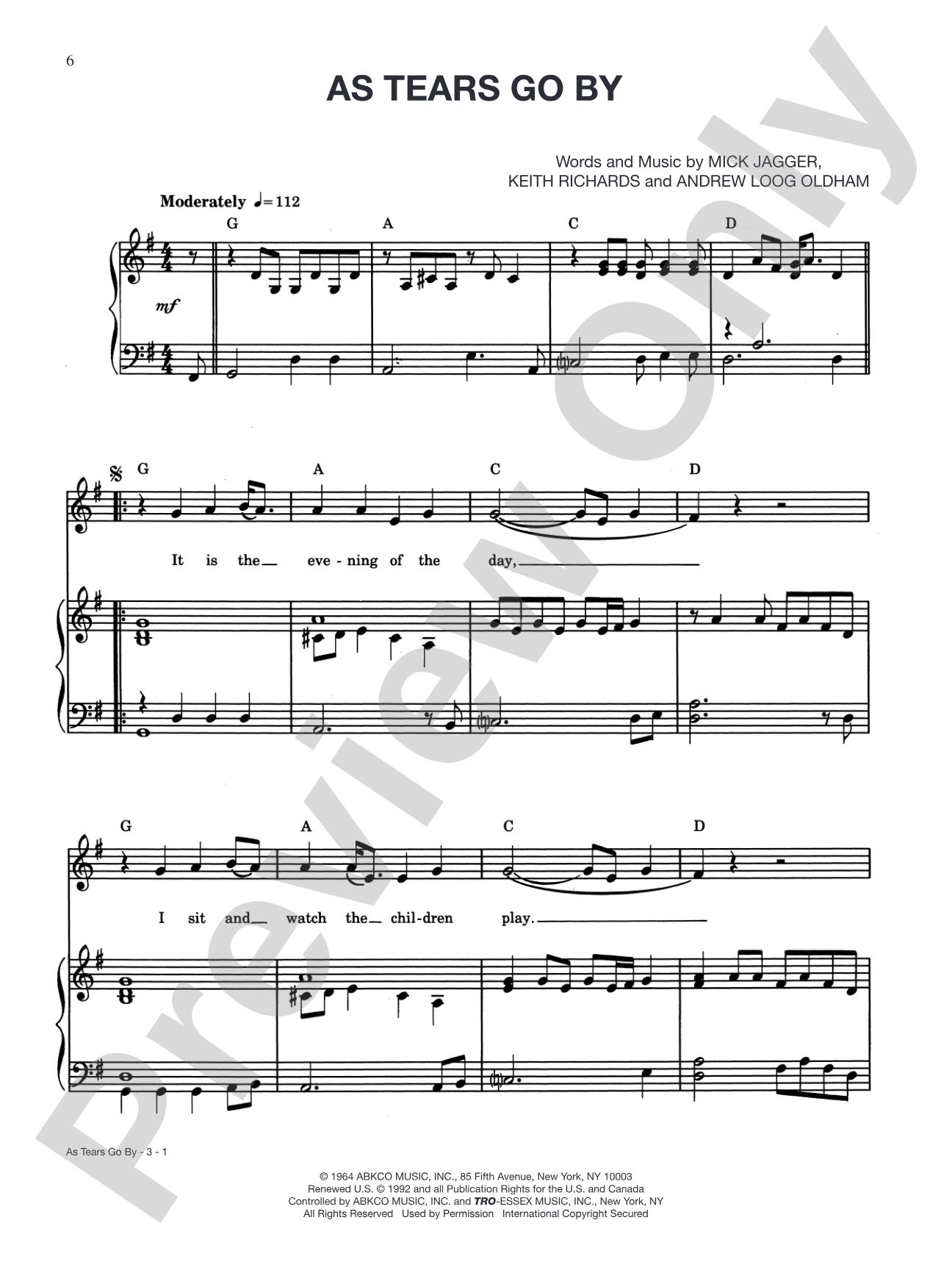

As Tears Go By: Piano/Vocal/Chords
The Rolling Stones
Item: 00-PS-0012135
$4.99
Pickup currently not available
Related Items
Paint It, Black: Piano/Vocal/Chords |
$5.99
|
View | |
Dandelion: Piano/Vocal/Chords |
$4.99
|
View | |
(I Can't Get No) Satisfaction: Piano/Vocal/Chords |
$4.99
|
View | |
Lady Jane: Piano/Vocal/Chords |
$4.99
|
View | |
The Last Time: Piano/Vocal/Chords |
$5.99
|
View | |
Heart of Stone: Piano/Vocal/Chords |
$4.99
|
View | |
19th Nervous Breakdown: Piano/Vocal/Chords |
$5.99
|
View | |
Play With Fire: Piano/Vocal/Chords |
$4.99
|
View | |
I'm Free: Piano/Vocal/Chords |
$4.99
|
View | |
Mother's Little Helper: Piano/Vocal/Chords |
$4.99
|
View | |
Honky Tonk Women: Piano/Vocal/Chords |
$5.99
|
View | |
You Can't Always Get What You Want: Piano/Vocal/Chords |
$9.99
|
View | |
It's All Over Now: Piano/Vocal/Chords |
$5.99
|
View | |
Out of Time: Piano/Vocal/Chords |
$4.99
|
View | |
Ruby Tuesday: Piano/Vocal/Chords |
$4.99
|
View | |
2000 Light Years From Home: Piano/Vocal/Chords |
$5.99
|
View | |
She's a Rainbow: Piano/Vocal/Chords |
$5.99
|
View | |
Let's Spend the Night Together: Piano/Vocal/Chords |
$5.99
|
View | |
Under My Thumb: Piano/Vocal/Chords |
$4.99
|
View | |
Gimme Shelter: Piano/Vocal/Chords |
$5.99
|
View | |
Let It Bleed: Piano/Vocal/Chords |
$5.99
|
View | |
Monkey Man: Piano/Vocal/Chords |
$5.99
|
View | |
No Expectations: Piano/Vocal/Chords |
$4.99
|
View | |
She Smiled Sweetly: Piano/Vocal/Chords |
$4.99
|
View | |
Wild Horses: Piano/Vocal/Chords |
$4.99
|
View | |
The Rolling Stones: Sheet Music Anthology: Piano/Vocal/Chords Book |
$19.99
|
View |
Description
The Rolling Stones Sheet Music Anthology contains 27 piano/vocal/chord arrangements of the legendary British group's greatest hits. Many of the band's most memorable melodies are included, such as "She's a Rainbow," "Lady Jane," and "Ruby Tuesday." Titles: As Tears Go By * Dandelion * Gimme Shelter * Heart of Stone * I'm Free * Honky Tonk Women * It's All Over Now * The Last Time * Let's Spend the Night Together * Let It Bleed * Monkey Man * Mother's Little Helper * 19th Nervous Breakdown * Out of Time * No Expectations * Play with Fire * Paint It, Black * (I Can't Get No) Satisfaction * Sympathy for the Devil * She Smiled Sweetly * 2000 Light Years from Home * Under My Thumb * Wild Horses * You Can't Always Get What You Want.


Discover MakeMusic Cloud: thousands of interactive titles your students can play along with today.
Sample Audio
No sample audio found.
Sample Video
No sample videos found.
Additional Details
Series:
Sheet Music Anthology
Publisher:
Alfred Music
Page Count:
156
SKU:
00-PS-0012135
More about this title
About the Composer: Mick Jagger
Mick Jagger cofounded The Rolling Stones in 1962 and established himself as one of rock music's most dynamic frontmen and prolific songwriters. Working primarily with Keith Richards, Jagger crafted some of the most enduring rock compositions of the 20th century, blending blues influences with a distinctive British sensibility that shaped popular music for generations.
Why we love this
This anthology captures the melodic sophistication beneath The Rolling Stones' raw energy. The piano/vocal arrangements reveal harmonic depth and lyrical craft that often gets overlooked in the original recordings, making these songs rewarding for pianists and singers who want to explore the compositional architecture of rock classics.
What to expect
These songs carry the confident swagger and emotional depth of 1960s and 1970s rock. Whether you're tackling the bitter resignation of "As Tears Go By," the hypnotic groove of "Sympathy for the Devil," or the tender restraint of "Wild Horses," the arrangements invite you into songs that feel both instantly familiar and newly intimate at the piano.
Who it's for
Pianists and singer-pianists preparing for recitals, auditions, or casual performance who love rock standards and want accessible, complete arrangements. Voice students and musical theater performers will also find strong material here for building contemporary repertoire alongside classical and musical theater pieces.
How to get the most out of it
- Study the original recordings to internalize the vocal phrasing and rhythmic swing; the printed melody can feel stiff without the characteristic Jagger delivery.
- Use the chord symbols as a guide for improvisation and reharmonization rather than strict voicing instructions, especially if you're accompanying a vocalist.
- Balance the bass line with intentional rhythmic feel. Many of these songs drive on groove rather than strict time, so lock the left hand into the pulse without rushing.
- Adjust the arrangement density to your venue. The printed parts work at a solo piano level, but you can expand them with bass, drums, or additional instrumentation for larger spaces.
How to use it
Weave individual songs into recitals alongside other popular song arrangements to demonstrate range and stylistic versatility. A well-chosen Stones song can anchor a program segment on rock composition or serve as an engaging encore that connects with younger audiences.
Skills your students will build
- Reading lead sheet notation and interpreting chord symbols for flexible accompaniment
- Managing rhythmic swing and groove in written rock arrangements
- Coordinating melody, harmony, and bass line across both hands
- Adapting classic rock melodies for solo piano or vocal accompaniment contexts
- Building interpretive choices through study of original vocal deliveries