
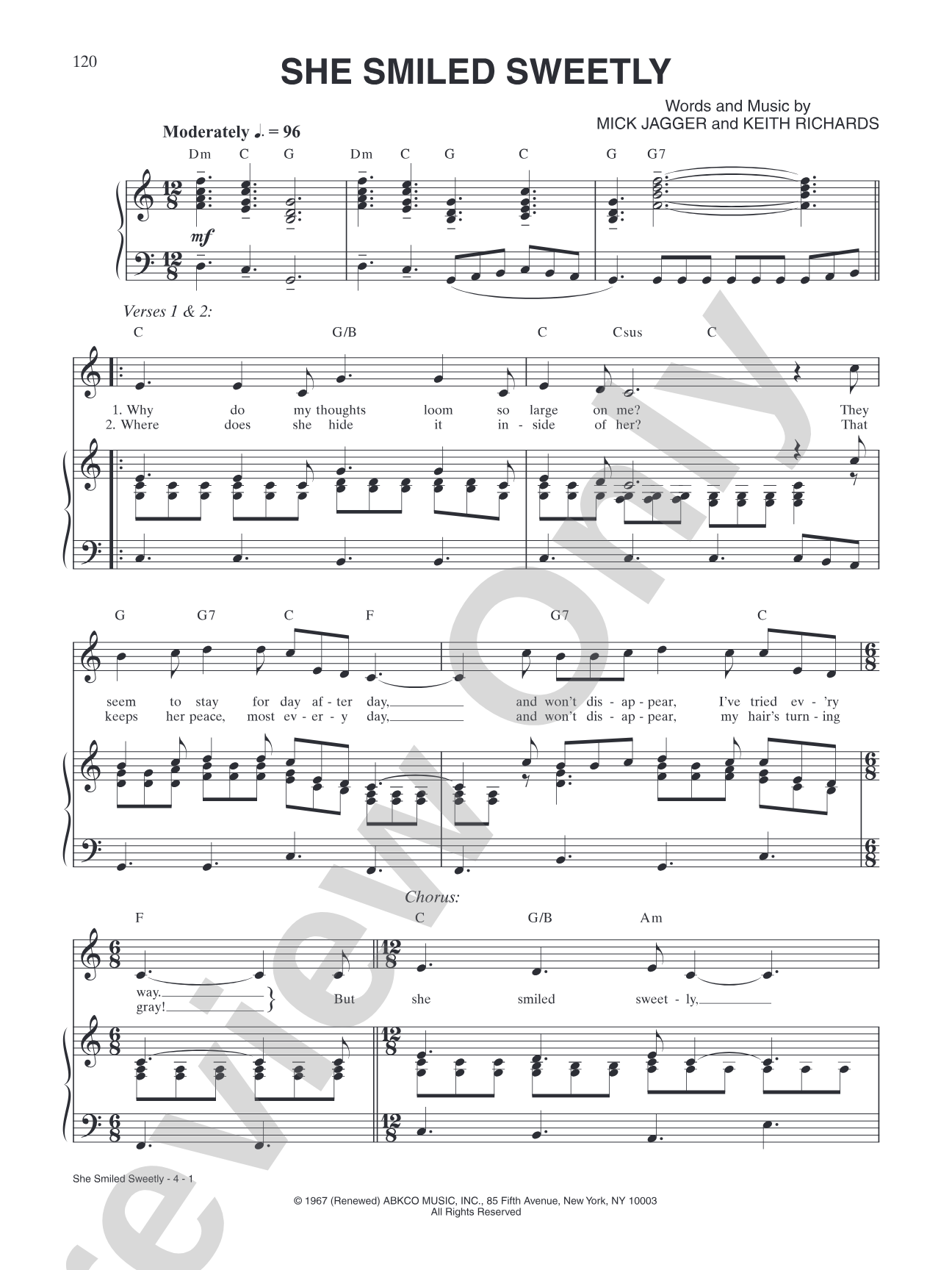

She Smiled Sweetly: Piano/Vocal/Chords
The Rolling Stones
Item: 00-PS-0012171
$4.99
Pickup currently not available
Related Items
Paint It, Black: Piano/Vocal/Chords |
$5.99
|
View | |
Dandelion: Piano/Vocal/Chords |
$4.99
|
View | |
(I Can't Get No) Satisfaction: Piano/Vocal/Chords |
$4.99
|
View | |
Lady Jane: Piano/Vocal/Chords |
$4.99
|
View | |
The Last Time: Piano/Vocal/Chords |
$5.99
|
View | |
Heart of Stone: Piano/Vocal/Chords |
$4.99
|
View | |
19th Nervous Breakdown: Piano/Vocal/Chords |
$5.99
|
View | |
Play With Fire: Piano/Vocal/Chords |
$4.99
|
View | |
I'm Free: Piano/Vocal/Chords |
$4.99
|
View | |
Mother's Little Helper: Piano/Vocal/Chords |
$4.99
|
View | |
Honky Tonk Women: Piano/Vocal/Chords |
$5.99
|
View | |
You Can't Always Get What You Want: Piano/Vocal/Chords |
$9.99
|
View | |
As Tears Go By: Piano/Vocal/Chords |
$4.99
|
View | |
It's All Over Now: Piano/Vocal/Chords |
$5.99
|
View | |
Out of Time: Piano/Vocal/Chords |
$4.99
|
View | |
Ruby Tuesday: Piano/Vocal/Chords |
$4.99
|
View | |
2000 Light Years From Home: Piano/Vocal/Chords |
$5.99
|
View | |
She's a Rainbow: Piano/Vocal/Chords |
$5.99
|
View | |
Let's Spend the Night Together: Piano/Vocal/Chords |
$5.99
|
View | |
Under My Thumb: Piano/Vocal/Chords |
$4.99
|
View | |
Gimme Shelter: Piano/Vocal/Chords |
$5.99
|
View | |
Let It Bleed: Piano/Vocal/Chords |
$5.99
|
View | |
Monkey Man: Piano/Vocal/Chords |
$5.99
|
View | |
No Expectations: Piano/Vocal/Chords |
$4.99
|
View | |
Wild Horses: Piano/Vocal/Chords |
$4.99
|
View | |
The Rolling Stones: Sheet Music Anthology: Piano/Vocal/Chords Book |
$19.99
|
View |
Description
The Rolling Stones Sheet Music Anthology contains 27 piano/vocal/chord arrangements of the legendary British group's greatest hits. Many of the band's most memorable melodies are included, such as "She's a Rainbow," "Lady Jane," and "Ruby Tuesday." Titles: As Tears Go By * Dandelion * Gimme Shelter * Heart of Stone * I'm Free * Honky Tonk Women * It's All Over Now * The Last Time * Let's Spend the Night Together * Let It Bleed * Monkey Man * Mother's Little Helper * 19th Nervous Breakdown * Out of Time * No Expectations * Play with Fire * Paint It, Black * (I Can't Get No) Satisfaction * Sympathy for the Devil * She Smiled Sweetly * 2000 Light Years from Home * Under My Thumb * Wild Horses * You Can't Always Get What You Want.


Discover MakeMusic Cloud: thousands of interactive titles your students can play along with today.
Sample Audio
No sample audio found.
Sample Video
No sample videos found.
Additional Details
Series:
Sheet Music Anthology
Publisher:
Alfred Music
Page Count:
156
SKU:
00-PS-0012171
More about this title
About the Composer: Mick Jagger
Mick Jagger stands as one of rock music's most distinctive lyricists and frontmen, co-writing The Rolling Stones' catalogue with guitarist Keith Richards. His gift for crafting memorable melodies paired with sharp, often provocative lyrics shaped the sound of rock and roll from the 1960s onward. For musicians learning to interpret rock repertoire, Jagger's songwriting offers lessons in economy of language, rhythmic phrasing, and the power of a strong melodic hook.
Why we love this
These arrangements capture some of rock's most enduring melodies in accessible piano/vocal form, making it possible for singers and pianists to explore iconic material that might otherwise stay locked in band settings. The collection spans enough stylistic ground—from the folk-influenced "Lady Jane" to the funk-driven "Sympathy for the Devil"—that ensemble directors can draw pieces suited to different skill levels and concert themes throughout a season.
What to expect
Swagger meets sophistication. These arrangements preserve the unmistakable attitude and groove of the Stones while translating it into a format that lets piano and voice take center stage. The textures range from intimate and sparse to richly layered, with plenty of moments that showcase both instrumental and vocal personality.
Who it's for
Piano students exploring rock repertoire beyond classical tradition, singer-pianists preparing recital material, and choral directors hunting for rock material that doesn't require a full band. The collection also serves accompanying musicians who want to deepen their fluency with this catalog.
How to get the most out of it
- Study the original recordings to absorb the rhythmic swagger and phrasing that define these songs; the written notation alone won't capture the hesitations and pushes that give Stones songs their attitude.
- Pay attention to the chord symbols as guides for comping and harmonic color rather than strict voicing instructions; pianists have room to adapt inversions and textures to match their technique and the accompaniment style.
- Treat the vocal line as a conversation with the piano rather than a melody floating above accompaniment; these songs reward singers who listen closely to what the left hand is doing and respond rhythmically.
How to use it
Select individual pieces for cabaret-style concerts or pop-rock recital evenings, where a pianist and vocalist can build a set around their favorite Stones era. Alternatively, cherry-pick one or two pieces to balance a program rooted in other genres, bringing contemporary energy to an otherwise traditional concert.
Skills your students will build
- Interpreting rock rhythms and swing in a notated format
- Reading and realizing lead-sheet chord symbols
- Balancing melodic storytelling with rhythmic groove
- Adapting classical piano technique to rock and blues idioms
- Collaborating between vocalist and pianist in popular music contexts