
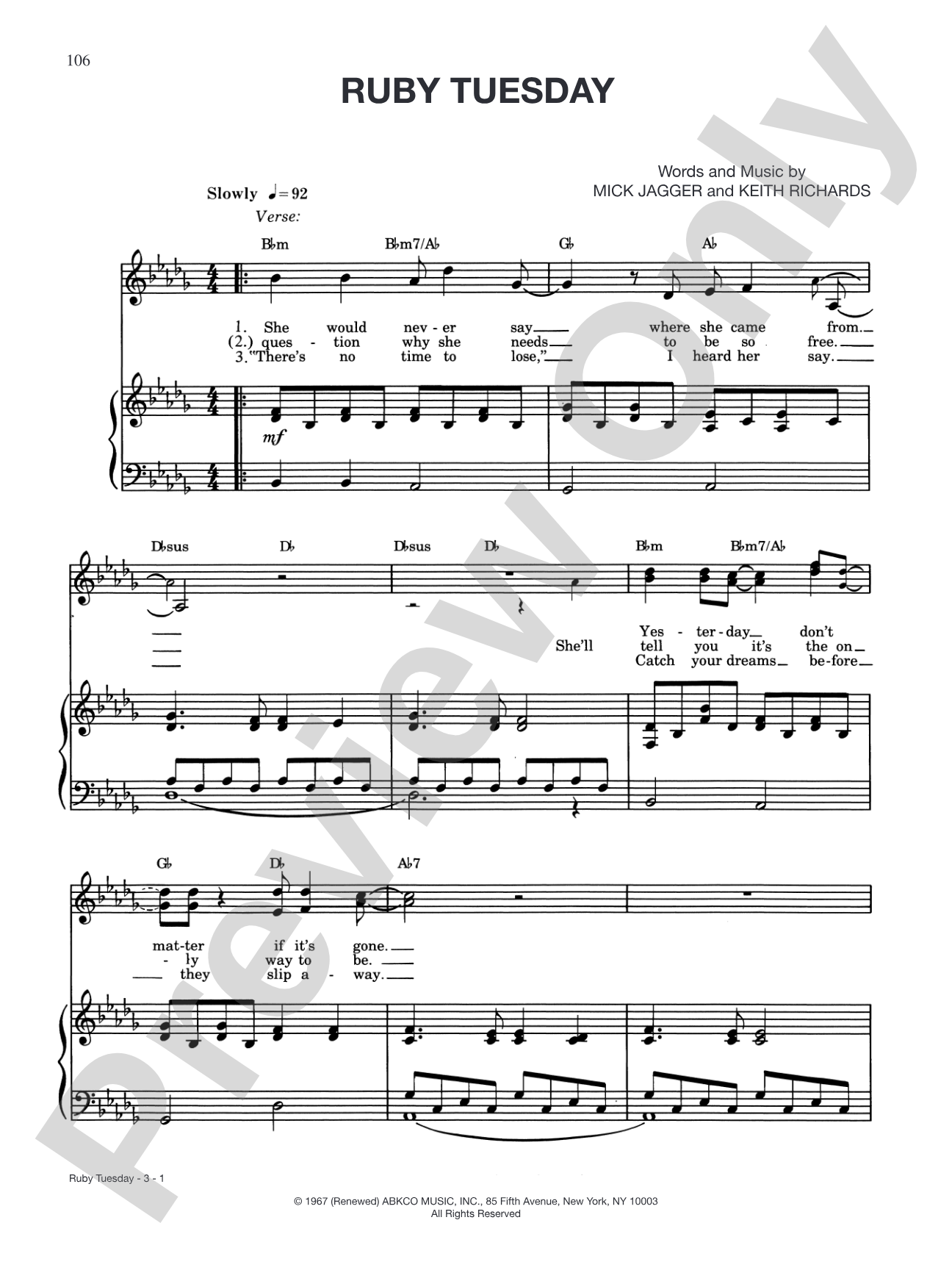

Ruby Tuesday: Piano/Vocal/Chords
The Rolling Stones
Item: 00-PS-0012138
$4.99
Pickup currently not available
Related Items
Paint It, Black: Piano/Vocal/Chords |
$5.99
|
View | |
Dandelion: Piano/Vocal/Chords |
$4.99
|
View | |
(I Can't Get No) Satisfaction: Piano/Vocal/Chords |
$4.99
|
View | |
Lady Jane: Piano/Vocal/Chords |
$4.99
|
View | |
The Last Time: Piano/Vocal/Chords |
$5.99
|
View | |
Heart of Stone: Piano/Vocal/Chords |
$4.99
|
View | |
19th Nervous Breakdown: Piano/Vocal/Chords |
$5.99
|
View | |
Play With Fire: Piano/Vocal/Chords |
$4.99
|
View | |
I'm Free: Piano/Vocal/Chords |
$4.99
|
View | |
Mother's Little Helper: Piano/Vocal/Chords |
$4.99
|
View | |
Honky Tonk Women: Piano/Vocal/Chords |
$5.99
|
View | |
You Can't Always Get What You Want: Piano/Vocal/Chords |
$9.99
|
View | |
As Tears Go By: Piano/Vocal/Chords |
$4.99
|
View | |
It's All Over Now: Piano/Vocal/Chords |
$5.99
|
View | |
Out of Time: Piano/Vocal/Chords |
$4.99
|
View | |
2000 Light Years From Home: Piano/Vocal/Chords |
$5.99
|
View | |
She's a Rainbow: Piano/Vocal/Chords |
$5.99
|
View | |
Let's Spend the Night Together: Piano/Vocal/Chords |
$5.99
|
View | |
Under My Thumb: Piano/Vocal/Chords |
$4.99
|
View | |
Gimme Shelter: Piano/Vocal/Chords |
$5.99
|
View | |
Let It Bleed: Piano/Vocal/Chords |
$5.99
|
View | |
Monkey Man: Piano/Vocal/Chords |
$5.99
|
View | |
No Expectations: Piano/Vocal/Chords |
$4.99
|
View | |
She Smiled Sweetly: Piano/Vocal/Chords |
$4.99
|
View | |
Wild Horses: Piano/Vocal/Chords |
$4.99
|
View | |
The Rolling Stones: Sheet Music Anthology: Piano/Vocal/Chords Book |
$19.99
|
View |
Description
The Rolling Stones Sheet Music Anthology contains 27 piano/vocal/chord arrangements of the legendary British group's greatest hits. Many of the band's most memorable melodies are included, such as "She's a Rainbow," "Lady Jane," and "Ruby Tuesday." Titles: As Tears Go By * Dandelion * Gimme Shelter * Heart of Stone * I'm Free * Honky Tonk Women * It's All Over Now * The Last Time * Let's Spend the Night Together * Let It Bleed * Monkey Man * Mother's Little Helper * 19th Nervous Breakdown * Out of Time * No Expectations * Play with Fire * Paint It, Black * (I Can't Get No) Satisfaction * Sympathy for the Devil * She Smiled Sweetly * 2000 Light Years from Home * Under My Thumb * Wild Horses * You Can't Always Get What You Want.


Discover MakeMusic Cloud: thousands of interactive titles your students can play along with today.
Sample Audio
No sample audio found.
Sample Video
No sample videos found.
Additional Details
Series:
Sheet Music Anthology
Publisher:
Alfred Music
Page Count:
156
SKU:
00-PS-0012138
More about this title
About the Composer: Mick Jagger
Mick Jagger co-wrote the majority of The Rolling Stones' catalog alongside Keith Richards, establishing himself as one of rock music's most prolific and influential songwriters. His gift for crafting memorable melodies paired with emotionally direct lyrics shaped the sound of British rock from the 1960s onward, influencing generations of musicians across multiple genres.
Beyond songwriting, Jagger's understanding of performance and vocal delivery elevated every composition he penned. His ability to layer storytelling with infectious hooks makes his work particularly valuable for performers learning how rock songwriting balances technical craft with emotional authenticity.
Why we love this
This collection gives singers and pianists access to some of the most recognizable melodies in rock history, arranged in a format that respects the original vocal lines while remaining playable in a practice or performance setting. The variety across 27 songs means you can program anything from the reflective beauty of 'Wild Horses' to the swagger of 'Satisfaction,' making it easy to build a cohesive set that showcases different facets of The Stones' songwriting.
What to expect
These songs pulse with a kind of effortless cool tempered by genuine emotional depth. Whether you're playing a hard-driving rocker or a tender ballad, there's always a sense of understated confidence in the melodic writing, the kind that makes simple phrases feel both timeless and alive.
Who it's for
Singers preparing for auditions, recitals, or cabaret-style performances will find rock-solid material that audiences recognize immediately. Pianists in studios or voice lessons can use these arrangements to accompany students or to refresh their own interpretive skills in a genre outside the classical canon.
How to get the most out of it
- Keep the vocal phrasing conversational rather than theatrical. These songs live in the space between storytelling and attitude; overacting the delivery flattens their impact.
- Use the chord symbols as a guide for harmonic color, not gospel. Small adjustments to voicing can shift the feel from 1960s studio sound to something fresher for contemporary audiences.
- Anchor the piano part to the essential harmonic structure in rehearsal, then listen to the original recordings to understand where to add texture, space, or rhythmic drive.
- Balance the vocal melody with sensitive accompaniment. Many of these songs rely on restraint in the arrangement to let the lyric breathe.
How to use it
Build a rock history concert around a single decade of Stones writing, or use individual songs as scene changes or mood shifts in a larger variety show. Solo performers can program two or three songs across a recital to demonstrate range while staying within material that showcases vocal storytelling rather than technical fireworks.
Skills your students will build
- Singing with interpretive restraint and conversational phrasing in rock idioms
- Reading chord symbols and understanding harmonic function in contemporary music
- Accompanying singers while balancing support with space for vocal expression
- Interpreting melodic nuance across different song moods and tempos
- Applying stylistic knowledge of 1960s rock production to modern performance contexts