
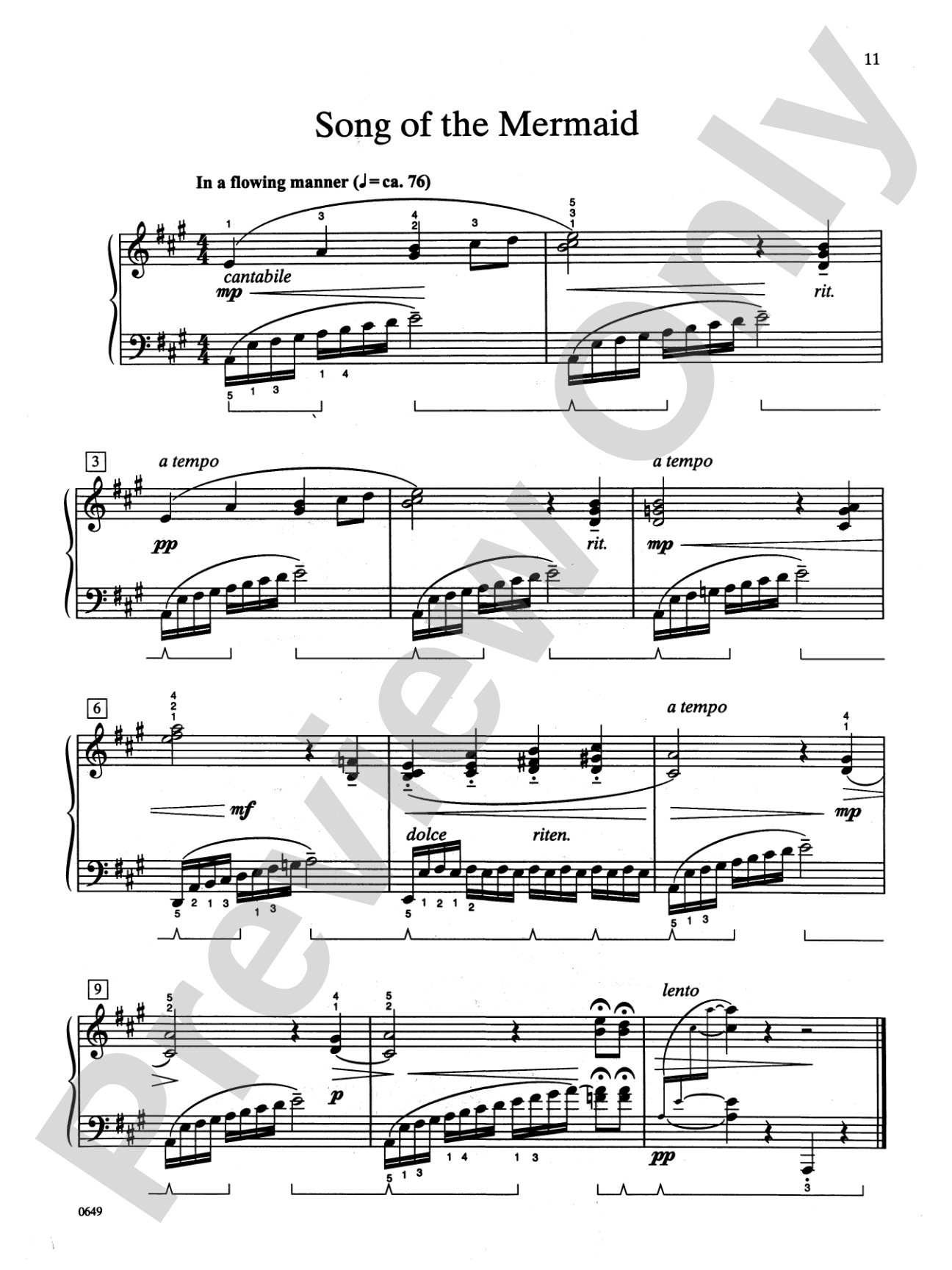

Song of the Mermaid - Piano Solo: Piano Solo
24 Short Piano Pieces in All Keys
By William L. Gillock
Level: Intermediate / Late Intermediate
Item: 00-PS-0017410
$4.99
Pickup currently not available
Related Items
Legend - Piano Solo: Piano Solo |
$4.99
|
View | |
Soaring - Piano Solo: Piano Solo |
$4.99
|
View | |
Seascape - Piano Solo: Piano Solo |
$4.99
|
View | |
Serenade - Piano Solo: Piano Solo |
$4.99
|
View | |
Interlude - Piano Solo: Piano Solo |
$4.99
|
View | |
Dragon Fly - Piano Solo: Piano Solo |
$4.99
|
View | |
Night Song - Piano Solo: Piano Solo |
$4.99
|
View | |
Humming Bird - Piano Solo: Piano Solo |
$4.99
|
View | |
Summer Storm - Piano Solo: Piano Solo |
$4.99
|
View | |
Winter Scene - Piano Solo: Piano Solo |
$4.99
|
View | |
A Witch's Cat - Piano Solo: Piano Solo |
$4.99
|
View | |
Autumn Sketch - Piano Solo: Piano Solo |
$4.99
|
View | |
Night Journey - Piano Solo: Piano Solo |
$4.99
|
View | |
Phantom Rider - Piano Solo: Piano Solo |
$4.99
|
View | |
A Faded Letter - Piano Solo: Piano Solo |
$4.99
|
View | |
Forest Murmurs - Piano Solo: Piano Solo |
$4.99
|
View | |
Moonlight Mood - Piano Solo: Piano Solo |
$4.99
|
View | |
October Morning - Piano Solo: Piano Solo |
$4.99
|
View | |
The Silent Snow - Piano Solo: Piano Solo |
$4.99
|
View | |
An Old Valentine - Piano Solo: Piano Solo |
$4.99
|
View | |
Fountain of Diana - Piano Solo: Piano Solo |
$4.99
|
View | |
Deserted Ball Room - Piano Solo: Piano Solo |
$4.99
|
View | |
Procession of the Mandarin - Piano Solo: Piano Solo |
$8.99
|
View | |
Lyric Preludes in Romantic Style: Piano Book & Online Audio |
$10.99
|
View | |
Lyric Preludes in Romantic Style: Piano Book |
$8.99
|
View |
Description
Lyric Preludes is an introduction to the whole Romantic period -- from Chopin and Schumann to Brahms and Debussy. Like Chopin, Gillock has written 24 preludes featuring all major and minor keys. But his preludes aren't just imitations of other composer's styles, they are valid, original works. An essential book for all pianists. A Federation Festivals 2024-2028 selection.


Discover MakeMusic Cloud: thousands of interactive titles your students can play along with today.
Sample Audio
No sample audio found.
Sample Video
No sample videos found.
Additional Details
Publisher:
Alfred Music
Page Count:
32
SKU:
00-PS-0017410
More about this title
About the Composer: William L. Gillock
William L. Gillock (1917, 2002) was an American composer and pedagogue whose gift lay in writing accessible yet musically substantial pieces for developing pianists. He understood the learning journey intimately, crafting works that expanded technical and interpretive skills without sacrificing artistic merit. His prolific output includes thousands of compositions spanning multiple genres, but his pedagogical works remain his most enduring legacy in music education.
Why we love this
Gillock's approach to the prelude form respects the structural ambitions of the Romantic masters while remaining genuinely pianistic for intermediate students. Unlike more dated pedagogical collections, these pieces invite real musical interpretation; they're concert-worthy in their own right, not stepping stones. Programming one alongside works by Chopin or Schumann demonstrates stylistic continuity rather than creating a jarring pedagogical gap.
What to expect
Each prelude unlocks a different color within the Romantic palette. Some pieces shimmer with Debussyian impressionism; others pulse with the lyrical directness of Schumann. Throughout, there's an unhurried elegance, a sense of exploring emotion through sound rather than displaying virtuosity.
Who it's for
Intermediate to late intermediate pianists ready to engage with Romantic aesthetics without the technical demands of the standard repertoire. Festival participants preparing for 2024, 2028 competition seasons will find these selections both musically rewarding and strategically smart programming choices.
How to get the most out of it
- Attend to the harmonic language carefully; Gillock's progressions often evoke Romantic composers but demand clarity in voice leading, not just surface-level playing.
- Explore the piece's tonal architecture by mapping where keys shift and return; treating each prelude as a miniature journey rather than a brief exercise deepens the interpretation.
- Balance the lyrical quality with structural pacing. These are called 'Lyric Preludes' because lyricism drives them, but that lyricism must breathe across the full span of the piece.
How to use it
These work beautifully as short recital openers or closing encores, especially when you're building a Romantic-era program. Select a few pieces that complement your student's other repertoire, or use the collection as a semester-long exploration of 24 different compositional moods and technical angles.
Skills your students will build
- Phrasing in lyrical, song-like writing without explicit text
- Harmonic analysis and functional understanding of Romantic progressions
- Tonal relationships across all major and minor keys
- Pedal control and tonal blending appropriate to Romantic aesthetics
- Interpretive independence; choosing tempo, dynamics, and rubato within a substantial musical framework
- Stylistic awareness of composers from Chopin through Debussy