
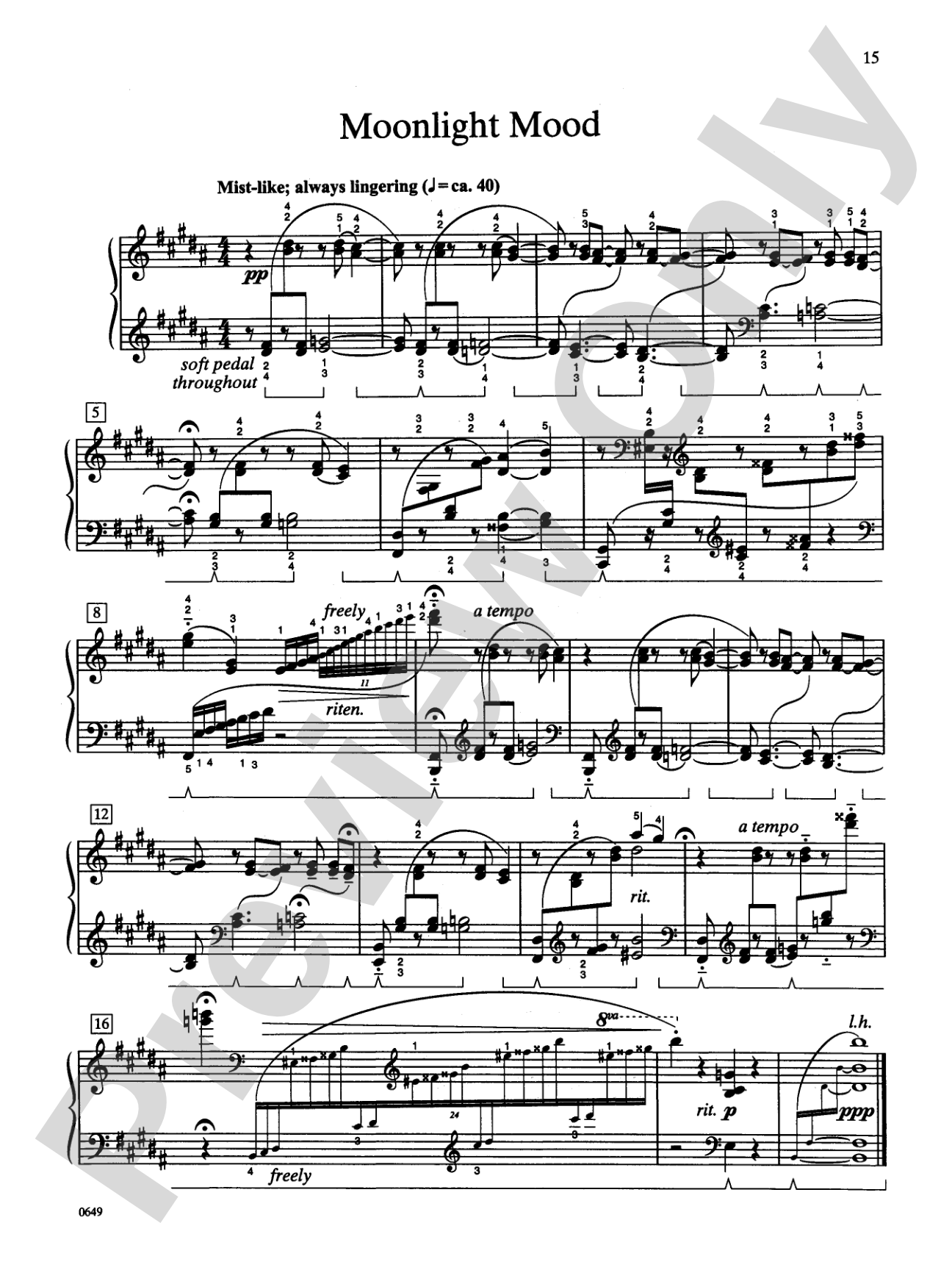

Moonlight Mood - Piano Solo: Piano Solo
24 Short Piano Pieces in All Keys
By William L. Gillock
Level: Intermediate / Late Intermediate
Item: 00-PS-0017404
$4.99
Pickup currently not available
Related Items
Legend - Piano Solo: Piano Solo |
$4.99
|
View | |
Soaring - Piano Solo: Piano Solo |
$4.99
|
View | |
Seascape - Piano Solo: Piano Solo |
$4.99
|
View | |
Serenade - Piano Solo: Piano Solo |
$4.99
|
View | |
Interlude - Piano Solo: Piano Solo |
$4.99
|
View | |
Dragon Fly - Piano Solo: Piano Solo |
$4.99
|
View | |
Night Song - Piano Solo: Piano Solo |
$4.99
|
View | |
Humming Bird - Piano Solo: Piano Solo |
$4.99
|
View | |
Summer Storm - Piano Solo: Piano Solo |
$4.99
|
View | |
Winter Scene - Piano Solo: Piano Solo |
$4.99
|
View | |
A Witch's Cat - Piano Solo: Piano Solo |
$4.99
|
View | |
Autumn Sketch - Piano Solo: Piano Solo |
$4.99
|
View | |
Night Journey - Piano Solo: Piano Solo |
$4.99
|
View | |
Phantom Rider - Piano Solo: Piano Solo |
$4.99
|
View | |
A Faded Letter - Piano Solo: Piano Solo |
$4.99
|
View | |
Forest Murmurs - Piano Solo: Piano Solo |
$4.99
|
View | |
October Morning - Piano Solo: Piano Solo |
$4.99
|
View | |
The Silent Snow - Piano Solo: Piano Solo |
$4.99
|
View | |
An Old Valentine - Piano Solo: Piano Solo |
$4.99
|
View | |
Fountain of Diana - Piano Solo: Piano Solo |
$4.99
|
View | |
Deserted Ball Room - Piano Solo: Piano Solo |
$4.99
|
View | |
Song of the Mermaid - Piano Solo: Piano Solo |
$4.99
|
View | |
Procession of the Mandarin - Piano Solo: Piano Solo |
$8.99
|
View | |
Lyric Preludes in Romantic Style: Piano Book & Online Audio |
$10.99
|
View | |
Lyric Preludes in Romantic Style: Piano Book |
$8.99
|
View |
Description
Lyric Preludes is an introduction to the whole Romantic period -- from Chopin and Schumann to Brahms and Debussy. Like Chopin, Gillock has written 24 preludes featuring all major and minor keys. But his preludes aren't just imitations of other composer's styles, they are valid, original works. An essential book for all pianists. A Federation Festivals 2024-2028 selection.


Discover MakeMusic Cloud: thousands of interactive titles your students can play along with today.
Sample Audio
No sample audio found.
Sample Video
No sample videos found.
Additional Details
Publisher:
Alfred Music
Page Count:
32
SKU:
00-PS-0017404
More about this title
About the Composer: William L. Gillock
William L. Gillock (1917-2002) shaped American piano pedagogy by composing accessible yet musically substantial works for intermediate students. His understanding of what pianists at this level could achieve led him to create pieces that demand real musicianship without requiring virtuosic technique.
Gillock's approach to composition for students set him apart from his contemporaries. He believed young pianists deserved exposure to legitimate musical ideas, not watered-down exercises, and his prolific output reflects this philosophy. His pieces appear consistently on festival lists and in the studios of teachers who refuse to compromise between accessibility and artistry.
Why we love this
Gillock's cycle of 24 preludes stands on its own merit rather than functioning as a Chopin study guide. Each prelude explores a specific character or technical idea in the Romantic idiom, but his voice remains distinctly his own; students discover what Romantic music can be without imitating historical models. Programming selections from this collection signals to audiences and adjudicators that your students are engaging with real literature.
What to expect
Each prelude captures a distinct mood; some float with Debussy-like impressionism while others pulse with Brahmsian warmth. The book invites pianists into a gallery of emotional snapshots, each one painted in the musical language of the Romantic period but filtered through Gillock's accessible, unpretentious sensibility. There's a generosity in these pieces, a sense that the composer is sharing something genuine rather than demonstrating how much a student should know.
Who it's for
Intermediate to late intermediate pianists ready to move beyond simplified Romantic pastiche and engage with genuine compositional craft. Students preparing for festival competitions will find a goldmine of contrasting selections that showcase their interpretive abilities. This collection suits any pianist seeking a bridge between technical studies and the full repertoire of the Romantic era.
How to get the most out of it
- Pay close attention to the dynamic landscape of each prelude; Gillock often uses subtle shifts in volume to shape phrases rather than obvious structural markers.
- Let the harmonic language breathe. Many of these pieces contain chromatic movement and unexpected chord progressions that can sound muddied if the pedal is changed too infrequently or without sensitivity to voice leading.
- Consider the tempo marking as a starting point for conversation, not a fixed boundary. A prelude might need to settle into its true character only after a few measures of exploration.
- Balance independence between hands. These works often feature singing melodies that share the stage with equally important accompaniment figures; neither should dominate unless the score clearly indicates it.
How to use it
Select contrasting preludes as short solo works for a mixed recital, allowing multiple students to perform without monopolizing rehearsal time on a single long work. The variety within the collection makes it ideal for festival entries where you need several short pieces in different keys and moods. Consider pairing a selection of these with a student composition project, using Gillock's approach as a model for how to write music that respects both the listener and the performer.
Skills your students will build
- Navigating chromatic harmony and voice leading across all major and minor keys
- Rubato and phrase shaping within a Romantic harmonic language
- Pedal technique that respects harmonic changes and textural clarity
- Dynamic control and nuance in single-staff melodies
- Understanding prelude form and how character establishes structure