
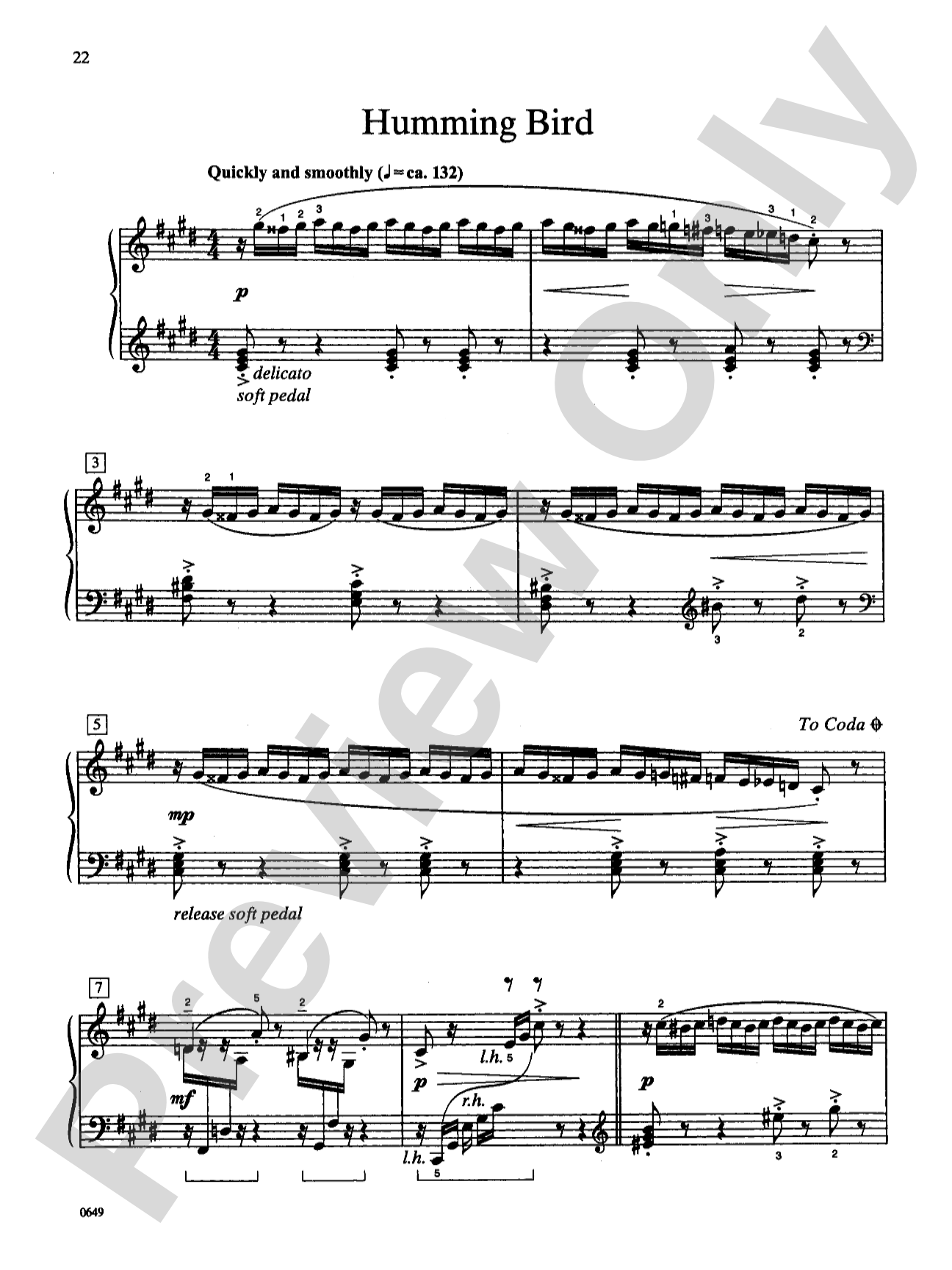

Humming Bird - Piano Solo: Piano Solo
24 Short Piano Pieces in All Keys
By William L. Gillock
Level: Intermediate / Late Intermediate
Item: 00-PS-0017395
$4.99
Pickup currently not available
Related Items
Legend - Piano Solo: Piano Solo |
$4.99
|
View | |
Soaring - Piano Solo: Piano Solo |
$4.99
|
View | |
Seascape - Piano Solo: Piano Solo |
$4.99
|
View | |
Serenade - Piano Solo: Piano Solo |
$4.99
|
View | |
Interlude - Piano Solo: Piano Solo |
$4.99
|
View | |
Dragon Fly - Piano Solo: Piano Solo |
$4.99
|
View | |
Night Song - Piano Solo: Piano Solo |
$4.99
|
View | |
Summer Storm - Piano Solo: Piano Solo |
$4.99
|
View | |
Winter Scene - Piano Solo: Piano Solo |
$4.99
|
View | |
A Witch's Cat - Piano Solo: Piano Solo |
$4.99
|
View | |
Autumn Sketch - Piano Solo: Piano Solo |
$4.99
|
View | |
Night Journey - Piano Solo: Piano Solo |
$4.99
|
View | |
Phantom Rider - Piano Solo: Piano Solo |
$4.99
|
View | |
A Faded Letter - Piano Solo: Piano Solo |
$4.99
|
View | |
Forest Murmurs - Piano Solo: Piano Solo |
$4.99
|
View | |
Moonlight Mood - Piano Solo: Piano Solo |
$4.99
|
View | |
October Morning - Piano Solo: Piano Solo |
$4.99
|
View | |
The Silent Snow - Piano Solo: Piano Solo |
$4.99
|
View | |
An Old Valentine - Piano Solo: Piano Solo |
$4.99
|
View | |
Fountain of Diana - Piano Solo: Piano Solo |
$4.99
|
View | |
Deserted Ball Room - Piano Solo: Piano Solo |
$4.99
|
View | |
Song of the Mermaid - Piano Solo: Piano Solo |
$4.99
|
View | |
Procession of the Mandarin - Piano Solo: Piano Solo |
$8.99
|
View | |
Lyric Preludes in Romantic Style: Piano Book & Online Audio |
$10.99
|
View | |
Lyric Preludes in Romantic Style: Piano Book |
$8.99
|
View |
Description
Lyric Preludes is an introduction to the whole Romantic period -- from Chopin and Schumann to Brahms and Debussy. Like Chopin, Gillock has written 24 preludes featuring all major and minor keys. But his preludes aren't just imitations of other composer's styles, they are valid, original works. An essential book for all pianists. A Federation Festivals 2024-2028 selection.


Discover MakeMusic Cloud: thousands of interactive titles your students can play along with today.
Sample Audio
No sample audio found.
Sample Video
No sample videos found.
Additional Details
Publisher:
Alfred Music
Page Count:
32
SKU:
00-PS-0017395
More about this title
About the Composer: William L. Gillock
William L. Gillock (1917, 2001) was an American composer and pedagogue whose gift was making serious musical ideas accessible to developing pianists. He understood that students didn't need watered-down exercises; they needed real compositions that honored the tradition while speaking in a contemporary voice.
Gillock's catalog includes hundreds of pieces written with the learner's hand and ear firmly in mind. His work appears on festival lists nationwide, and teachers turn to his collections again and again because the music teaches as it engages.
Why we love this
Gillock takes the Romantic prelude cycle as a serious blueprint and delivers 24 original works, each one a window into a different key. He respects the form without imitating it, which means students hear Romantic idiom without hearing pastiches of Chopin. The writing is pianistic without being showy, and the melodic quality means students actually want to practice these pieces.
What to expect
These preludes exhale a quiet lyricism that feels both intimate and reflective. There's a restraint to them, a clarity of voice that lets the harmonic language and melodic contour speak without excessive ornamentation. Playing through them feels like turning pages in a musical diary.
Who it's for
Intermediate and late intermediate pianists ready to engage with Romantic style without the technical demands of the standard repertoire. Students preparing for festival or recital and teachers seeking pieces that deepen musicianship while remaining within reach.
How to get the most out of it
- Listen carefully to which voices carry the primary melody in each prelude; Gillock often weaves the tune through different registers rather than spotlighting it in the right hand alone.
- Attend to harmonic rhythm as your structural roadmap. Many of these preludes move more through harmonic motion than through phrase punctuation, so let the chord changes guide your pacing.
- Shape phrases by understanding the emotional arc of each piece rather than relying on obvious dynamic markings. Gillock's notation is clean and spare by design.
- Take time with rubato and pedal choices once you have the notes secure. These pieces reward the interpretive choices that Romantic style demands.
How to use it
The collection's breadth makes it ideal for a student recital featuring one prelude per piece, or as contrasting interludes in a longer program. A teacher might also use selections from this book as an alternative to traditional technique studies, since working through the cycle in keys builds both security and stylistic understanding.
Skills your students will build
- Harmonic analysis across major and minor keys
- Rubato and expressive phrasing in Romantic style
- Voice leading and independence of hands
- Pedal technique and its relationship to harmonic change
- Structural navigation through harmonic rather than metric landmarks