
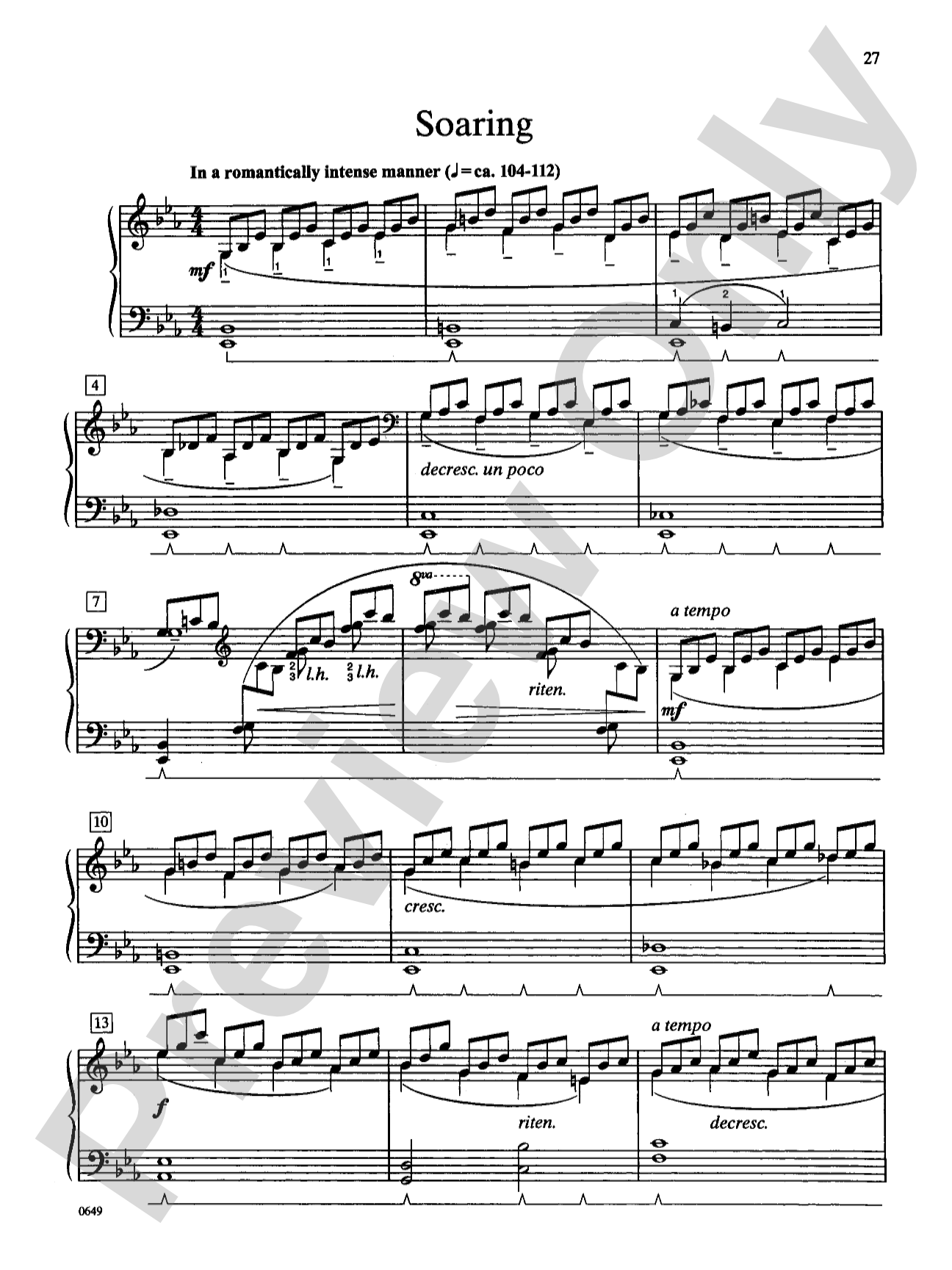

Soaring - Piano Solo: Piano Solo
24 Short Piano Pieces in All Keys
By William L. Gillock
Level: Intermediate / Late Intermediate
Item: 00-PS-0017389
$4.99
Pickup currently not available
Related Items
Legend - Piano Solo: Piano Solo |
$4.99
|
View | |
Seascape - Piano Solo: Piano Solo |
$4.99
|
View | |
Serenade - Piano Solo: Piano Solo |
$4.99
|
View | |
Interlude - Piano Solo: Piano Solo |
$4.99
|
View | |
Dragon Fly - Piano Solo: Piano Solo |
$4.99
|
View | |
Night Song - Piano Solo: Piano Solo |
$4.99
|
View | |
Humming Bird - Piano Solo: Piano Solo |
$4.99
|
View | |
Summer Storm - Piano Solo: Piano Solo |
$4.99
|
View | |
Winter Scene - Piano Solo: Piano Solo |
$4.99
|
View | |
A Witch's Cat - Piano Solo: Piano Solo |
$4.99
|
View | |
Autumn Sketch - Piano Solo: Piano Solo |
$4.99
|
View | |
Night Journey - Piano Solo: Piano Solo |
$4.99
|
View | |
Phantom Rider - Piano Solo: Piano Solo |
$4.99
|
View | |
A Faded Letter - Piano Solo: Piano Solo |
$4.99
|
View | |
Forest Murmurs - Piano Solo: Piano Solo |
$4.99
|
View | |
Moonlight Mood - Piano Solo: Piano Solo |
$4.99
|
View | |
October Morning - Piano Solo: Piano Solo |
$4.99
|
View | |
The Silent Snow - Piano Solo: Piano Solo |
$4.99
|
View | |
An Old Valentine - Piano Solo: Piano Solo |
$4.99
|
View | |
Fountain of Diana - Piano Solo: Piano Solo |
$4.99
|
View | |
Deserted Ball Room - Piano Solo: Piano Solo |
$4.99
|
View | |
Song of the Mermaid - Piano Solo: Piano Solo |
$4.99
|
View | |
Procession of the Mandarin - Piano Solo: Piano Solo |
$8.99
|
View | |
Lyric Preludes in Romantic Style: Piano Book & Online Audio |
$10.99
|
View | |
Lyric Preludes in Romantic Style: Piano Book |
$8.99
|
View |
Description
Lyric Preludes is an introduction to the whole Romantic period -- from Chopin and Schumann to Brahms and Debussy. Like Chopin, Gillock has written 24 preludes featuring all major and minor keys. But his preludes aren't just imitations of other composer's styles, they are valid, original works. An essential book for all pianists. A Federation Festivals 2024-2028 selection.


Discover MakeMusic Cloud: thousands of interactive titles your students can play along with today.
Sample Audio
No sample audio found.
Sample Video
No sample videos found.
Additional Details
Publisher:
Alfred Music
Page Count:
32
SKU:
00-PS-0017389
More about this title
About the Composer: William L. Gillock
William L. Gillock (1917, 2002) was an American composer and educator who spent much of his career writing pedagogical music that never talked down to students. His gift was creating pieces that sounded genuinely musical, the kind students wanted to play, while building real technique and musicianship. Gillock understood that intermediate pianists needed access to authentic artistic expression, not watered-down miniatures.
His approach to the Romantic period was scholarly without being dry. By composing 24 preludes across all keys, Gillock created a resource that honored the Chopin tradition while establishing his own voice. His works became staples in American music education precisely because they asked students to think like musicians, not merely technicians.
Why we love this
Gillock gives intermediate pianists their first real encounter with the breadth of Romantic expression without requiring advanced virtuosity. The prelude format works beautifully for lesson planning and recitals: each piece stands alone, yet studying them sequentially builds harmonic understanding and stylistic awareness that surveys alone cannot achieve. A Festival selection spanning multiple seasons signals staying power.
What to expect
Lyric and introspective, with the song-like quality that defined the Romantic prelude. These pieces have intimacy without sentimentality, moments of genuine beauty that reward careful listening and honest playing, surrounded by harmonic surprises that make you lean in closer.
Who it's for
Intermediate to late-intermediate pianists ready to study the Romantic era through composition rather than anthology analysis. Teachers building students' harmonic vocabulary and historical awareness alongside technique. Students preparing for adjudicated festivals who need substantial, musically rewarding material at accessible technical levels.
How to get the most out of it
- Let the key character shape your tone color. A prelude in C minor demands different weight and resonance than one in A major; this collection teaches pianists to hear and respond to tonal centers with real specificity.
- Examine Gillock's harmonic language before you memorize. His chord progressions are closer to Brahms and Debussy than to Chopin in places; understanding the architecture prevents the piece from sounding generic.
- Treat rubato as structural, not ornamental. These pieces breathe in the Romantic tradition, but the breathing must serve the phrase shape, not float on top of it.
How to use it
Build a Romantic-era recital around a selection of these preludes, pairing them with works by the composers Gillock references to show stylistic connections and differences. Use them to anchor spring festival seasons when students need refined repertoire that demonstrates growth. A student performing four or five pieces from the collection demonstrates serious preparation and historical understanding.
Skills your students will build
- Tonal center recognition and harmonic function across major and minor keys
- Romantic-era rubato and expressive phrasing
- Pedal technique matched to harmonic density and resonance
- Comparative analysis of style periods (understanding how Gillock's language relates to Chopin, Schumann, Brahms, Debussy)
- Memorization strategies through thematic and harmonic patterns