
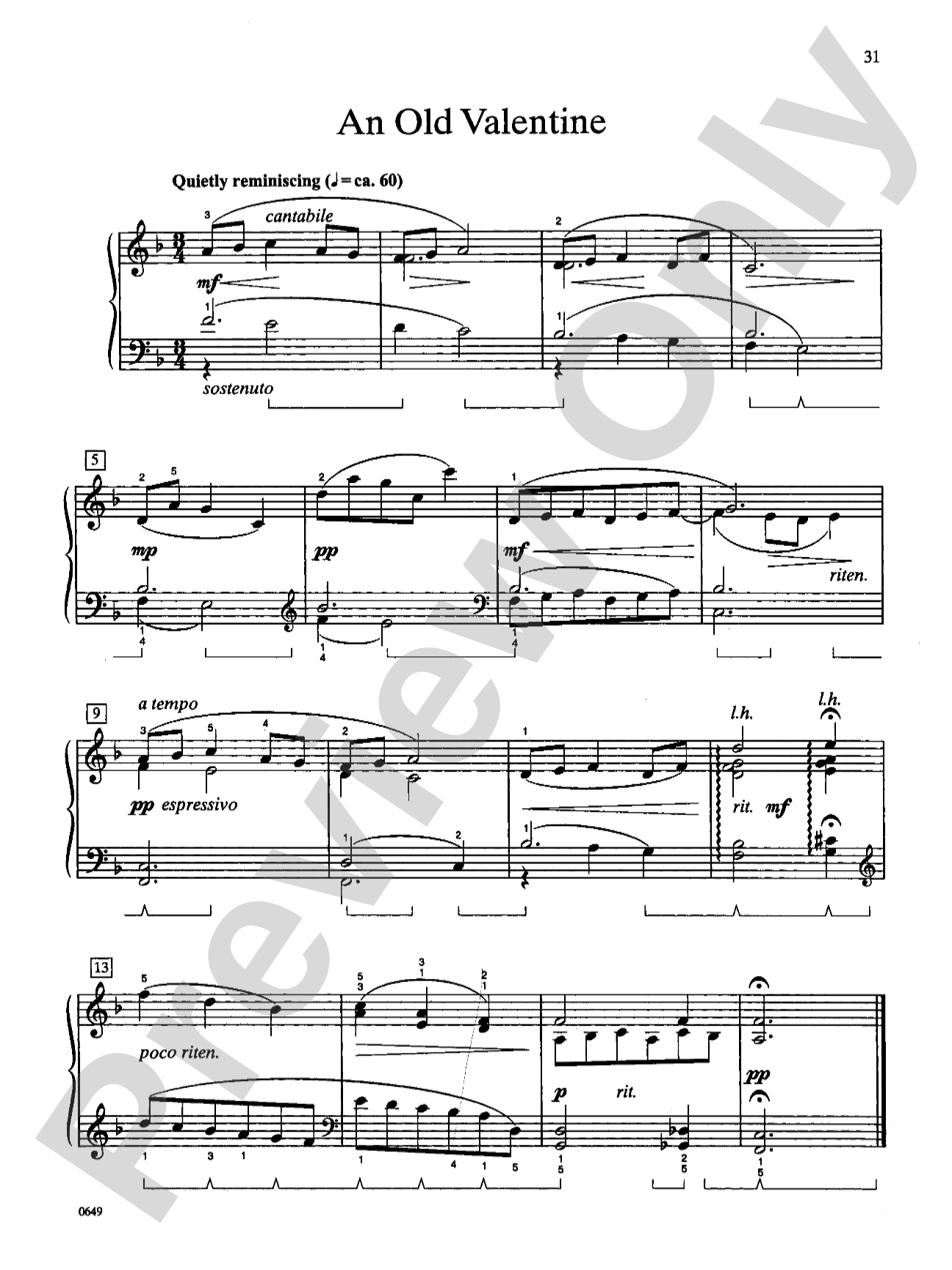

An Old Valentine - Piano Solo: Piano Solo
24 Short Piano Pieces in All Keys
By William L. Gillock
Level: Intermediate / Late Intermediate
Item: 00-PS-0017407
$4.99
Pickup currently not available
Related Items
Legend - Piano Solo: Piano Solo |
$4.99
|
View | |
Soaring - Piano Solo: Piano Solo |
$4.99
|
View | |
Seascape - Piano Solo: Piano Solo |
$4.99
|
View | |
Serenade - Piano Solo: Piano Solo |
$4.99
|
View | |
Interlude - Piano Solo: Piano Solo |
$4.99
|
View | |
Dragon Fly - Piano Solo: Piano Solo |
$4.99
|
View | |
Night Song - Piano Solo: Piano Solo |
$4.99
|
View | |
Humming Bird - Piano Solo: Piano Solo |
$4.99
|
View | |
Summer Storm - Piano Solo: Piano Solo |
$4.99
|
View | |
Winter Scene - Piano Solo: Piano Solo |
$4.99
|
View | |
A Witch's Cat - Piano Solo: Piano Solo |
$4.99
|
View | |
Autumn Sketch - Piano Solo: Piano Solo |
$4.99
|
View | |
Night Journey - Piano Solo: Piano Solo |
$4.99
|
View | |
Phantom Rider - Piano Solo: Piano Solo |
$4.99
|
View | |
A Faded Letter - Piano Solo: Piano Solo |
$4.99
|
View | |
Forest Murmurs - Piano Solo: Piano Solo |
$4.99
|
View | |
Moonlight Mood - Piano Solo: Piano Solo |
$4.99
|
View | |
October Morning - Piano Solo: Piano Solo |
$4.99
|
View | |
The Silent Snow - Piano Solo: Piano Solo |
$4.99
|
View | |
Fountain of Diana - Piano Solo: Piano Solo |
$4.99
|
View | |
Deserted Ball Room - Piano Solo: Piano Solo |
$4.99
|
View | |
Song of the Mermaid - Piano Solo: Piano Solo |
$4.99
|
View | |
Procession of the Mandarin - Piano Solo: Piano Solo |
$8.99
|
View | |
Lyric Preludes in Romantic Style: Piano Book & Online Audio |
$10.99
|
View | |
Lyric Preludes in Romantic Style: Piano Book |
$8.99
|
View |
Description
Lyric Preludes is an introduction to the whole Romantic period -- from Chopin and Schumann to Brahms and Debussy. Like Chopin, Gillock has written 24 preludes featuring all major and minor keys. But his preludes aren't just imitations of other composer's styles, they are valid, original works. An essential book for all pianists. A Federation Festivals 2024-2028 selection.


An Old Valentine - Piano Solo: Piano Solo isn't in MakeMusic Cloud just yet...but it could be. Let us know you'd like to see it, and you'll help shape what comes next. In the meantime, start a free trial and dive into thousands of interactive titles your students can play along with today.
Request This Title
Tell us you want it.
Start Your Free Trial
Explore everything that's ready to play right now.
Sample Audio
No sample audio found.
Sample Video
No sample videos found.
Additional Details
Publisher:
Alfred Music
Page Count:
32
SKU:
00-PS-0017407
More about this title
About the Composer: William L. Gillock
William L. Gillock (1917-2002) was an American composer and pedagogue who understood the gap between elementary method books and the standard concert repertoire. He spent decades writing accessible yet musically legitimate works for young pianists, earning recognition as one of the most performed contemporary composers in music education. His compositions combine clear harmonic language with genuine artistic substance, making him a trusted name in studios and classrooms worldwide.
Why we love this
Gillock's approach to the prelude cycle respects the Romantic tradition while avoiding pastiche. Each piece stands independently with its own character and harmonic interest, so students experience the genre's purpose (exploration of key and texture) without feeling like they're completing homework. The Federation recognition confirms what teachers already know: this collection bridges the intermediate student and the wider piano literature.
What to expect
Lyric Preludes capture the introspection and gentle harmonic richness of the Romantic salon. Each piece unfolds like a small character sketch, intimate and deeply felt, with the kind of emotional directness that draws listeners into the pianist's world. The writing never overwhelms; instead it invites you into a conversation between composer and interpreter.
Who it's for
Intermediate and late-intermediate pianists ready to engage with the Romantic era through original contemporary writing. This collection works equally well for students preparing for festivals and competitions, those exploring beyond their method books, or pianists building a recital program with historical context and manageable technical demands.
How to get the most out of it
- Let the harmonic language breathe. Romantic rubato comes naturally to this music, but anchor it in a clear sense of pulse so the rubato reads as musical shaping, not uncertainty.
- Listen to recordings of Chopin and Schumann preludes alongside these pieces. Hearing the conversation between Gillock and his influences will deepen your interpretation and reveal how his voice emerges.
- Practice the accompaniment patterns separately from the melody. Gillock's textures are deceptively sophisticated; solidifying the hand independence first frees you to shape the lyrical line.
- Honor the key signatures as expressive choices, not just technical hurdles. Each prelude's tonal center carries Romantic associations that shape mood and color.
How to use it
Use these preludes as standalone recital pieces or as thematic sets within a larger program exploring the prelude form. They work beautifully as opening or closing pieces in student recitals, and their range of character makes programming easy across different concert contexts. A Federation-selected collection like this also strengthens competition and festival entries.
Skills your students will build
- Executing Romantic rubato and expressive phrasing within a consistent harmonic language
- Building hand independence through varied accompaniment textures
- Understanding tonal exploration across major and minor keys
- Interpreting dynamic and tempo markings as expressive rather than mechanical directions
- Connecting compositional style to historical period and influence