
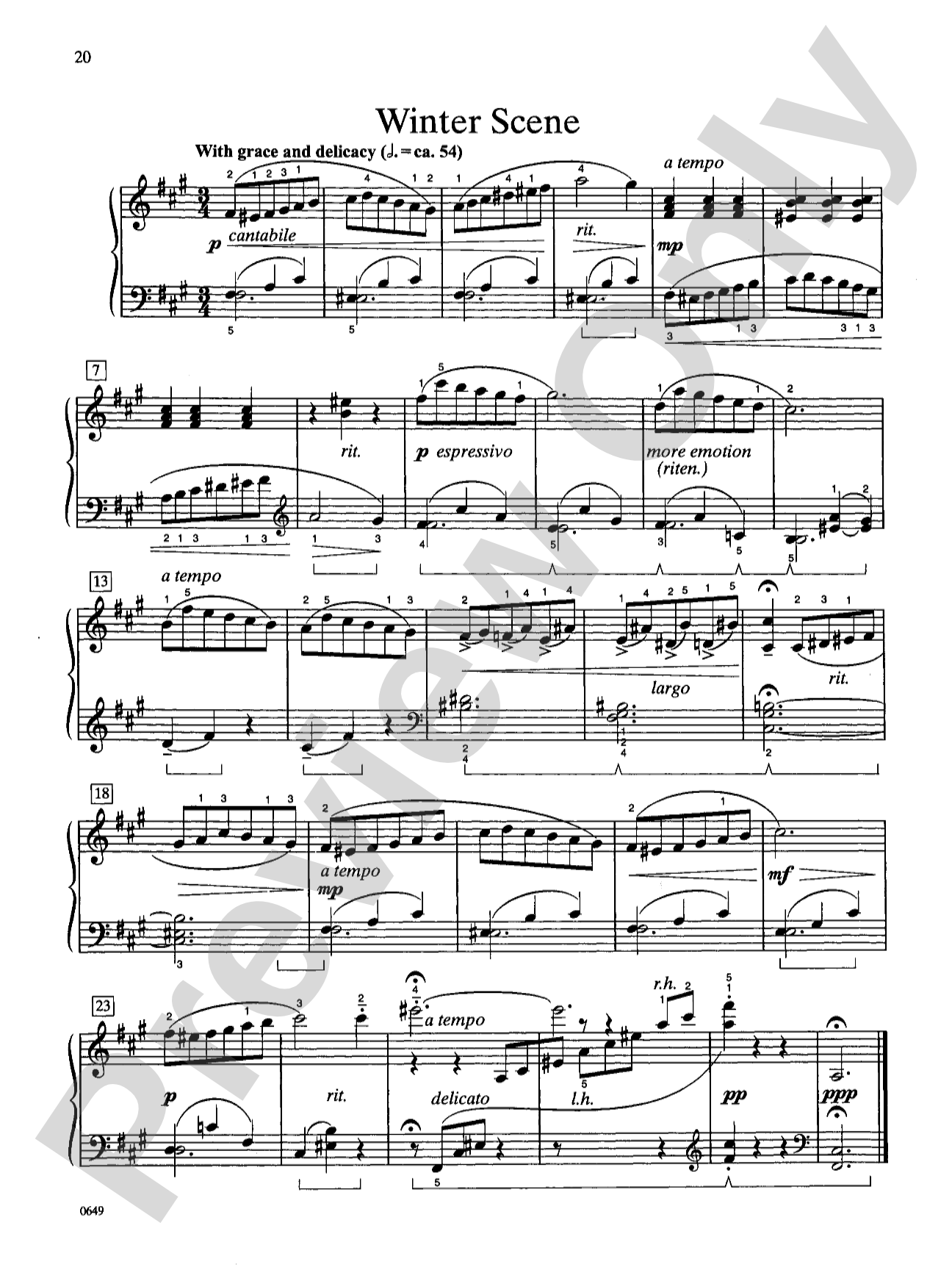

Winter Scene - Piano Solo: Piano Solo
24 Short Piano Pieces in All Keys
By William L. Gillock
Level: Intermediate / Late Intermediate
Item: 00-PS-0017397
$4.99
Pickup currently not available
Related Items
Legend - Piano Solo: Piano Solo |
$4.99
|
View | |
Soaring - Piano Solo: Piano Solo |
$4.99
|
View | |
Seascape - Piano Solo: Piano Solo |
$4.99
|
View | |
Serenade - Piano Solo: Piano Solo |
$4.99
|
View | |
Interlude - Piano Solo: Piano Solo |
$4.99
|
View | |
Dragon Fly - Piano Solo: Piano Solo |
$4.99
|
View | |
Night Song - Piano Solo: Piano Solo |
$4.99
|
View | |
Humming Bird - Piano Solo: Piano Solo |
$4.99
|
View | |
Summer Storm - Piano Solo: Piano Solo |
$4.99
|
View | |
A Witch's Cat - Piano Solo: Piano Solo |
$4.99
|
View | |
Autumn Sketch - Piano Solo: Piano Solo |
$4.99
|
View | |
Night Journey - Piano Solo: Piano Solo |
$4.99
|
View | |
Phantom Rider - Piano Solo: Piano Solo |
$4.99
|
View | |
A Faded Letter - Piano Solo: Piano Solo |
$4.99
|
View | |
Forest Murmurs - Piano Solo: Piano Solo |
$4.99
|
View | |
Moonlight Mood - Piano Solo: Piano Solo |
$4.99
|
View | |
October Morning - Piano Solo: Piano Solo |
$4.99
|
View | |
The Silent Snow - Piano Solo: Piano Solo |
$4.99
|
View | |
An Old Valentine - Piano Solo: Piano Solo |
$4.99
|
View | |
Fountain of Diana - Piano Solo: Piano Solo |
$4.99
|
View | |
Deserted Ball Room - Piano Solo: Piano Solo |
$4.99
|
View | |
Song of the Mermaid - Piano Solo: Piano Solo |
$4.99
|
View | |
Procession of the Mandarin - Piano Solo: Piano Solo |
$8.99
|
View | |
Lyric Preludes in Romantic Style: Piano Book & Online Audio |
$10.99
|
View | |
Lyric Preludes in Romantic Style: Piano Book |
$8.99
|
View |
Description
Lyric Preludes is an introduction to the whole Romantic period -- from Chopin and Schumann to Brahms and Debussy. Like Chopin, Gillock has written 24 preludes featuring all major and minor keys. But his preludes aren't just imitations of other composer's styles, they are valid, original works. An essential book for all pianists. A Federation Festivals 2024-2028 selection.


Discover MakeMusic Cloud: thousands of interactive titles your students can play along with today.
Sample Audio
No sample audio found.
Sample Video
No sample videos found.
Additional Details
Publisher:
Alfred Music
Page Count:
32
SKU:
00-PS-0017397
More about this title
About the Composer: William L. Gillock
William L. Gillock (1917-2002) was an American composer and pedagogue whose gift for writing musically substantive yet accessible works made him a cornerstone of mid-twentieth-century piano education. His output spans hundreds of compositions, but he is best known for bridging the gap between classical forms and contemporary teaching needs, creating pieces that challenge without alienating developing musicians.
Gillock's approach to pedagogy was rooted in the belief that students should encounter genuine musical ideas at every level. His Lyric Preludes represent this philosophy in full: a systematic exploration of tonality that honors the great European tradition while asserting his own compositional voice. Teachers and festival committees have long recognized his work as both educationally sound and artistically legitimate.
Why we love this
Gillock's decision to write 24 preludes across all keys is not mere homage to Chopin; it's a genuine engagement with tonal organization that serves real pedagogical purposes. Each prelude stands on its own merits, avoiding the thin-sounding imitation that plagues so much "romantic-style" student music. Festival selectors recognized this durability when they added Lyric Preludes to the 2024-2028 Federation Festivals list.
What to expect
Winter Scene captures the introspective, atmospheric quality that defines Gillock's approach to romantic character. The piece unfolds with the quiet contemplation of a snowy landscape, building emotional depth through subtle harmonic shifts and a lyrical melody that avoids sentimentality. Its gentle architecture invites the pianist to inhabit a moment of stillness rather than display technical prowess.
Who it's for
Intermediate and late-intermediate pianists ready to explore how composers think through large-scale harmonic organization while maintaining melodic interest. This book works especially well for students preparing for festivals, auditions, or recitals who need repertoire that satisfies both musician and audience.
How to get the most out of it
- Study the character marking and opening melodic gesture before diving into technical details. Gillock's titles direct your interpretation; honor them as structural anchors, not mere decoration.
- Track the harmonic rhythm in each piece. Many of these preludes move through surprising tonal areas, and awareness of chord changes prevents performances from sounding rushed or harmonically adrift.
- Balance lyrical singing tone against the book's wide range of moods. Some pieces call for tenderness; others demand drama. Avoid a one-speed delivery across the collection.
- Listen to the recorded accompaniment if available, but shape your phrasing independently. Use it as a timing reference, not a rhythmic crutch.
How to use it
Winter Scene fits naturally into holiday concerts or winter-themed recitals without sounding greeting-card shallow. It pairs well with other Romantic miniatures in chamber or solo recital contexts, and its moderate technical demands make it a dependable choice for competition seasons when you need quality repertoire at this intermediate level.
Skills your students will build
- Sustaining a singing melody over independent harmonic accompaniment
- Voice leading across multiple registers without losing tonal clarity
- Navigating chromatic harmony within a tonal framework
- Interpreting romantic character markings and translating them into sound
- Building large musical forms from smaller motivic ideas