
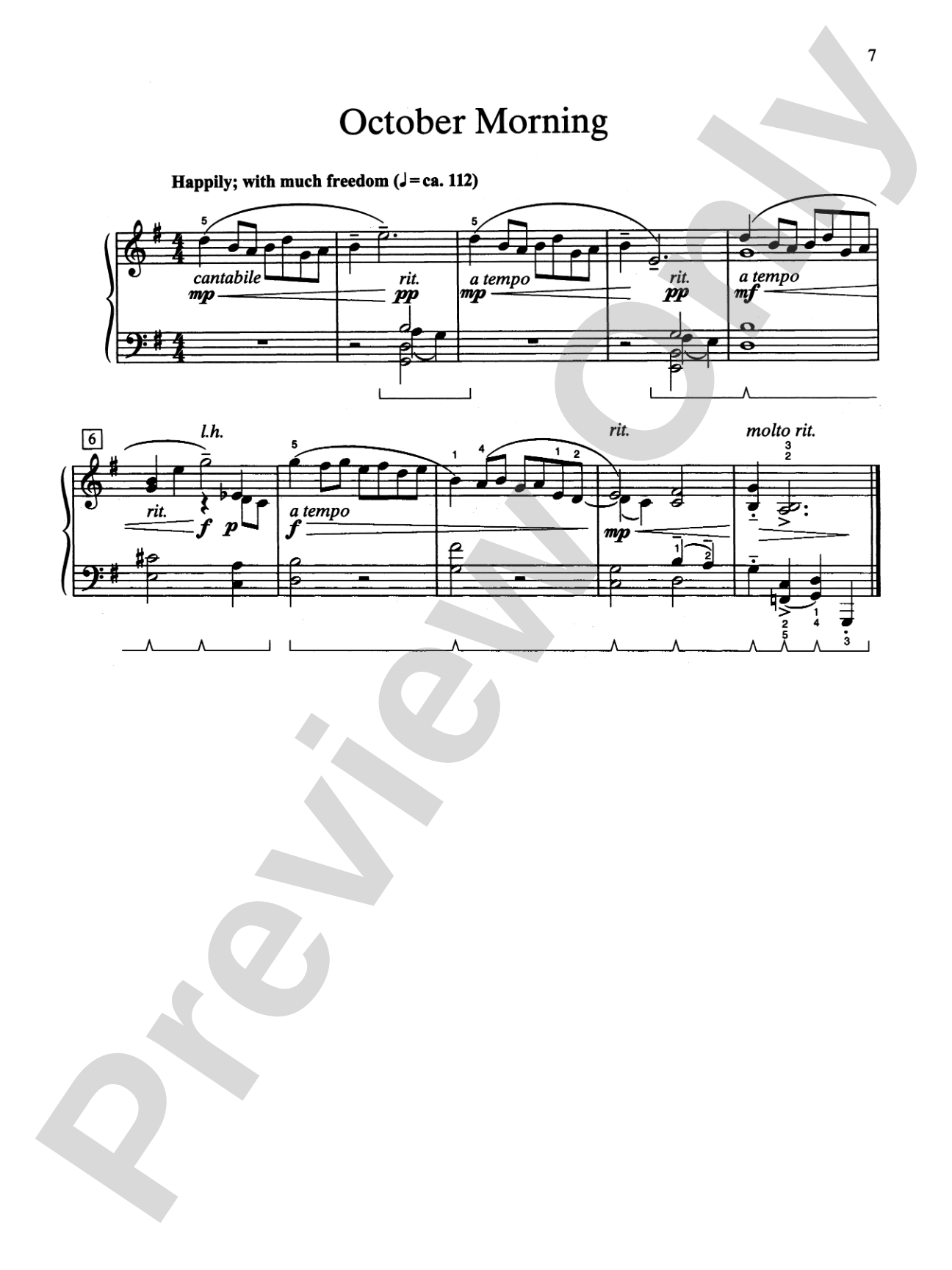

October Morning - Piano Solo: Piano Solo
24 Short Piano Pieces in All Keys
By William L. Gillock
Level: Intermediate / Late Intermediate
Item: 00-PS-0017405
$4.99
Pickup currently not available
Related Items
Legend - Piano Solo: Piano Solo |
$4.99
|
View | |
Soaring - Piano Solo: Piano Solo |
$4.99
|
View | |
Seascape - Piano Solo: Piano Solo |
$4.99
|
View | |
Serenade - Piano Solo: Piano Solo |
$4.99
|
View | |
Interlude - Piano Solo: Piano Solo |
$4.99
|
View | |
Dragon Fly - Piano Solo: Piano Solo |
$4.99
|
View | |
Night Song - Piano Solo: Piano Solo |
$4.99
|
View | |
Humming Bird - Piano Solo: Piano Solo |
$4.99
|
View | |
Summer Storm - Piano Solo: Piano Solo |
$4.99
|
View | |
Winter Scene - Piano Solo: Piano Solo |
$4.99
|
View | |
A Witch's Cat - Piano Solo: Piano Solo |
$4.99
|
View | |
Autumn Sketch - Piano Solo: Piano Solo |
$4.99
|
View | |
Night Journey - Piano Solo: Piano Solo |
$4.99
|
View | |
Phantom Rider - Piano Solo: Piano Solo |
$4.99
|
View | |
A Faded Letter - Piano Solo: Piano Solo |
$4.99
|
View | |
Forest Murmurs - Piano Solo: Piano Solo |
$4.99
|
View | |
Moonlight Mood - Piano Solo: Piano Solo |
$4.99
|
View | |
The Silent Snow - Piano Solo: Piano Solo |
$4.99
|
View | |
An Old Valentine - Piano Solo: Piano Solo |
$4.99
|
View | |
Fountain of Diana - Piano Solo: Piano Solo |
$4.99
|
View | |
Deserted Ball Room - Piano Solo: Piano Solo |
$4.99
|
View | |
Song of the Mermaid - Piano Solo: Piano Solo |
$4.99
|
View | |
Procession of the Mandarin - Piano Solo: Piano Solo |
$8.99
|
View | |
Lyric Preludes in Romantic Style: Piano Book & Online Audio |
$10.99
|
View | |
Lyric Preludes in Romantic Style: Piano Book |
$8.99
|
View |
Description
Lyric Preludes is an introduction to the whole Romantic period -- from Chopin and Schumann to Brahms and Debussy. Like Chopin, Gillock has written 24 preludes featuring all major and minor keys. But his preludes aren't just imitations of other composer's styles, they are valid, original works. An essential book for all pianists. A Federation Festivals 2024-2028 selection.


October Morning - Piano Solo: Piano Solo isn't in MakeMusic Cloud just yet...but it could be. Let us know you'd like to see it, and you'll help shape what comes next. In the meantime, start a free trial and dive into thousands of interactive titles your students can play along with today.
Request This Title
Tell us you want it.
Start Your Free Trial
Explore everything that's ready to play right now.
Sample Audio
No sample audio found.
Sample Video
No sample videos found.
Additional Details
Publisher:
Alfred Music
Page Count:
32
SKU:
00-PS-0017405
More about this title
About the Composer: William L. Gillock
William L. Gillock (1917, 2002) was an American composer and pedagogue who understood what intermediate pianists needed: music that sounded mature without demanding virtuosic chops. His compositions appear on virtually every festival syllabus and in countless studio libraries because they balance technical accessibility with genuine artistic substance. Gillock had a gift for writing memorable melodies and idiomatic keyboard writing that feels natural under the fingers.
His Lyric Preludes collection stands as one of his most enduring contributions to piano literature. By tackling all 24 major and minor keys in a single book, Gillock created a resource that teaches harmonic and tonal literacy while honoring the prelude tradition of Chopin and others. His preludes remain relevant in 21st-century studios and classrooms because they work: students engage with them, audiences enjoy hearing them, and teachers recognize their pedagogical value.
Why we love this
October Morning shows Gillock at his most lyrical, delivering the kind of piece that makes intermediate students feel like real musicians. The writing is unpretentious but never simple, with enough harmonic color and textural variety to sustain attention across a full recital. It's exactly the repertoire that fills the gap between early intermediate etudes and the demands of advanced sonatas.
What to expect
Quietly introspective, with the gentle melancholy of early autumn light. The harmonic language feels warm and familiar without being predictable, unfolding naturally across the keyboard like thoughts drifting through an unhurried morning.
Who it's for
Intermediate to late-intermediate pianists building a working repertoire of Romantic character pieces. Teachers seeking music for studio recitals, student competitions (the collection's Federation Festival selection confirms its appropriateness), and exploratory listening projects. Students ready to move beyond simplified arrangements but still developing independence in both hands.
How to get the most out of it
- Shape the opening melody as a genuine song line; imagine a vocalist breathing at phrase endings and let that guide your phrasing.
- Explore the tension between the harmonic movement and the lyrical surface. Slight rubato can enhance the Romantic character without disrupting the underlying pulse.
- Balance accompaniment textures so they support rather than overshadow the cantabile line. The piece rewards transparent voicing.
How to use it
Pair it with other pieces from the Lyric Preludes collection to build a thematic recital exploring 19th-century prelude traditions. It also works beautifully in a mixed program of Romantic miniatures, offering a moment of reflection between more extroverted works. As a supplementary repertoire choice, it fits naturally into curriculum that touches on Chopin, Schumann, and Brahms.
Skills your students will build
- Harmonic analysis of Romantic-era tonality (functional harmony with chromatic inflections)
- Lyrical melody shaping and phrase architecture
- Texture and voicing independence between hands
- Sustaining musical interest across a form built on contrast rather than development
- Pedal control for atmosphere and harmonic resonance