
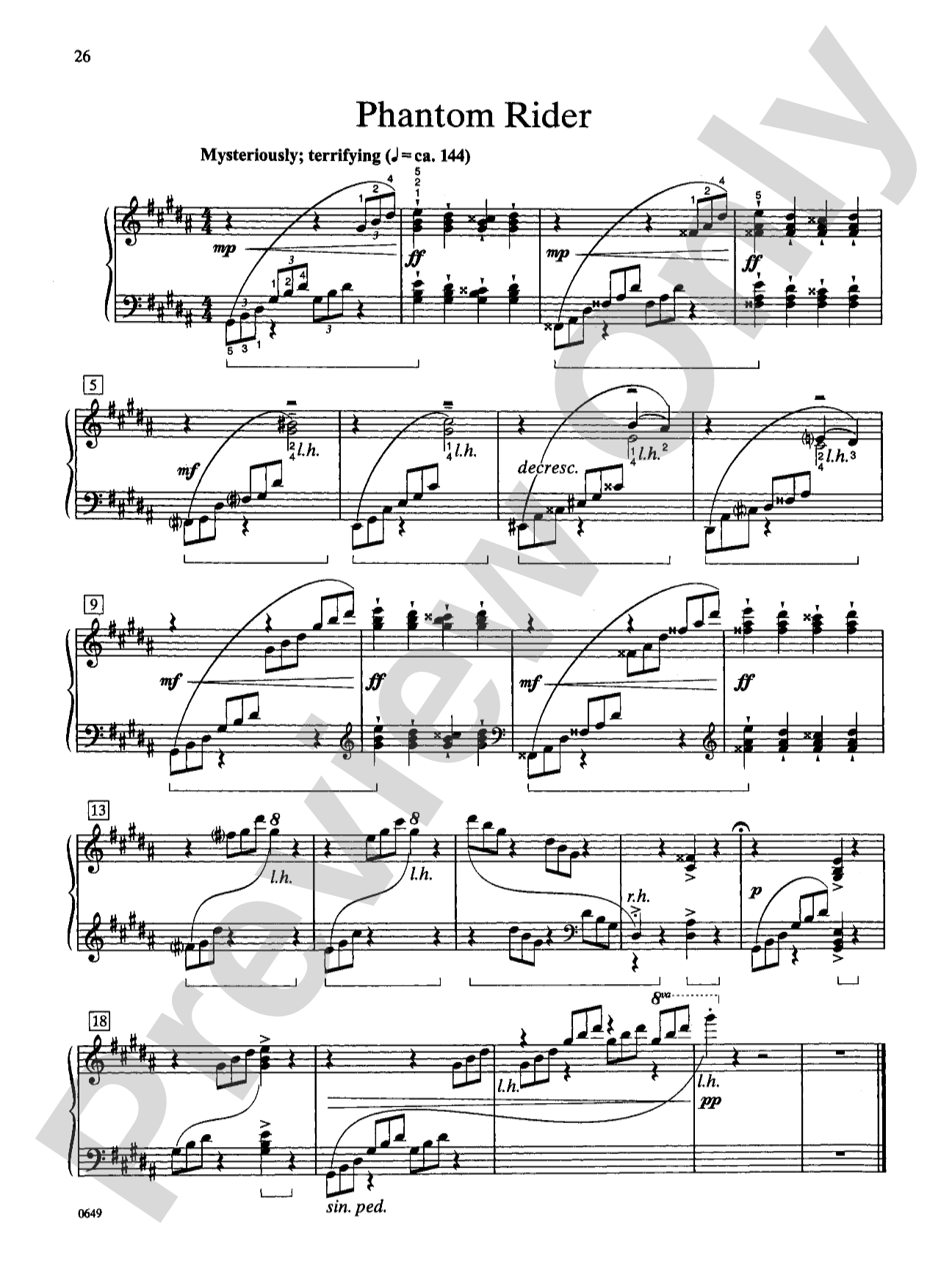

Phantom Rider - Piano Solo: Piano Solo
24 Short Piano Pieces in All Keys
By William L. Gillock
Level: Intermediate / Late Intermediate
Item: 00-PS-0017401
$4.99
Pickup currently not available
Related Items
Legend - Piano Solo: Piano Solo |
$4.99
|
View | |
Soaring - Piano Solo: Piano Solo |
$4.99
|
View | |
Seascape - Piano Solo: Piano Solo |
$4.99
|
View | |
Serenade - Piano Solo: Piano Solo |
$4.99
|
View | |
Interlude - Piano Solo: Piano Solo |
$4.99
|
View | |
Dragon Fly - Piano Solo: Piano Solo |
$4.99
|
View | |
Night Song - Piano Solo: Piano Solo |
$4.99
|
View | |
Humming Bird - Piano Solo: Piano Solo |
$4.99
|
View | |
Summer Storm - Piano Solo: Piano Solo |
$4.99
|
View | |
Winter Scene - Piano Solo: Piano Solo |
$4.99
|
View | |
A Witch's Cat - Piano Solo: Piano Solo |
$4.99
|
View | |
Autumn Sketch - Piano Solo: Piano Solo |
$4.99
|
View | |
Night Journey - Piano Solo: Piano Solo |
$4.99
|
View | |
A Faded Letter - Piano Solo: Piano Solo |
$4.99
|
View | |
Forest Murmurs - Piano Solo: Piano Solo |
$4.99
|
View | |
Moonlight Mood - Piano Solo: Piano Solo |
$4.99
|
View | |
October Morning - Piano Solo: Piano Solo |
$4.99
|
View | |
The Silent Snow - Piano Solo: Piano Solo |
$4.99
|
View | |
An Old Valentine - Piano Solo: Piano Solo |
$4.99
|
View | |
Fountain of Diana - Piano Solo: Piano Solo |
$4.99
|
View | |
Deserted Ball Room - Piano Solo: Piano Solo |
$4.99
|
View | |
Song of the Mermaid - Piano Solo: Piano Solo |
$4.99
|
View | |
Procession of the Mandarin - Piano Solo: Piano Solo |
$8.99
|
View | |
Lyric Preludes in Romantic Style: Piano Book & Online Audio |
$10.99
|
View | |
Lyric Preludes in Romantic Style: Piano Book |
$8.99
|
View |
Description
Lyric Preludes is an introduction to the whole Romantic period -- from Chopin and Schumann to Brahms and Debussy. Like Chopin, Gillock has written 24 preludes featuring all major and minor keys. But his preludes aren't just imitations of other composer's styles, they are valid, original works. An essential book for all pianists. A Federation Festivals 2024-2028 selection.


Discover MakeMusic Cloud: thousands of interactive titles your students can play along with today.
Sample Audio
No sample audio found.
Sample Video
No sample videos found.
Additional Details
Publisher:
Alfred Music
Page Count:
32
SKU:
00-PS-0017401
More about this title
About the Composer: William L. Gillock
William L. Gillock (1917-2002) was an American composer and pedagogue who understood what intermediate pianists needed: music that sounded sophisticated without demanding virtuosity. He spent decades writing accessible yet musically substantial works, building a catalog that bridges the gap between method books and concert repertoire. His prolific output for young pianists earned him a central place in American music education, and his pieces remain standards in studio teaching and festival competitions.
Gillock's genius lay in respecting both the student and the tradition. Rather than simplify the Romantic vocabulary, he wrote in its idioms authentically, giving students real musical problems to solve while keeping technical demands reasonable. His Lyric Preludes project demonstrates this philosophy perfectly: a systematic exploration of all keys in the tradition of Chopin, but filtered through Gillock's own voice and pedagogical sensibility.
Why we love this
Gillock's cycle gives your students legitimate Romantic repertoire without requiring them to sight-read hand spans they can't manage. The 24-prelude structure works beautifully for progressive study or for concert programming, and each piece is self-contained enough that pianists can cherry-pick favorites. That a full collection earned recognition as a Federation Festivals selection speaks to the quality; these aren't stepping-stone pieces, they're keepers.
What to expect
Lyric and introspective, with the harmonic richness of the Romantic period distilled into forms that feel intimate rather than grand. These are pieces that reward careful listening and thoughtful interpretation; they invite the pianist into the world of the Romantics without overwhelming them with technical fireworks.
Who it's for
Intermediate to late-intermediate pianists studying Romantic period literature, or students preparing for festival competitions and recitals who need repertoire that combines musical substance with reasonable technical demands. This collection also serves teachers seeking a systematic approach to key signatures and period style in a single book.
How to get the most out of it
- Resist the urge to rush the phrasing. These melodic lines need space to breathe; the lyric quality depends on restraint in tempo, especially in the opening statements.
- Explore the relationship between melody and accompaniment figures before locking in a tempo. Often the accompanimental pattern will suggest a natural pulse that supports the vocal quality of the top line.
- Pay close attention to the harmonic rhythm. Gillock uses rubato and harmonic language that can feel modern; letting those shifts land clearly prevents the piece from sounding muddy.
- Record yourself and listen back for balance. The Romantic textures can easily bury the melody if the student hasn't developed independent hand control.
How to use it
String multiple preludes together from different keys for a thematic recital exploring Romantic period writing, or feature individual pieces alongside larger Romantic works to show students the continuum from miniature to extended form. The Federation Festivals recognition makes these natural choices for competition seasons, and the 24-prelude structure allows you to assign one per week as a semester-long study project.
Skills your students will build
- Navigating all major and minor keys with fluency and historical context
- Pedal control and harmonic listening (Romantic textures require clarity despite thickness)
- Phrasing and rubato in the Romantic idiom
- Balancing melody with accompaniment in mid-range textures
- Interpreting period style without period instruments or extensive background reading