
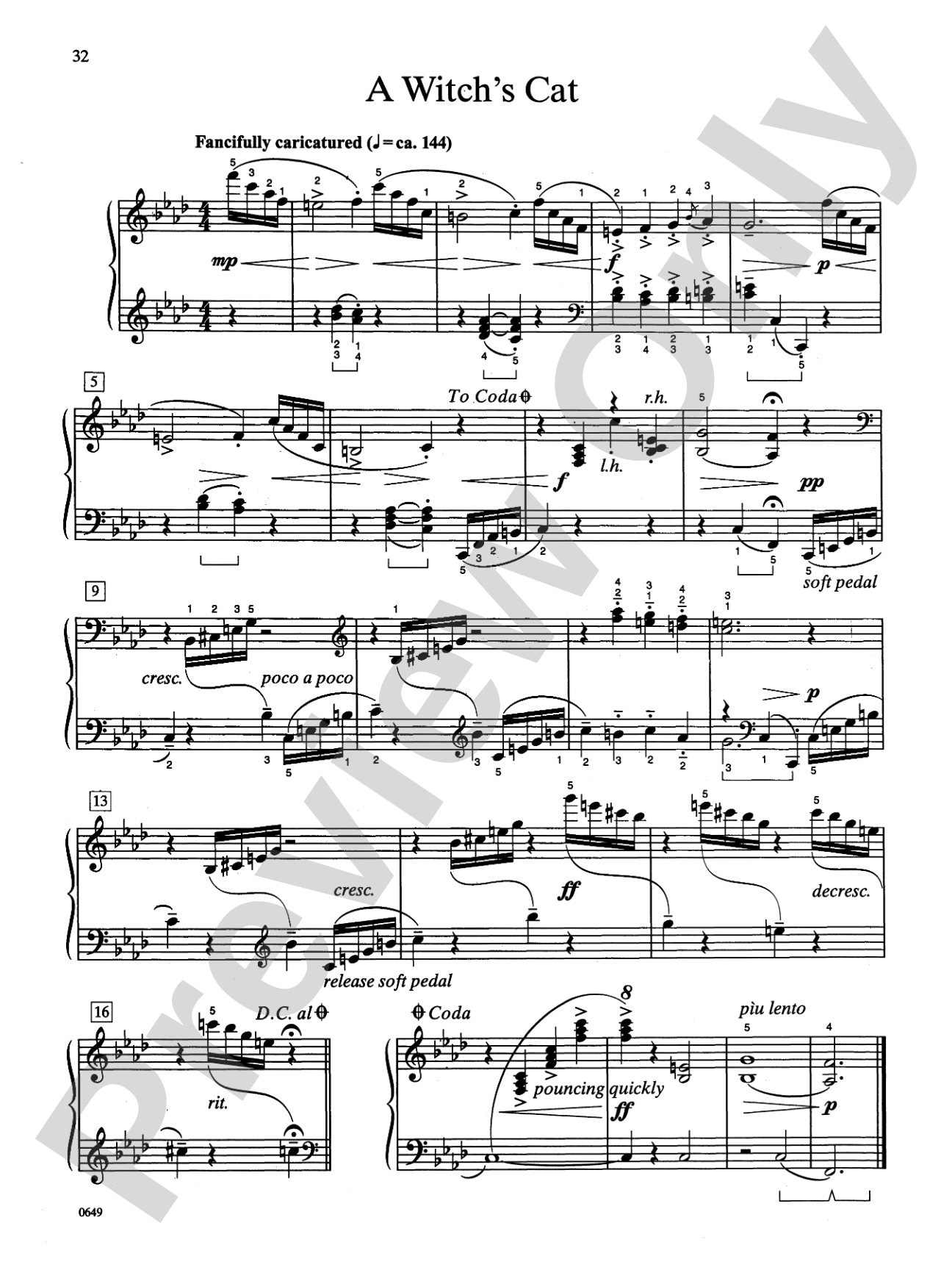

A Witch's Cat - Piano Solo: Piano Solo
24 Short Piano Pieces in All Keys
By William L. Gillock
Level: Intermediate / Late Intermediate
Item: 00-PS-0017398
$4.99
Pickup currently not available
Related Items
Legend - Piano Solo: Piano Solo |
$4.99
|
View | |
Soaring - Piano Solo: Piano Solo |
$4.99
|
View | |
Seascape - Piano Solo: Piano Solo |
$4.99
|
View | |
Serenade - Piano Solo: Piano Solo |
$4.99
|
View | |
Interlude - Piano Solo: Piano Solo |
$4.99
|
View | |
Dragon Fly - Piano Solo: Piano Solo |
$4.99
|
View | |
Night Song - Piano Solo: Piano Solo |
$4.99
|
View | |
Humming Bird - Piano Solo: Piano Solo |
$4.99
|
View | |
Summer Storm - Piano Solo: Piano Solo |
$4.99
|
View | |
Winter Scene - Piano Solo: Piano Solo |
$4.99
|
View | |
Autumn Sketch - Piano Solo: Piano Solo |
$4.99
|
View | |
Night Journey - Piano Solo: Piano Solo |
$4.99
|
View | |
Phantom Rider - Piano Solo: Piano Solo |
$4.99
|
View | |
A Faded Letter - Piano Solo: Piano Solo |
$4.99
|
View | |
Forest Murmurs - Piano Solo: Piano Solo |
$4.99
|
View | |
Moonlight Mood - Piano Solo: Piano Solo |
$4.99
|
View | |
October Morning - Piano Solo: Piano Solo |
$4.99
|
View | |
The Silent Snow - Piano Solo: Piano Solo |
$4.99
|
View | |
An Old Valentine - Piano Solo: Piano Solo |
$4.99
|
View | |
Fountain of Diana - Piano Solo: Piano Solo |
$4.99
|
View | |
Deserted Ball Room - Piano Solo: Piano Solo |
$4.99
|
View | |
Song of the Mermaid - Piano Solo: Piano Solo |
$4.99
|
View | |
Procession of the Mandarin - Piano Solo: Piano Solo |
$8.99
|
View | |
Lyric Preludes in Romantic Style: Piano Book & Online Audio |
$10.99
|
View | |
Lyric Preludes in Romantic Style: Piano Book |
$8.99
|
View |
Description
Lyric Preludes is an introduction to the whole Romantic period -- from Chopin and Schumann to Brahms and Debussy. Like Chopin, Gillock has written 24 preludes featuring all major and minor keys. But his preludes aren't just imitations of other composer's styles, they are valid, original works. An essential book for all pianists. A Federation Festivals 2024-2028 selection.


Discover MakeMusic Cloud: thousands of interactive titles your students can play along with today.
Sample Audio
No sample audio found.
Sample Video
No sample videos found.
Additional Details
Publisher:
Alfred Music
Page Count:
32
SKU:
00-PS-0017398
More about this title
About the Composer: William L. Gillock
William L. Gillock was an American composer and pedagogue who became one of the most performed contemporary classical composers in music education. His output spans thousands of compositions across multiple genres, but he is best known for creating works that bridge the gap between classical rigor and accessibility, making sophisticated musical ideas available to developing musicians without compromising artistic integrity.
Gillock's approach to composition reflects deep understanding of how students learn. Rather than simplify masterworks, he writes original pieces that introduce genuine musical concepts through carefully crafted technical and harmonic challenges. His Lyric Preludes stand as a cornerstone of intermediate piano pedagogy precisely because they honor both the student's stage of development and the composer's artistic voice.
Why we love this
Gillock's cycle of 24 preludes succeeds where many collections fail: each piece is substantial enough to feel like real music, not a stepping stone. Students encounter genuine Romantic harmony and texture while building facility across all keys. The writing avoids twee sentimentality; instead, it offers emotional honesty that makes students want to play through the entire set.
What to expect
These pieces evoke intimate salon music: reflective, lyrical, sometimes tinged with melancholy. The harmonic language feels both familiar and slightly sophisticated, drawing you into the Romantic era's emotional directness. Each prelude occupies its own small world while collectively building a comprehensive musical journey.
Who it's for
Intermediate and late-intermediate pianists ready to explore key signatures systematically without losing musical engagement. This collection works equally well for students preparing for festivals and competitions, or for anyone building foundation in the Romantic vocabulary that anchors so much classical piano literature.
How to get the most out of it
- Listen carefully to how the melody sits against the accompaniment figure. Gillock frequently layers the primary theme atop a consistent rhythmic or harmonic pattern, so clarity comes from balancing transparency in the left hand with a singing right hand.
- Explore the pedal consciously rather than continuously. Gillock's harmonies often shift subtly, and lifting the pedal on those moments prevents harmonic fog and reveals the voice-leading underneath.
- Let rubato breathe naturally from the phrase shape rather than imposing it uniformly. The Romantic idiom Gillock invokes suggests flexibility, but his notation is precise enough that you'll feel where true flexibility belongs.
How to use it
Feature individual preludes as recital pieces across a season, or pair several consecutive preludes into a thematic program that showcases tonal contrast. The collection also works beautifully as a curriculum guide: teach one prelude every few weeks to anchor concurrent repertoire study and repertoire knowledge in a methodical way.
Skills your students will build
- Harmonic function across major and minor tonalities
- Pedal control and voice clarity in Romantic textures
- Singing tone production while managing accompanying figures
- Key modulation and harmonic color
- Musical phrasing and rubato in Romantic style
- Sight-reading fluency through systematic key exposure