
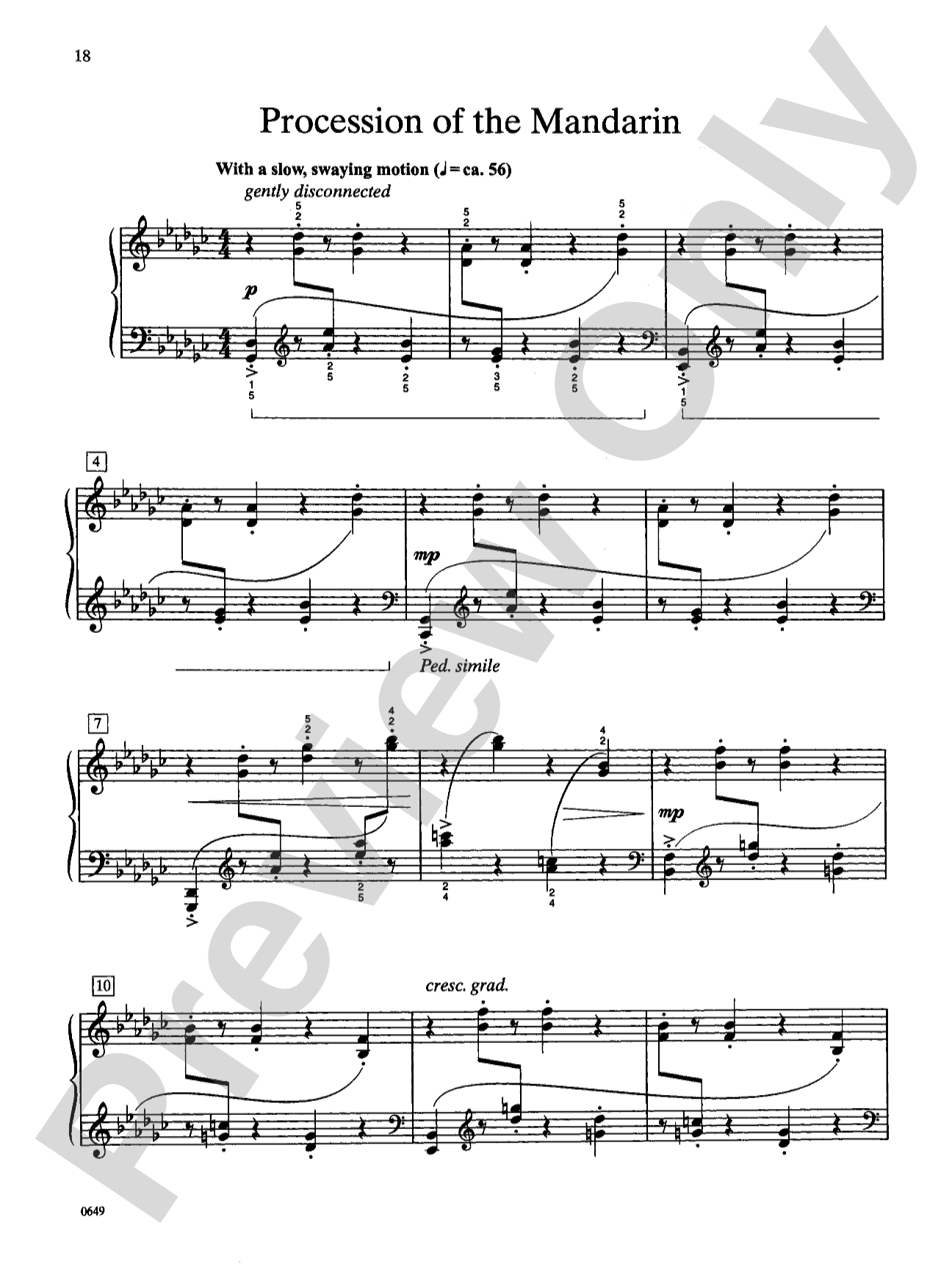

Procession of the Mandarin - Piano Solo: Piano Solo
24 Short Piano Pieces in All Keys
By William L. Gillock
Level: Intermediate / Late Intermediate
Item: 00-PS-0017415
$8.99
Pickup currently not available
Related Items
Legend - Piano Solo: Piano Solo |
$4.99
|
View | |
Soaring - Piano Solo: Piano Solo |
$4.99
|
View | |
Seascape - Piano Solo: Piano Solo |
$4.99
|
View | |
Serenade - Piano Solo: Piano Solo |
$4.99
|
View | |
Interlude - Piano Solo: Piano Solo |
$4.99
|
View | |
Dragon Fly - Piano Solo: Piano Solo |
$4.99
|
View | |
Night Song - Piano Solo: Piano Solo |
$4.99
|
View | |
Humming Bird - Piano Solo: Piano Solo |
$4.99
|
View | |
Summer Storm - Piano Solo: Piano Solo |
$4.99
|
View | |
Winter Scene - Piano Solo: Piano Solo |
$4.99
|
View | |
A Witch's Cat - Piano Solo: Piano Solo |
$4.99
|
View | |
Autumn Sketch - Piano Solo: Piano Solo |
$4.99
|
View | |
Night Journey - Piano Solo: Piano Solo |
$4.99
|
View | |
Phantom Rider - Piano Solo: Piano Solo |
$4.99
|
View | |
A Faded Letter - Piano Solo: Piano Solo |
$4.99
|
View | |
Forest Murmurs - Piano Solo: Piano Solo |
$4.99
|
View | |
Moonlight Mood - Piano Solo: Piano Solo |
$4.99
|
View | |
October Morning - Piano Solo: Piano Solo |
$4.99
|
View | |
The Silent Snow - Piano Solo: Piano Solo |
$4.99
|
View | |
An Old Valentine - Piano Solo: Piano Solo |
$4.99
|
View | |
Fountain of Diana - Piano Solo: Piano Solo |
$4.99
|
View | |
Deserted Ball Room - Piano Solo: Piano Solo |
$4.99
|
View | |
Song of the Mermaid - Piano Solo: Piano Solo |
$4.99
|
View | |
Lyric Preludes in Romantic Style: Piano Book & Online Audio |
$10.99
|
View | |
Lyric Preludes in Romantic Style: Piano Book |
$8.99
|
View |
Description
Lyric Preludes is an introduction to the whole Romantic period -- from Chopin and Schumann to Brahms and Debussy. Like Chopin, Gillock has written 24 preludes featuring all major and minor keys. But his preludes aren't just imitations of other composer's styles, they are valid, original works. An essential book for all pianists. A Federation Festivals 2024-2028 selection.


Discover MakeMusic Cloud: thousands of interactive titles your students can play along with today.
Sample Audio
No sample audio found.
Sample Video
No sample videos found.
Additional Details
Publisher:
Alfred Music
Page Count:
32
SKU:
00-PS-0017415
More about this title
About the Composer: William L. Gillock
William L. Gillock (1917, 2002) shaped American piano pedagogy through his gift for writing accessible yet musically sophisticated works. His understanding of what intermediate pianists could achieve, and what would genuinely engage them, made him a trusted voice in studios and classrooms across generations.
Gillock's approach to the prelude form demonstrates his philosophical commitment to composition as teaching. Rather than settling for pale imitations of established masters, he created works that honor Romantic idioms while maintaining his own voice, proving that pedagogical music need not compromise artistic integrity.
Why we love this
Gillock's cycle mirrors the ambition of Chopin's op. 28 without asking students to navigate the technical firestorm those pieces demand. Each prelude functions as a complete artistic statement, some lyrical, others rhythmically vibrant, giving students genuine repertoire they'll actually want to perform rather than studies they must endure. The Federation Festivals selection validates what teachers have known for decades: these pieces earn their place in any pianist's development.
What to expect
A curated journey through Romantic sensibility: some pieces shimmer with Debussian impressionism, others pulse with Brahmsian warmth, and several capture the introspective lyricism Chopin perfected. The collection never feels didactic despite its systematic approach to keys; instead, each prelude opens a different emotional landscape.
Who it's for
Intermediate and late intermediate pianists ready to engage with Romantic idioms and harmonic language beyond simplified versions. Teachers seeking a complete cycle that covers all keys without resorting to exercise books or historically distant models.
How to get the most out of it
- Listen to how each key signature behaves musically across the collection; Gillock's harmonic language shifts subtly between pieces, so resist playing them as if they're interchangeable etudes
- Treat the title piece as an orchestral reduction rather than pure keyboard writing, Gillock often implies instrumental colors and dynamic waves that benefit from slight pedal voicing and voicing clarity
- Explore the recorded accompaniments if available; they reveal the harmonic and textural intentions Gillock embedded in the solo line, especially in pieces with sparse notation
How to use it
Feature individual preludes in student recitals alongside standard Romantic repertoire, or pair them with corresponding works from the historical composers they reference. The complete cycle works beautifully as a piano solo concert program in itself, or select 5, 7 pieces as a thematic showcase of Romantic piano writing.
Skills your students will build
- Pedal control across varying harmonic densities
- Romantic-era rubato and phrasing conventions
- Voice leading and harmonic analysis across all major and minor keys
- Character interpretation and stylistic awareness
- Sight-reading fluency in extended tonal contexts