
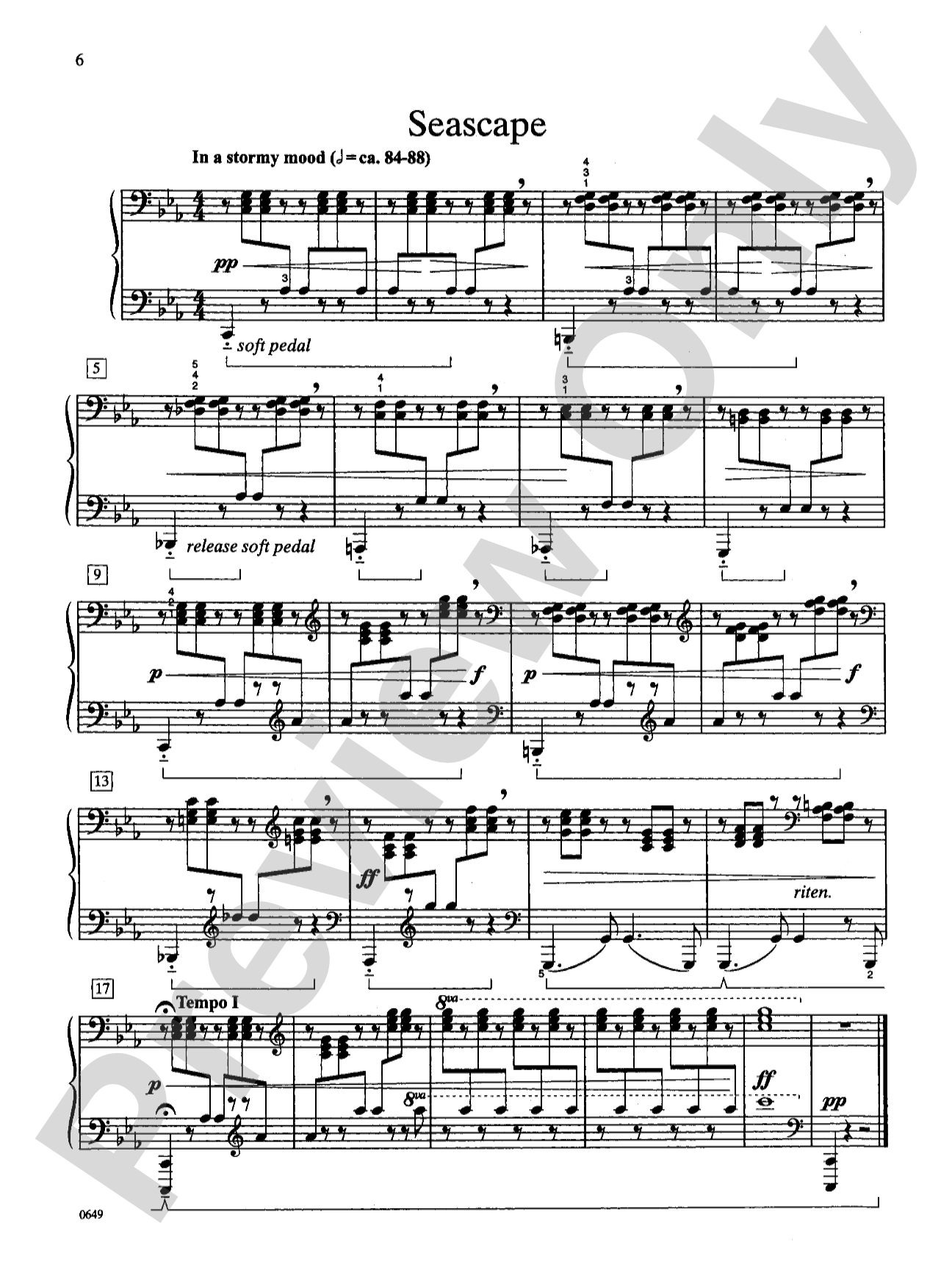

Seascape - Piano Solo: Piano Solo
24 Short Piano Pieces in All Keys
By William L. Gillock
Level: Intermediate / Late Intermediate
Item: 00-PS-0017390
$4.99
Pickup currently not available
Related Items
Legend - Piano Solo: Piano Solo |
$4.99
|
View | |
Soaring - Piano Solo: Piano Solo |
$4.99
|
View | |
Serenade - Piano Solo: Piano Solo |
$4.99
|
View | |
Interlude - Piano Solo: Piano Solo |
$4.99
|
View | |
Dragon Fly - Piano Solo: Piano Solo |
$4.99
|
View | |
Night Song - Piano Solo: Piano Solo |
$4.99
|
View | |
Humming Bird - Piano Solo: Piano Solo |
$4.99
|
View | |
Summer Storm - Piano Solo: Piano Solo |
$4.99
|
View | |
Winter Scene - Piano Solo: Piano Solo |
$4.99
|
View | |
A Witch's Cat - Piano Solo: Piano Solo |
$4.99
|
View | |
Autumn Sketch - Piano Solo: Piano Solo |
$4.99
|
View | |
Night Journey - Piano Solo: Piano Solo |
$4.99
|
View | |
Phantom Rider - Piano Solo: Piano Solo |
$4.99
|
View | |
A Faded Letter - Piano Solo: Piano Solo |
$4.99
|
View | |
Forest Murmurs - Piano Solo: Piano Solo |
$4.99
|
View | |
Moonlight Mood - Piano Solo: Piano Solo |
$4.99
|
View | |
October Morning - Piano Solo: Piano Solo |
$4.99
|
View | |
The Silent Snow - Piano Solo: Piano Solo |
$4.99
|
View | |
An Old Valentine - Piano Solo: Piano Solo |
$4.99
|
View | |
Fountain of Diana - Piano Solo: Piano Solo |
$4.99
|
View | |
Deserted Ball Room - Piano Solo: Piano Solo |
$4.99
|
View | |
Song of the Mermaid - Piano Solo: Piano Solo |
$4.99
|
View | |
Procession of the Mandarin - Piano Solo: Piano Solo |
$8.99
|
View | |
Lyric Preludes in Romantic Style: Piano Book & Online Audio |
$10.99
|
View | |
Lyric Preludes in Romantic Style: Piano Book |
$8.99
|
View |
Description
Lyric Preludes is an introduction to the whole Romantic period -- from Chopin and Schumann to Brahms and Debussy. Like Chopin, Gillock has written 24 preludes featuring all major and minor keys. But his preludes aren't just imitations of other composer's styles, they are valid, original works. An essential book for all pianists. A Federation Festivals 2024-2028 selection.


Discover MakeMusic Cloud: thousands of interactive titles your students can play along with today.
Sample Audio
No sample audio found.
Sample Video
No sample videos found.
Additional Details
Publisher:
Alfred Music
Page Count:
32
SKU:
00-PS-0017390
More about this title
About the Composer: William L. Gillock
William L. Gillock (1917, 2002) was an American composer and pedagogue who shaped twentieth-century piano education through works that honored classical forms while speaking directly to intermediate students. His output spans thousands of compositions, from teaching pieces to concert works, all distinguished by their clarity, musicality, and respect for the player's developing technique.
Gillock's genius lay in understanding what pianists at each level were ready to accomplish. He never condescended to younger players, instead offering them authentic musical experiences scaled to their hands and minds. His harmonic language draws from Impressionism and Romanticism, giving students a genuine entry point into the music of Chopin, Debussy, and their contemporaries.
Why we love this
Gillock set out to do what Chopin did: write 24 preludes spanning all keys, each one a self-contained musical statement. What distinguishes this collection is that Gillock doesn't mimic historical style but instead channels Romantic language through his own voice. Students get the harmonic sophistication and formal clarity of the period without entering a museum; they're playing contemporary music that happens to be rooted in a great tradition.
What to expect
Intimate, introspective, and occasionally luminous. These pieces breathe with the restraint and lyricism of the Romantic salon, finding drama in small gestures, a shift of harmony, a change in register, a moment of quiet reflection. The writing feels inevitable, never rushed.
Who it's for
Late intermediate pianists ready to explore Romantic harmony and form without the technical demands of the major works. Students preparing for competitions or festivals benefit from the variety of keys and moods; music teachers value this collection as a bridge between early intermediate exercises and concert-level repertoire.
How to get the most out of it
- Pay close attention to the pedal markings. Gillock writes them deliberately to shape color and resonance, not as ornament. Experiment with timing the releases to match harmonic changes rather than holding through automatic rhythm.
- Listen for the underlying voice leading beneath melody and accompaniment. These preludes often hide a middle voice or counter-melody that emerges only when you shape phrasing as a three-part conversation rather than a tune-plus-harmony.
- Treat each prelude as a study in a specific pianistic gesture or texture. One might emphasize legato scalar movement, another staccato broken chords. Identifying what each prelude teaches rhythmically and technically helps you find the character Gillock intended.
How to use it
Feature individual preludes in student recitals across the year, choosing keys and characters that contrast with other works on the program. The collection's breadth makes it ideal for exploring a single prelude each month in studio teaching, building familiarity with all 24 keys without overwhelming the practice schedule. Its recognition as a Federation Festivals selection also makes it a natural choice for students preparing competitive festival repertoire.
Skills your students will build
- Pedal technique and timing, particularly sustaining harmonically complex passages
- Voice leading across all registers, distinguishing melody, counter-melody, and accompaniment
- Harmonic analysis in the Romantic tradition, recognizing chromatic movement and secondary dominants
- Stylistic interpretation within a unified compositional language
- Facility in all major and minor keys at intermediate tempo