
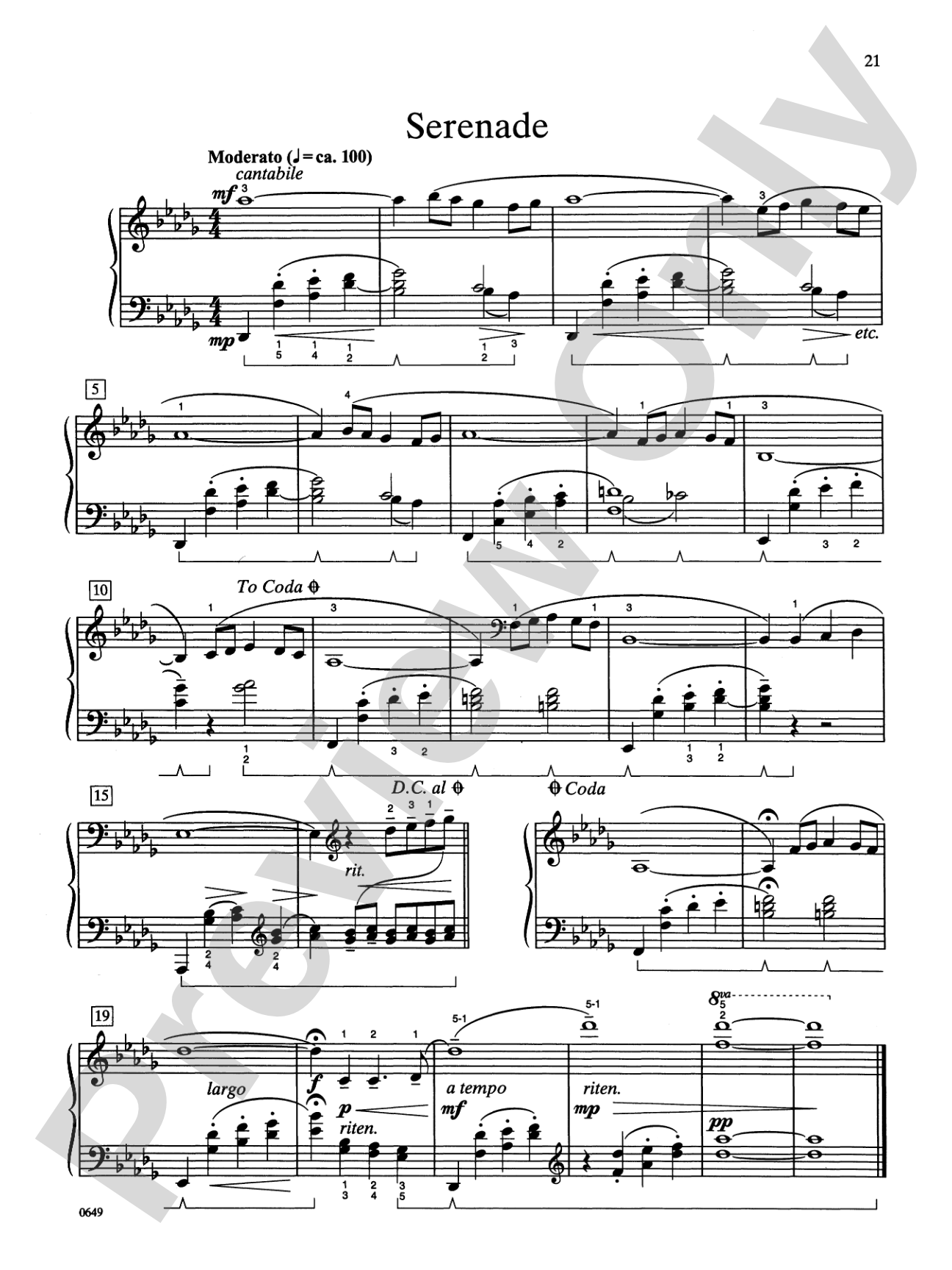

Serenade - Piano Solo: Piano Solo
24 Short Piano Pieces in All Keys
By William L. Gillock
Level: Intermediate / Late Intermediate
Item: 00-PS-0017391
$4.99
Pickup currently not available
Related Items
Legend - Piano Solo: Piano Solo |
$4.99
|
View | |
Soaring - Piano Solo: Piano Solo |
$4.99
|
View | |
Seascape - Piano Solo: Piano Solo |
$4.99
|
View | |
Interlude - Piano Solo: Piano Solo |
$4.99
|
View | |
Dragon Fly - Piano Solo: Piano Solo |
$4.99
|
View | |
Night Song - Piano Solo: Piano Solo |
$4.99
|
View | |
Humming Bird - Piano Solo: Piano Solo |
$4.99
|
View | |
Summer Storm - Piano Solo: Piano Solo |
$4.99
|
View | |
Winter Scene - Piano Solo: Piano Solo |
$4.99
|
View | |
A Witch's Cat - Piano Solo: Piano Solo |
$4.99
|
View | |
Autumn Sketch - Piano Solo: Piano Solo |
$4.99
|
View | |
Night Journey - Piano Solo: Piano Solo |
$4.99
|
View | |
Phantom Rider - Piano Solo: Piano Solo |
$4.99
|
View | |
A Faded Letter - Piano Solo: Piano Solo |
$4.99
|
View | |
Forest Murmurs - Piano Solo: Piano Solo |
$4.99
|
View | |
Moonlight Mood - Piano Solo: Piano Solo |
$4.99
|
View | |
October Morning - Piano Solo: Piano Solo |
$4.99
|
View | |
The Silent Snow - Piano Solo: Piano Solo |
$4.99
|
View | |
An Old Valentine - Piano Solo: Piano Solo |
$4.99
|
View | |
Fountain of Diana - Piano Solo: Piano Solo |
$4.99
|
View | |
Deserted Ball Room - Piano Solo: Piano Solo |
$4.99
|
View | |
Song of the Mermaid - Piano Solo: Piano Solo |
$4.99
|
View | |
Procession of the Mandarin - Piano Solo: Piano Solo |
$8.99
|
View | |
Lyric Preludes in Romantic Style: Piano Book & Online Audio |
$10.99
|
View | |
Lyric Preludes in Romantic Style: Piano Book |
$8.99
|
View |
Description
Lyric Preludes is an introduction to the whole Romantic period -- from Chopin and Schumann to Brahms and Debussy. Like Chopin, Gillock has written 24 preludes featuring all major and minor keys. But his preludes aren't just imitations of other composer's styles, they are valid, original works. An essential book for all pianists. A Federation Festivals 2024-2028 selection.


Discover MakeMusic Cloud: thousands of interactive titles your students can play along with today.
Sample Audio
No sample audio found.
Sample Video
No sample videos found.
Additional Details
Publisher:
Alfred Music
Page Count:
32
SKU:
00-PS-0017391
More about this title
About the Composer: William L. Gillock
William L. Gillock (1917, 2002) shaped American piano pedagogy for generations. A prolific composer and educator, he created thousands of works designed specifically for students, pieces that teach genuine musicianship while respecting young players' technical realities. His output spans classical forms and character pieces, all distinguished by clarity of voice and emotional directness.
Gillock understood that teaching pieces need not be simplified versions of "real" music. His compositions stand on their own merit, offering students access to authentic Romantic expression without unnecessary complexity. This philosophy made him one of the most performed contemporary composers in music education.
Why we love this
Gillock's 24 preludes deliver what Chopin's do, systematic exploration of all keys, but without requiring intermediate students to navigate Chopin's harmonic density or technical demands. Each prelude carries its own character and melodic substance, so practicing them never feels like drilling scales. For teachers balancing repertoire choices, these give students legitimate Romantic literature while protecting rehearsal time for ensemble work.
What to expect
Intimate and introspective. These preludes invite you into quiet moments, gentle conversations rather than grand declarations. Melodic lines breathe with Romantic lyricism while harmonic movement remains clear enough to follow, giving you the feeling of understanding the language being spoken rather than decoding it.
Who it's for
Intermediate and late intermediate pianists building fluency across all keys while deepening their understanding of Romantic idiom. Solo competitors preparing diverse recital material, or students in group lessons who benefit from having substantial pieces at similar technical levels. Teachers seeking repertoire that develops musicianship alongside technical facility without the time investment of larger Classical or Romantic forms.
How to get the most out of it
- Shape the melodic line first, letting accompaniment patterns support rather than dominate; too many pianists rush these pieces by treating them as rhythm studies.
- Explore the emotional arc within each prelude's short span; Gillock composes micro-dramas that reward phrasing choices.
- Pay attention to Gillock's dynamic markings and use them as scaffolding for interpretation rather than absolute rules, especially when moving between connected preludes.
- Listen to recordings of Romantic-era equivalents in the same keys to internalize the period style before locking in your own approach.
How to use it
String several preludes together in a solo recital or festival performance to showcase understanding of tonal centers and stylistic variety. Use them throughout the year as rotating warm-ups or focus pieces in lessons, cycling through two or three at a time. Their Federation Festivals selection status makes them natural preparation pieces for competition, since judges know the collection and can assess interpretation choices clearly.
Skills your students will build
- Fluency in all major and minor keys through direct application rather than abstraction
- Romantic-era harmonic language and voice leading conventions
- Pedal technique appropriate to sustaining harmonic color in Romantic textures
- Phrasing across period-specific melodic shapes and formal structures
- Sight-reading confidence in unfamiliar keys through systematic exposure