
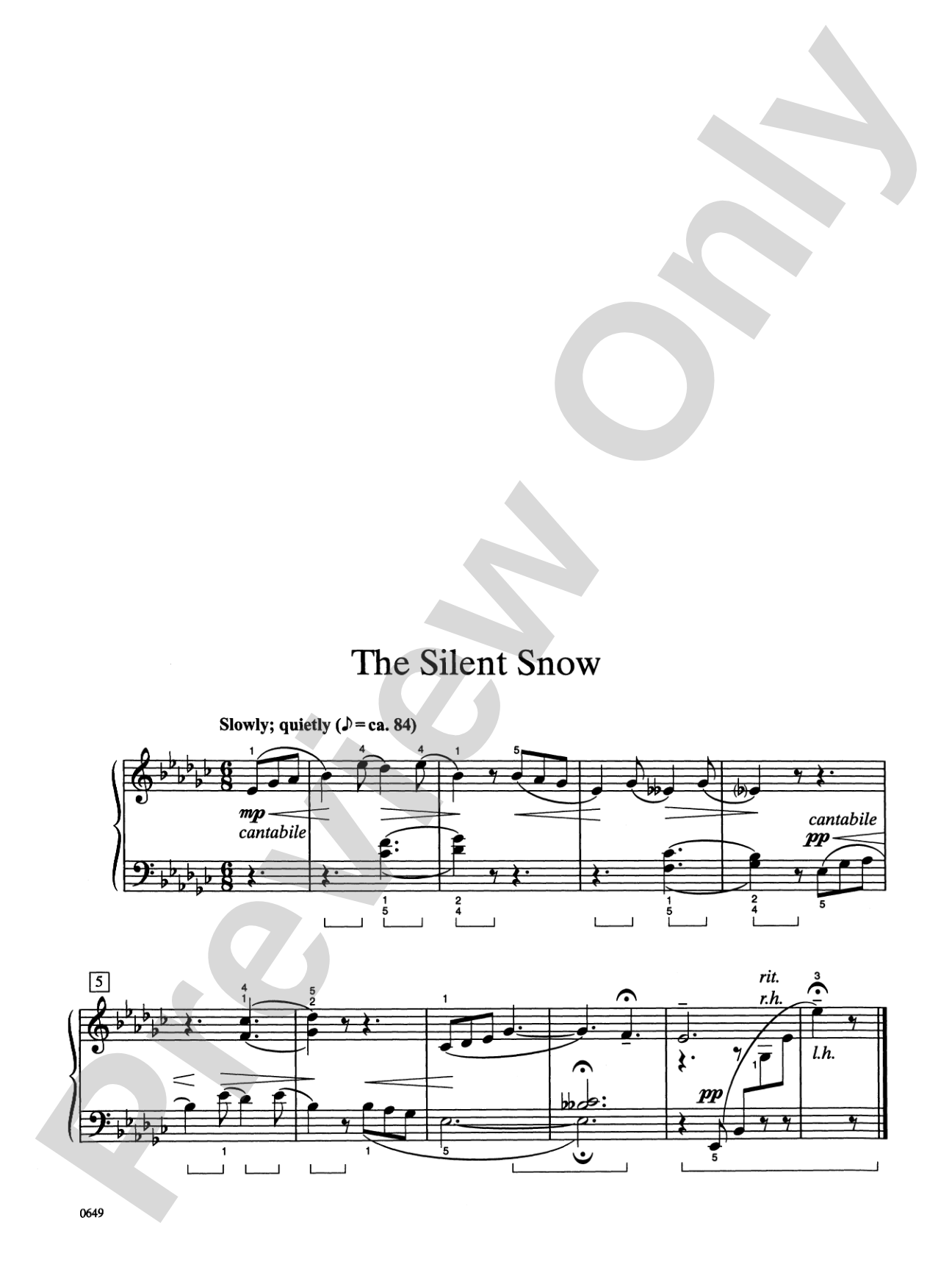

The Silent Snow - Piano Solo: Piano Solo
24 Short Piano Pieces in All Keys
By William L. Gillock
Level: Intermediate / Late Intermediate
Item: 00-PS-0017406
$4.99
Pickup currently not available
Related Items
Legend - Piano Solo: Piano Solo |
$4.99
|
View | |
Soaring - Piano Solo: Piano Solo |
$4.99
|
View | |
Seascape - Piano Solo: Piano Solo |
$4.99
|
View | |
Serenade - Piano Solo: Piano Solo |
$4.99
|
View | |
Interlude - Piano Solo: Piano Solo |
$4.99
|
View | |
Dragon Fly - Piano Solo: Piano Solo |
$4.99
|
View | |
Night Song - Piano Solo: Piano Solo |
$4.99
|
View | |
Humming Bird - Piano Solo: Piano Solo |
$4.99
|
View | |
Summer Storm - Piano Solo: Piano Solo |
$4.99
|
View | |
Winter Scene - Piano Solo: Piano Solo |
$4.99
|
View | |
A Witch's Cat - Piano Solo: Piano Solo |
$4.99
|
View | |
Autumn Sketch - Piano Solo: Piano Solo |
$4.99
|
View | |
Night Journey - Piano Solo: Piano Solo |
$4.99
|
View | |
Phantom Rider - Piano Solo: Piano Solo |
$4.99
|
View | |
A Faded Letter - Piano Solo: Piano Solo |
$4.99
|
View | |
Forest Murmurs - Piano Solo: Piano Solo |
$4.99
|
View | |
Moonlight Mood - Piano Solo: Piano Solo |
$4.99
|
View | |
October Morning - Piano Solo: Piano Solo |
$4.99
|
View | |
An Old Valentine - Piano Solo: Piano Solo |
$4.99
|
View | |
Fountain of Diana - Piano Solo: Piano Solo |
$4.99
|
View | |
Deserted Ball Room - Piano Solo: Piano Solo |
$4.99
|
View | |
Song of the Mermaid - Piano Solo: Piano Solo |
$4.99
|
View | |
Procession of the Mandarin - Piano Solo: Piano Solo |
$8.99
|
View | |
Lyric Preludes in Romantic Style: Piano Book & Online Audio |
$10.99
|
View | |
Lyric Preludes in Romantic Style: Piano Book |
$8.99
|
View |
Description
Lyric Preludes is an introduction to the whole Romantic period -- from Chopin and Schumann to Brahms and Debussy. Like Chopin, Gillock has written 24 preludes featuring all major and minor keys. But his preludes aren't just imitations of other composer's styles, they are valid, original works. An essential book for all pianists. A Federation Festivals 2024-2028 selection.


Discover MakeMusic Cloud: thousands of interactive titles your students can play along with today.
Sample Audio
No sample audio found.
Sample Video
No sample videos found.
Additional Details
Publisher:
Alfred Music
Page Count:
32
SKU:
00-PS-0017406
More about this title
About the Composer: William L. Gillock
William L. Gillock (1917-2002) was an American composer and pedagogue who spent his career bridging the gap between student repertoire and concert hall standards. His output of educational piano music stands out for its genuine artistry; rather than diluting Romantic idioms for young players, he wrote original pieces that respect both the learner's abilities and the listener's ear. Gillock understood that intermediate pianists deserved music that sounded beautiful without being simplistic.
Why we love this
Gillock's answer to Chopin's preludes respects the architectural challenge of the 24-key cycle while charting its own course. Each piece carries genuine character and avoids the trap of sounding like a pastiche; intermediate pianists get to inhabit a complete musical world rather than study a series of exercises. The Federation selection speaks to what teachers already know: these pieces work in recitals, in festivals, and in the practice room.
What to expect
The collection captures the intimate, reflective side of Romanticism without the virtuosic pyrotechnics. There's poetry in the restraint; a single melodic phrase can evoke a whole emotional landscape. Moving through all 24 keys feels like stepping through connected rooms, each with its own light and temperature.
Who it's for
Intermediate to late intermediate pianists ready for concert repertoire with substance. Teachers building recital programs or working toward festival appearances will find reliable, musically sound material at a manageable technical level. Students exploring the Romantic idiom without getting lost in Chopin's demands.
How to get the most out of it
- Approach each prelude as a complete statement rather than a warm-up. Gillock's economy of material means every gesture counts, so resist the urge to rush through shorter pieces.
- Use the key signatures as an expressive guide, not just a technical marker. The shift from major to relative minor (or vice versa) often carries emotional weight that's easy to undersell.
- Find the voice leading beneath the surface. These pieces reward attention to how lines connect across registers, especially in the more chromatic numbers.
- Record yourself working through the cycle. Hearing a progression of keys and moods revealed in sequence helps you shape individual pieces and avoid monotony.
How to use it
Build a festival program or recital around a thematic selection of keys from the cycle, pairing them with contrasting repertoire to highlight their distinct characters. The book also works beautifully as a pedagogical anchor in a curriculum unit on Romantic piano writing, offering students a way to hear continuity across a period that can feel fragmented in anthology samplings.
Skills your students will build
- Voice leading and phrasing in a single melodic line
- Harmonic language of the Romantic period (chromatic movement, extended chords, key relationships)
- Pedal technique and its role in sustaining harmonic color
- Sight-reading across all major and minor keys
- Musical interpretation and character development within compact forms
- Memorization strategies for a large collection of related works