
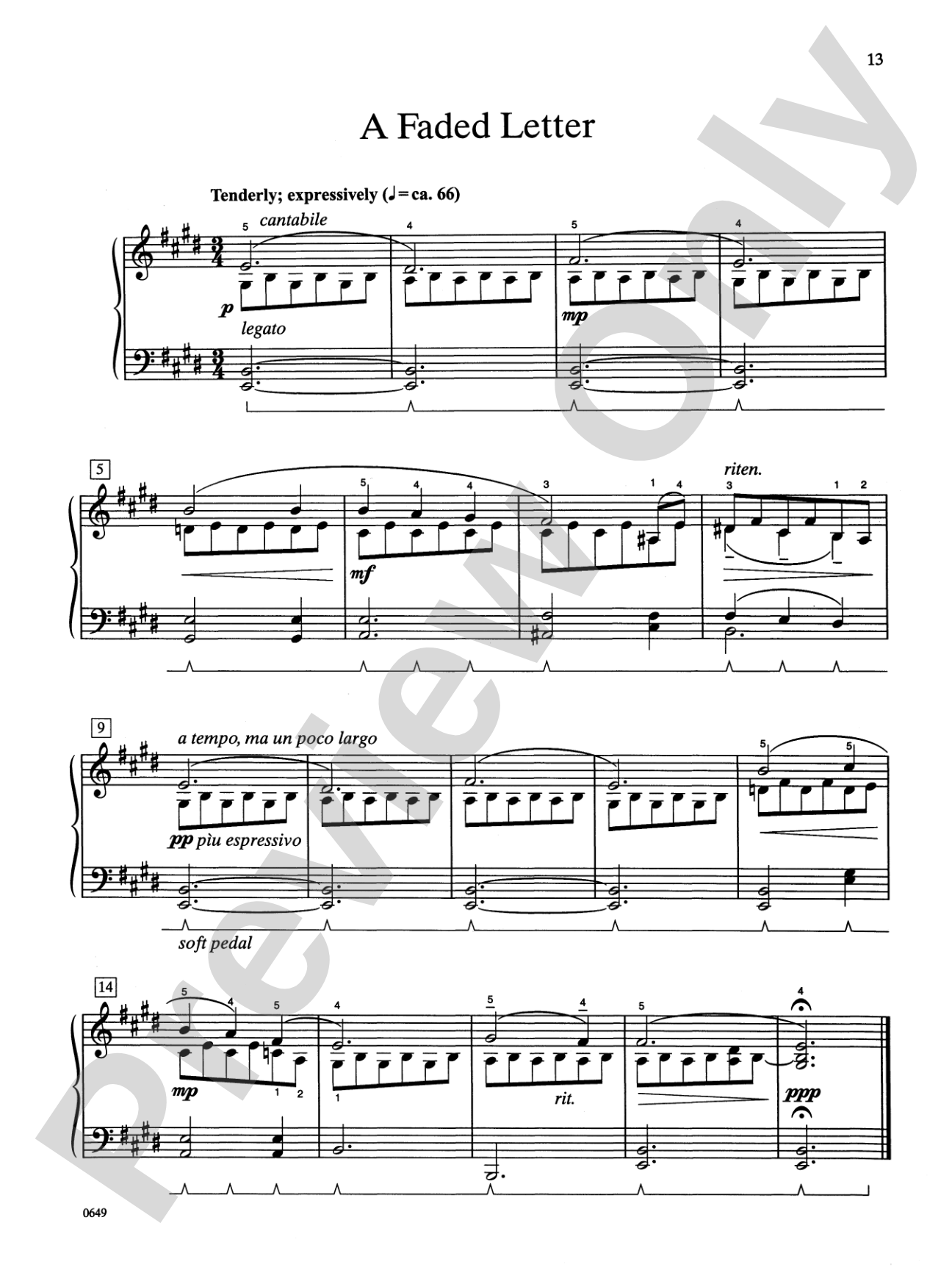

A Faded Letter - Piano Solo: Piano Solo
24 Short Piano Pieces in All Keys
By William L. Gillock
Level: Intermediate / Late Intermediate
Item: 00-PS-0017402
$4.99
Pickup currently not available
Related Items
Legend - Piano Solo: Piano Solo |
$4.99
|
View | |
Soaring - Piano Solo: Piano Solo |
$4.99
|
View | |
Seascape - Piano Solo: Piano Solo |
$4.99
|
View | |
Serenade - Piano Solo: Piano Solo |
$4.99
|
View | |
Interlude - Piano Solo: Piano Solo |
$4.99
|
View | |
Dragon Fly - Piano Solo: Piano Solo |
$4.99
|
View | |
Night Song - Piano Solo: Piano Solo |
$4.99
|
View | |
Humming Bird - Piano Solo: Piano Solo |
$4.99
|
View | |
Summer Storm - Piano Solo: Piano Solo |
$4.99
|
View | |
Winter Scene - Piano Solo: Piano Solo |
$4.99
|
View | |
A Witch's Cat - Piano Solo: Piano Solo |
$4.99
|
View | |
Autumn Sketch - Piano Solo: Piano Solo |
$4.99
|
View | |
Night Journey - Piano Solo: Piano Solo |
$4.99
|
View | |
Phantom Rider - Piano Solo: Piano Solo |
$4.99
|
View | |
Forest Murmurs - Piano Solo: Piano Solo |
$4.99
|
View | |
Moonlight Mood - Piano Solo: Piano Solo |
$4.99
|
View | |
October Morning - Piano Solo: Piano Solo |
$4.99
|
View | |
The Silent Snow - Piano Solo: Piano Solo |
$4.99
|
View | |
An Old Valentine - Piano Solo: Piano Solo |
$4.99
|
View | |
Fountain of Diana - Piano Solo: Piano Solo |
$4.99
|
View | |
Deserted Ball Room - Piano Solo: Piano Solo |
$4.99
|
View | |
Song of the Mermaid - Piano Solo: Piano Solo |
$4.99
|
View | |
Procession of the Mandarin - Piano Solo: Piano Solo |
$8.99
|
View | |
Lyric Preludes in Romantic Style: Piano Book & Online Audio |
$10.99
|
View | |
Lyric Preludes in Romantic Style: Piano Book |
$8.99
|
View |
Description
Lyric Preludes is an introduction to the whole Romantic period -- from Chopin and Schumann to Brahms and Debussy. Like Chopin, Gillock has written 24 preludes featuring all major and minor keys. But his preludes aren't just imitations of other composer's styles, they are valid, original works. An essential book for all pianists. A Federation Festivals 2024-2028 selection.


Discover MakeMusic Cloud: thousands of interactive titles your students can play along with today.
Sample Audio
No sample audio found.
Sample Video
No sample videos found.
Additional Details
Publisher:
Alfred Music
Page Count:
32
SKU:
00-PS-0017402
More about this title
About the Composer: William L. Gillock
William L. Gillock (1917-2002) was an American composer and pedagogue who shaped intermediate piano repertoire for generations. His gift lay in creating music that honored the concert tradition while remaining genuinely playable by developing musicians, striking a balance that eluded many of his contemporaries.
Gillock understood what students needed at each level of advancement. He wrote with clarity and purpose, never condescending, never oversimplifying. His works appear regularly on festival lists and in studio curricula because teachers trust them to deliver both musical substance and reasonable technical demands.
Why we love this
Gillock's 24 preludes operate on a principle worth celebrating: structural integrity without architectural pretension. Each prelude has its own character and harmonic language, yet they function as a coherent cycle that actually teaches the Romantic idiom rather than merely imitating it. Your students will encounter genuine musical problems to solve, not exercises in pastiche.
What to expect
Walking through a 19th-century salon where refined melody meets unexpected harmonic turns. There's intimacy here, a sense of personal reflection, but also structural sophistication that rewards careful listening. The music feels both familiar and fresh.
Who it's for
Intermediate to late intermediate pianists ready to work with the harmonic language of the Romantic period without the technical extremes of standard repertoire. Teachers building students toward festival repertoire or looking for substantial single pieces that don't require full-length sonata preparation.
How to get the most out of it
- Treat each prelude as a complete thought. The temptation with short pieces is to rush; these need the same interpretive attention you'd give a movement-length work.
- Listen to recordings of Chopin's Preludes op. 28 alongside these. Gillock's stylistic choices become clearer when you hear how he adapted rather than copied.
- Pay attention to the pedal markings. Gillock specifies them deliberately; they're part of the harmonic landscape, not optional color.
- Program these chronologically through a recital or practice cycle. The arc from early to late preludes reveals Gillock's deepening engagement with Romantic harmony.
How to use it
These work beautifully programmed individually within a larger recital, or you can build an entire junior recital around a sequence of 4-6 contrasting preludes. They're also ideal for music theory students studying Romantic harmony alongside actual performance.
Skills your students will build
- Voice leading through chromatic harmony and modal mixture
- Pedal technique and its relationship to chord voicing
- Interpretation of Romantic-era expressive markings and rubato
- Sight-reading fluency across varied key signatures and harmonic contexts
- Formal analysis of short forms with sophisticated harmonic language