
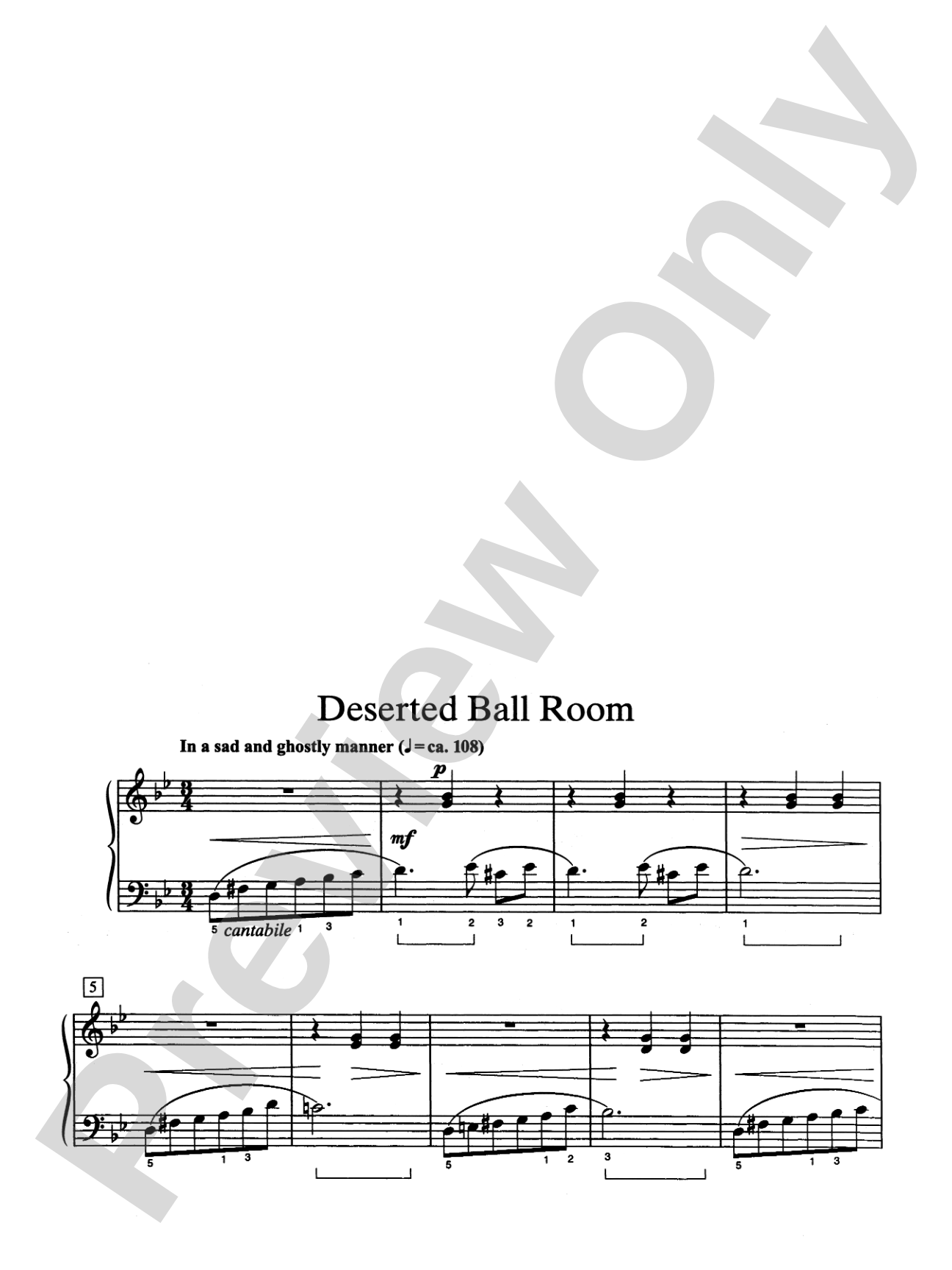

Deserted Ball Room - Piano Solo: Piano Solo
24 Short Piano Pieces in All Keys
By William L. Gillock
Level: Intermediate / Late Intermediate
Item: 00-PS-0017409
$4.99
Pickup currently not available
Related Items
Legend - Piano Solo: Piano Solo |
$4.99
|
View | |
Soaring - Piano Solo: Piano Solo |
$4.99
|
View | |
Seascape - Piano Solo: Piano Solo |
$4.99
|
View | |
Serenade - Piano Solo: Piano Solo |
$4.99
|
View | |
Interlude - Piano Solo: Piano Solo |
$4.99
|
View | |
Dragon Fly - Piano Solo: Piano Solo |
$4.99
|
View | |
Night Song - Piano Solo: Piano Solo |
$4.99
|
View | |
Humming Bird - Piano Solo: Piano Solo |
$4.99
|
View | |
Summer Storm - Piano Solo: Piano Solo |
$4.99
|
View | |
Winter Scene - Piano Solo: Piano Solo |
$4.99
|
View | |
A Witch's Cat - Piano Solo: Piano Solo |
$4.99
|
View | |
Autumn Sketch - Piano Solo: Piano Solo |
$4.99
|
View | |
Night Journey - Piano Solo: Piano Solo |
$4.99
|
View | |
Phantom Rider - Piano Solo: Piano Solo |
$4.99
|
View | |
A Faded Letter - Piano Solo: Piano Solo |
$4.99
|
View | |
Forest Murmurs - Piano Solo: Piano Solo |
$4.99
|
View | |
Moonlight Mood - Piano Solo: Piano Solo |
$4.99
|
View | |
October Morning - Piano Solo: Piano Solo |
$4.99
|
View | |
The Silent Snow - Piano Solo: Piano Solo |
$4.99
|
View | |
An Old Valentine - Piano Solo: Piano Solo |
$4.99
|
View | |
Fountain of Diana - Piano Solo: Piano Solo |
$4.99
|
View | |
Song of the Mermaid - Piano Solo: Piano Solo |
$4.99
|
View | |
Procession of the Mandarin - Piano Solo: Piano Solo |
$8.99
|
View | |
Lyric Preludes in Romantic Style: Piano Book & Online Audio |
$10.99
|
View | |
Lyric Preludes in Romantic Style: Piano Book |
$8.99
|
View |
Description
Lyric Preludes is an introduction to the whole Romantic period -- from Chopin and Schumann to Brahms and Debussy. Like Chopin, Gillock has written 24 preludes featuring all major and minor keys. But his preludes aren't just imitations of other composer's styles, they are valid, original works. An essential book for all pianists. A Federation Festivals 2024-2028 selection.


Discover MakeMusic Cloud: thousands of interactive titles your students can play along with today.
Sample Audio
No sample audio found.
Sample Video
No sample videos found.
Additional Details
Publisher:
Alfred Music
Page Count:
32
SKU:
00-PS-0017409
More about this title
About the Composer: William L. Gillock
William L. Gillock (1917, 2002) was an American composer and pedagogue who bridged the gap between teaching repertoire and concert music with uncommon grace. His ability to write pieces that sound far more sophisticated than their technical demands made him a trusted voice in piano education for decades.
Why we love this
Gillock understood what intermediate pianists need: music that builds genuine musicianship without becoming a technical obstacle. His deliberate choice to write 24 preludes across all keys signals serious structural ambition, yet each prelude stands as a complete musical thought rather than an academic exercise. Programming these works shows students that writing for their level doesn't mean compromising artistic vision.
What to expect
Gillock captures the Romantic impulse for lyrical expression and harmonic color, but through a cleaner, more modern lens. The music feels intimate and contemplative rather than virtuosic, with moments of genuine warmth balanced against quieter introspection.
Who it's for
This collection speaks to pianists ready to explore the Romantic era through accessible but artistically substantial writing. Intermediate and late-intermediate students benefit from encountering Romantic harmonic language and structural thinking without the steep technical demands of Chopin or Debussy originals.
How to get the most out of it
- Listen closely to the harmonic language in each prelude before diving into technique; Gillock's voice leading reveals itself through careful voicing rather than dramatic gestures.
- Let the tempo breathe. These pieces live or die by their ability to sustain lyrical shapes, so resist rushing even when the writing feels conversational.
- Pedal judiciously and change it with harmonic intent. Gillock's textures are cleaner than Romantic originals; heavy pedaling obscures the clarity he built into the writing.
- Explore the emotional range across the cycle. Each prelude has a distinct character, so vary your approach and discovery process from one to the next.
How to use it
Feature individual preludes on student recitals throughout the year, or perform a short sequence of three to five consecutive pieces as a thematic concert segment. The collection's coherence makes it an excellent study tool for understanding how major and minor keys relate across a large-scale work.
Skills your students will build
- Harmonic analysis and voice leading in Romantic-era writing
- Sustaining lyrical melodic lines over accompanying textures
- Tonal center and key relationships across all 24 major and minor keys
- Pedal technique and its relationship to harmonic clarity
- Understanding how composer voice and originality function within pedagogical constraints