
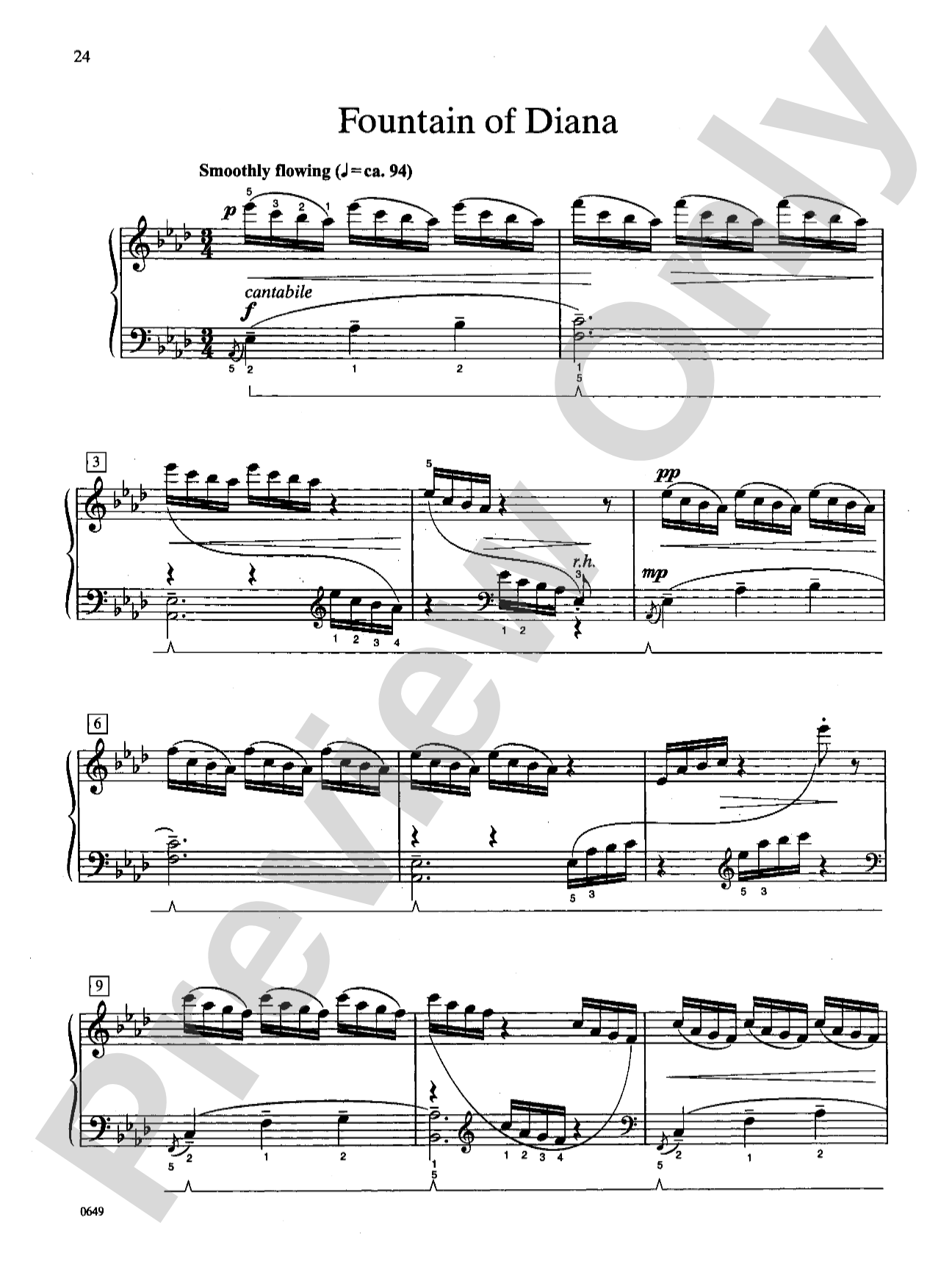

Fountain of Diana - Piano Solo: Piano Solo
24 Short Piano Pieces in All Keys
By William L. Gillock
Level: Intermediate / Late Intermediate
Item: 00-PS-0017408
$4.99
Pickup currently not available
Related Items
Legend - Piano Solo: Piano Solo |
$4.99
|
View | |
Soaring - Piano Solo: Piano Solo |
$4.99
|
View | |
Seascape - Piano Solo: Piano Solo |
$4.99
|
View | |
Serenade - Piano Solo: Piano Solo |
$4.99
|
View | |
Interlude - Piano Solo: Piano Solo |
$4.99
|
View | |
Dragon Fly - Piano Solo: Piano Solo |
$4.99
|
View | |
Night Song - Piano Solo: Piano Solo |
$4.99
|
View | |
Humming Bird - Piano Solo: Piano Solo |
$4.99
|
View | |
Summer Storm - Piano Solo: Piano Solo |
$4.99
|
View | |
Winter Scene - Piano Solo: Piano Solo |
$4.99
|
View | |
A Witch's Cat - Piano Solo: Piano Solo |
$4.99
|
View | |
Autumn Sketch - Piano Solo: Piano Solo |
$4.99
|
View | |
Night Journey - Piano Solo: Piano Solo |
$4.99
|
View | |
Phantom Rider - Piano Solo: Piano Solo |
$4.99
|
View | |
A Faded Letter - Piano Solo: Piano Solo |
$4.99
|
View | |
Forest Murmurs - Piano Solo: Piano Solo |
$4.99
|
View | |
Moonlight Mood - Piano Solo: Piano Solo |
$4.99
|
View | |
October Morning - Piano Solo: Piano Solo |
$4.99
|
View | |
The Silent Snow - Piano Solo: Piano Solo |
$4.99
|
View | |
An Old Valentine - Piano Solo: Piano Solo |
$4.99
|
View | |
Deserted Ball Room - Piano Solo: Piano Solo |
$4.99
|
View | |
Song of the Mermaid - Piano Solo: Piano Solo |
$4.99
|
View | |
Procession of the Mandarin - Piano Solo: Piano Solo |
$8.99
|
View | |
Lyric Preludes in Romantic Style: Piano Book & Online Audio |
$10.99
|
View | |
Lyric Preludes in Romantic Style: Piano Book |
$8.99
|
View |
Description
Lyric Preludes is an introduction to the whole Romantic period -- from Chopin and Schumann to Brahms and Debussy. Like Chopin, Gillock has written 24 preludes featuring all major and minor keys. But his preludes aren't just imitations of other composer's styles, they are valid, original works. An essential book for all pianists. A Federation Festivals 2024-2028 selection.


Discover MakeMusic Cloud: thousands of interactive titles your students can play along with today.
Sample Audio
No sample audio found.
Sample Video
No sample videos found.
Additional Details
Publisher:
Alfred Music
Page Count:
32
SKU:
00-PS-0017408
More about this title
About the Composer: William L. Gillock
William L. Gillock (1917-2002) was an American composer and educator whose gift lay in creating accessible yet musically substantial works for young pianists. His prolific output bridged the gap between pedagogical writing and genuine artistry, earning him recognition as one of the most performed composers in American music education. Gillock understood that intermediate students didn't need watered-down miniatures; they needed real pieces that respected their growing musicianship while remaining within their technical reach.
Why we love this
Gillock's 24 Lyric Preludes accomplish what few pedagogical collections do: they teach students about an entire musical era while remaining genuinely rewarding to perform. Rather than pastiche, each prelude stands as an original composition that happens to explore the harmonic language, textures, and character pieces typical of the Romantic masters. The Federation Festivals selection carries real weight for teachers planning audition repertoire with lasting musical substance.
What to expect
Lyrical, introspective, and occasionally dreamlike. Gillock captures the intimate character-piece sensibility of the Romantic period, with rich harmonies and singing melodies that invite the performer into a more expressive musical language. These are pieces that reveal something new with each encounter.
Who it's for
Intermediate and late intermediate pianists who are ready to explore Romantic-era writing without tackling the full demands of Chopin or Brahms. Students preparing for music festivals, auditions, or simply looking to deepen their musical literacy will find these preludes both accessible and genuinely moving.
How to get the most out of it
- Pay attention to the title 'Fountain of Diana' and consider the imagery of flowing water and classical mythology as your interpretive lens; let that guide your phrasing and pedal choices rather than playing the notes mechanically.
- Experiment with different pedal techniques to create clarity within the texture; Romantic-era writing often requires selective pedaling rather than sustaining throughout.
- Balance the melodic line against accompanying figures so listeners hear the primary voice clearly, a skill that transfers directly to the larger classical repertoire students will encounter later.
How to use it
Individual preludes work beautifully as recital selections, either standing alone or grouped thematically with other Romantic-era works. The complete collection serves as an excellent curriculum unit for introducing students to compositional techniques across the Romantic period, or as a resource for building a varied performance set when audition guidelines call for contrasting styles.
Skills your students will build
- Romantic-era harmonic language and functional harmony
- Pedal technique and selective sustain control
- Phrasing and shaping lyrical melodic lines
- Understanding of character pieces and program music
- Interpretive decision-making based on title and imagery
- Comfort with extended key signatures across major and minor tonalities