
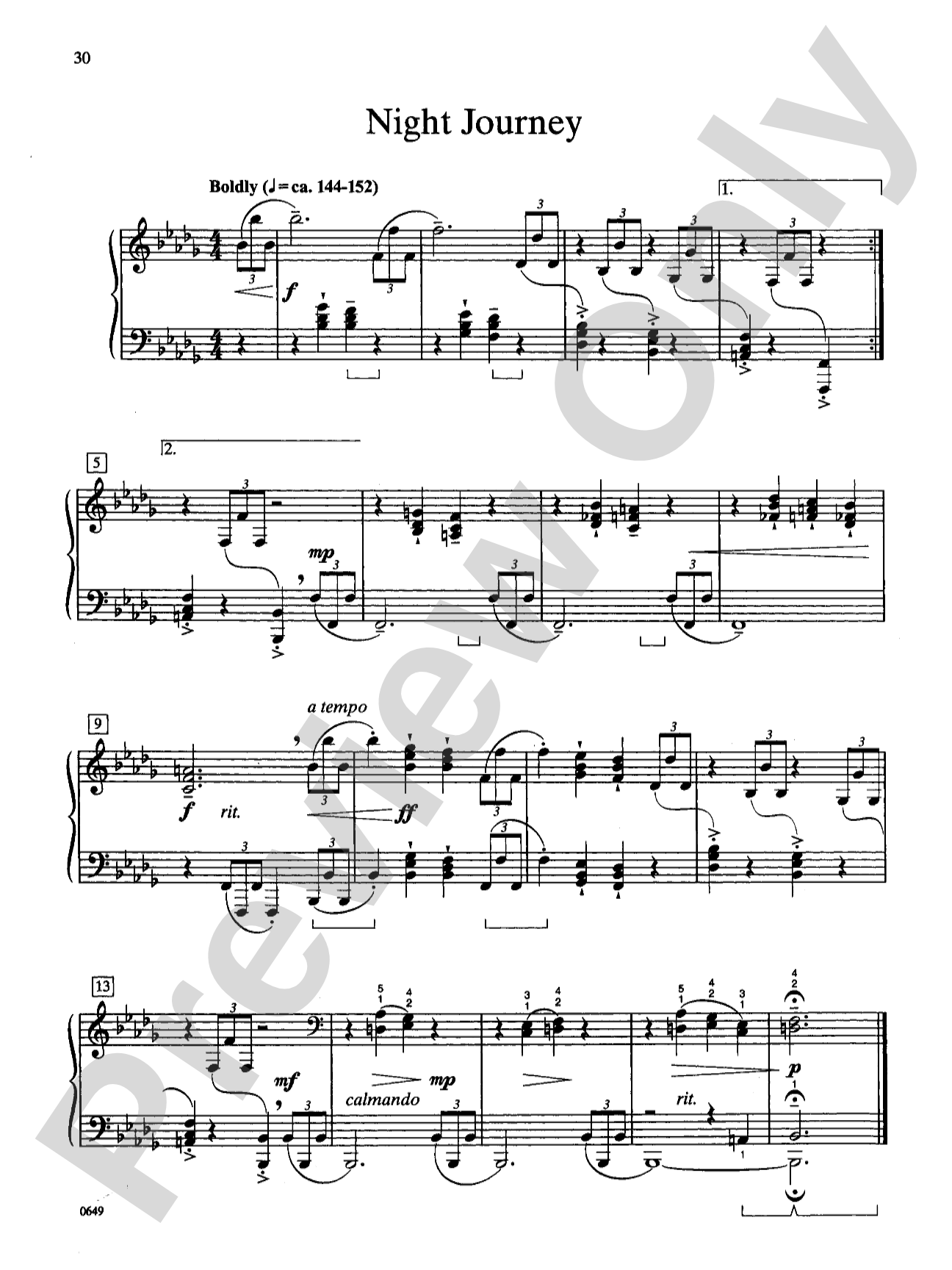

Night Journey - Piano Solo: Piano Solo
24 Short Piano Pieces in All Keys
By William L. Gillock
Level: Intermediate / Late Intermediate
Item: 00-PS-0017400
$4.99
Pickup currently not available
Related Items
Legend - Piano Solo: Piano Solo |
$4.99
|
View | |
Soaring - Piano Solo: Piano Solo |
$4.99
|
View | |
Seascape - Piano Solo: Piano Solo |
$4.99
|
View | |
Serenade - Piano Solo: Piano Solo |
$4.99
|
View | |
Interlude - Piano Solo: Piano Solo |
$4.99
|
View | |
Dragon Fly - Piano Solo: Piano Solo |
$4.99
|
View | |
Night Song - Piano Solo: Piano Solo |
$4.99
|
View | |
Humming Bird - Piano Solo: Piano Solo |
$4.99
|
View | |
Summer Storm - Piano Solo: Piano Solo |
$4.99
|
View | |
Winter Scene - Piano Solo: Piano Solo |
$4.99
|
View | |
A Witch's Cat - Piano Solo: Piano Solo |
$4.99
|
View | |
Autumn Sketch - Piano Solo: Piano Solo |
$4.99
|
View | |
Phantom Rider - Piano Solo: Piano Solo |
$4.99
|
View | |
A Faded Letter - Piano Solo: Piano Solo |
$4.99
|
View | |
Forest Murmurs - Piano Solo: Piano Solo |
$4.99
|
View | |
Moonlight Mood - Piano Solo: Piano Solo |
$4.99
|
View | |
October Morning - Piano Solo: Piano Solo |
$4.99
|
View | |
The Silent Snow - Piano Solo: Piano Solo |
$4.99
|
View | |
An Old Valentine - Piano Solo: Piano Solo |
$4.99
|
View | |
Fountain of Diana - Piano Solo: Piano Solo |
$4.99
|
View | |
Deserted Ball Room - Piano Solo: Piano Solo |
$4.99
|
View | |
Song of the Mermaid - Piano Solo: Piano Solo |
$4.99
|
View | |
Procession of the Mandarin - Piano Solo: Piano Solo |
$8.99
|
View | |
Lyric Preludes in Romantic Style: Piano Book & Online Audio |
$10.99
|
View | |
Lyric Preludes in Romantic Style: Piano Book |
$8.99
|
View |
Description
Lyric Preludes is an introduction to the whole Romantic period -- from Chopin and Schumann to Brahms and Debussy. Like Chopin, Gillock has written 24 preludes featuring all major and minor keys. But his preludes aren't just imitations of other composer's styles, they are valid, original works. An essential book for all pianists. A Federation Festivals 2024-2028 selection.


Discover MakeMusic Cloud: thousands of interactive titles your students can play along with today.
Sample Audio
No sample audio found.
Sample Video
No sample videos found.
Additional Details
Publisher:
Alfred Music
Page Count:
32
SKU:
00-PS-0017400
More about this title
About the Composer: William L. Gillock
William L. Gillock (1917-2002) was an American composer and educator who built his career on creating accessible yet artistically substantial music for young pianists. His gift was recognizing what intermediate students could handle musically without condescending to them; his works balance technical accessibility with genuine compositional craft.
Gillock's output spans hundreds of pieces, but his collections of character pieces and preludes remain his most enduring contribution to piano pedagogy. He understood that students learning to navigate different musical languages and styles needed models that felt alive and original, not merely dutiful exercises in imitation.
Why we love this
Gillock's 24 preludes accomplish something that's harder than it sounds: each one inhabits the spirit of the Romantic era while maintaining a distinct personality. Your students will encounter genuine musical ideas, not recycled patterns, which means they're learning from a composer who respected their developing ears. The Federation Festivals selection validates what teachers have known for decades, this collection holds up.
What to expect
These preludes breathe with the lyrical sensibility their title promises. You'll move through passages of gentle introspection, moments of harmonic color and surprise, and the kind of accessible beauty that makes pianists want to keep playing. There's elegance without pretension.
Who it's for
Intermediate to late-intermediate pianists ready to engage with the Romantic period on their own terms. Students preparing for competitions, auditions, or simply wanting a coherent survey of Romantic keyboard writing will find substantial material here.
How to get the most out of it
- Treat each prelude as a complete thought rather than a technical hurdle. The musical content always matters more than the fingering.
- Listen for the harmonic language in each piece; Gillock's use of chromatic movement and Romantic-era chord progressions rewards careful voicing and sensitive pedal work.
- Vary your approach to the minor key preludes. They're not darker cousins of the major ones; they often have their own lyrical quality that comes through when you resist over-dramatizing them.
- Work through the collection chronologically, as Gillock spaces the difficulty gradually and the later pieces build on harmonic concepts introduced earlier.
How to use it
Feature individual preludes in student recitals throughout the year, or program several as a curated sequence in a concert devoted to the Romantic era. The collection works equally well as a studio staple for students working on stylistic awareness and as a public performance vehicle, these pieces sound polished without requiring virtuosic pyrotechnics.
Skills your students will build
- Reading and interpreting Romantic-era harmonic language (chromaticism, modulation, extended chords)
- Pedal technique and control across different textural contexts
- Stylistic flexibility across 24 distinct musical ideas
- Tonal memory and ear training through all major and minor keys
- Phrasing and line direction without relying on dramatic tempo changes