
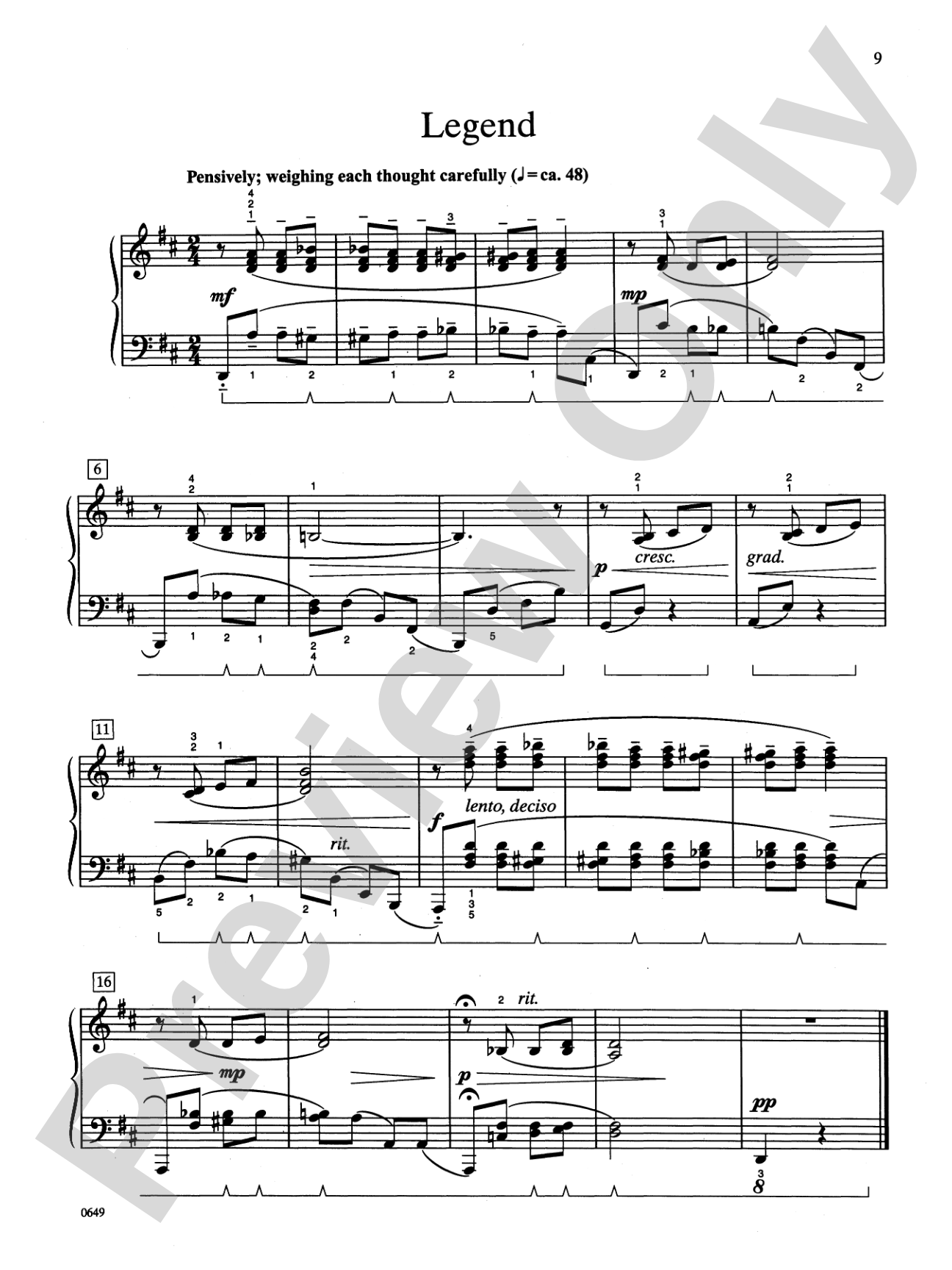

Legend - Piano Solo: Piano Solo
24 Short Piano Pieces in All Keys
By William L. Gillock
Level: Intermediate / Late Intermediate
Item: 00-PS-0017388
$4.99
Pickup currently not available
Related Items
Soaring - Piano Solo: Piano Solo |
$4.99
|
View | |
Seascape - Piano Solo: Piano Solo |
$4.99
|
View | |
Serenade - Piano Solo: Piano Solo |
$4.99
|
View | |
Interlude - Piano Solo: Piano Solo |
$4.99
|
View | |
Dragon Fly - Piano Solo: Piano Solo |
$4.99
|
View | |
Night Song - Piano Solo: Piano Solo |
$4.99
|
View | |
Humming Bird - Piano Solo: Piano Solo |
$4.99
|
View | |
Summer Storm - Piano Solo: Piano Solo |
$4.99
|
View | |
Winter Scene - Piano Solo: Piano Solo |
$4.99
|
View | |
A Witch's Cat - Piano Solo: Piano Solo |
$4.99
|
View | |
Autumn Sketch - Piano Solo: Piano Solo |
$4.99
|
View | |
Night Journey - Piano Solo: Piano Solo |
$4.99
|
View | |
Phantom Rider - Piano Solo: Piano Solo |
$4.99
|
View | |
A Faded Letter - Piano Solo: Piano Solo |
$4.99
|
View | |
Forest Murmurs - Piano Solo: Piano Solo |
$4.99
|
View | |
Moonlight Mood - Piano Solo: Piano Solo |
$4.99
|
View | |
October Morning - Piano Solo: Piano Solo |
$4.99
|
View | |
The Silent Snow - Piano Solo: Piano Solo |
$4.99
|
View | |
An Old Valentine - Piano Solo: Piano Solo |
$4.99
|
View | |
Fountain of Diana - Piano Solo: Piano Solo |
$4.99
|
View | |
Deserted Ball Room - Piano Solo: Piano Solo |
$4.99
|
View | |
Song of the Mermaid - Piano Solo: Piano Solo |
$4.99
|
View | |
Procession of the Mandarin - Piano Solo: Piano Solo |
$8.99
|
View | |
Lyric Preludes in Romantic Style: Piano Book & Online Audio |
$10.99
|
View | |
Lyric Preludes in Romantic Style: Piano Book |
$8.99
|
View |
Description
Lyric Preludes is an introduction to the whole Romantic period -- from Chopin and Schumann to Brahms and Debussy. Like Chopin, Gillock has written 24 preludes featuring all major and minor keys. But his preludes aren't just imitations of other composer's styles, they are valid, original works. An essential book for all pianists. A Federation Festivals 2024-2028 selection.


Legend - Piano Solo: Piano Solo isn't in MakeMusic Cloud just yet...but it could be. Let us know you'd like to see it, and you'll help shape what comes next. In the meantime, start a free trial and dive into thousands of interactive titles your students can play along with today.
Request This Title
Tell us you want it.
Start Your Free Trial
Explore everything that's ready to play right now.
Sample Audio
No sample audio found.
Sample Video
No sample videos found.
Additional Details
Publisher:
Alfred Music
Page Count:
32
SKU:
00-PS-0017388
More about this title
About the Composer: William L. Gillock
William L. Gillock (1917-2002) shaped American piano pedagogy by creating works that genuinely bridge student technique and artistic musicmaking. His output spans teaching pieces, concert works, and collections designed around specific pedagogical goals, all written with an ear for what pianists at various levels could actually accomplish.
Gillock's approach to the prelude cycle draws from the Romantic tradition while remaining entirely his own voice. Rather than pastiche or imitation, his preludes function as fully realized compositions that introduce harmonic language, textural variety, and interpretive depth without requiring virtuosic finger work.
Why we love this
Gillock solved the real problem of prelude collections: most either present exercises in different keys or become stylistic exercises. His 24 preludes stand as complete musical statements, each exploring a different facet of Romantic expression while remaining performable for intermediate pianists. The Federation Festivals selection underscores what teachers already know, these pieces reward careful listening and reveal something new with each playing.
What to expect
These preludes capture the lyrical intimacy of the Romantic salon without demanding recital-hall virtuosity. Each piece opens a window into a different mood or textural world, some introspective and harmonically searching, others rhythmically alive, creating a collection that feels like a guided walk through the period rather than a textbook survey.
Who it's for
Intermediate to late intermediate pianists ready to step beyond technical studies and engage with genuine Romantic repertoire. Teachers building student programs around prelude cycles or introducing harmonic and stylistic concepts through performance rather than analysis alone.
How to get the most out of it
- Approach each prelude as a miniature character piece rather than a technical study. The musical content, not the difficulty, is the point.
- Let the harmonic language breathe. Gillock's writing often hinges on unexpected chord progressions that need time to register with listeners.
- Shape phrases by ear rather than mechanical phrasing. A single melodic line might span several measures, and recognizing these arcs transforms the performance.
- Experiment with tempo flexibility within a prelude. Romantic character demands subtle rubato, and these pieces respond to that treatment.
How to use it
Pair individual preludes with standard Romantic repertoire in student recitals, or program several in sequence as a concert set that showcases different colors and moods within a single composer's voice. They also work as curricular anchors for understanding harmonic language and character writing across a semester or year.
Skills your students will build
- voice leading and harmonic progression at the keyboard
- interpretive choices within a lyrical melodic framework
- control of tone color and dynamic shading in single-line and accompanied textures
- understanding of Romantic-era harmonic language through performance context
- reading and executing written articulation and dynamic markings with musical intent