
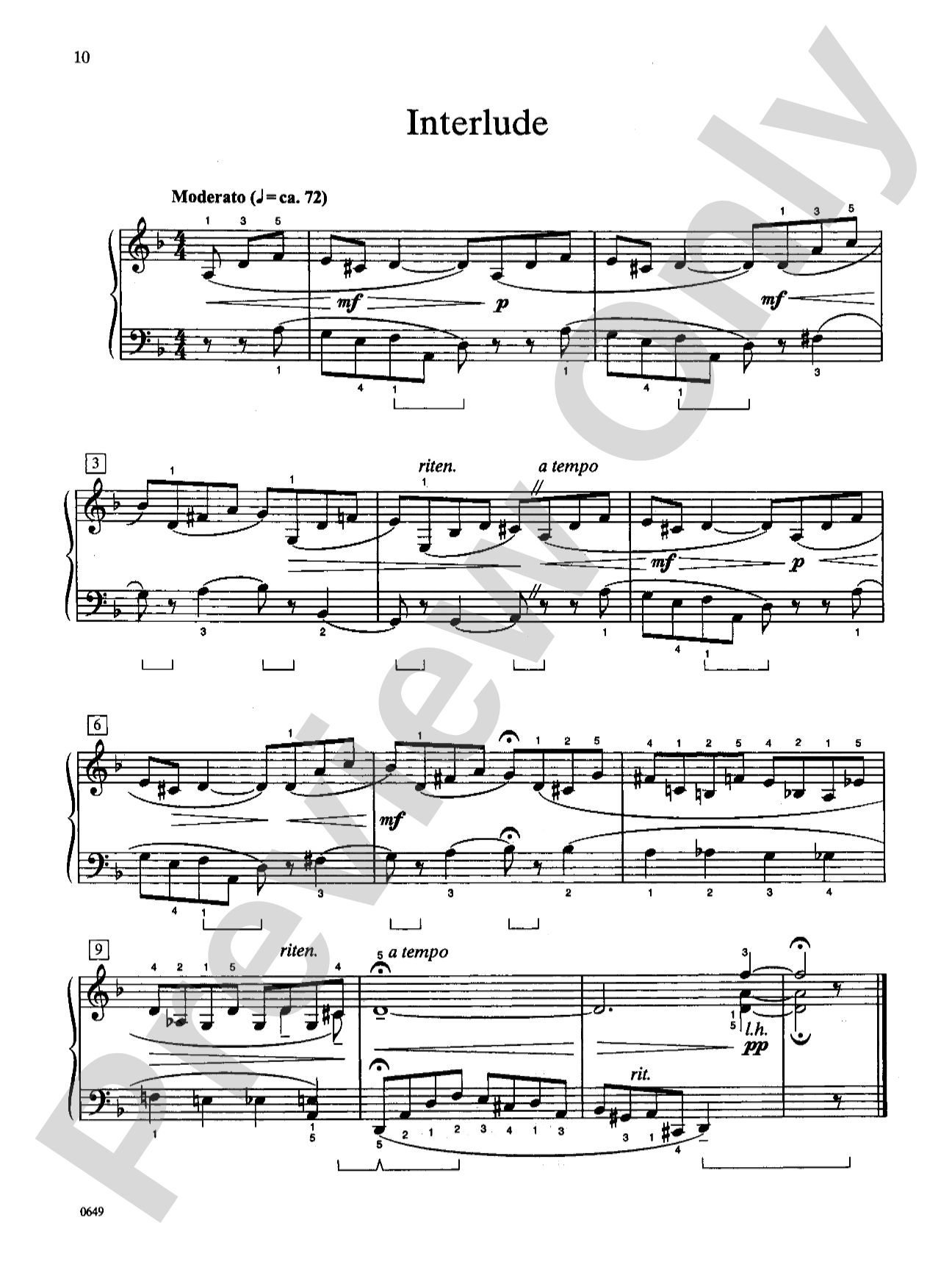

Interlude - Piano Solo: Piano Solo
24 Short Piano Pieces in All Keys
By William L. Gillock
Level: Intermediate / Late Intermediate
Item: 00-PS-0017392
$4.99
Pickup currently not available
Related Items
Legend - Piano Solo: Piano Solo |
$4.99
|
View | |
Soaring - Piano Solo: Piano Solo |
$4.99
|
View | |
Seascape - Piano Solo: Piano Solo |
$4.99
|
View | |
Serenade - Piano Solo: Piano Solo |
$4.99
|
View | |
Dragon Fly - Piano Solo: Piano Solo |
$4.99
|
View | |
Night Song - Piano Solo: Piano Solo |
$4.99
|
View | |
Humming Bird - Piano Solo: Piano Solo |
$4.99
|
View | |
Summer Storm - Piano Solo: Piano Solo |
$4.99
|
View | |
Winter Scene - Piano Solo: Piano Solo |
$4.99
|
View | |
A Witch's Cat - Piano Solo: Piano Solo |
$4.99
|
View | |
Autumn Sketch - Piano Solo: Piano Solo |
$4.99
|
View | |
Night Journey - Piano Solo: Piano Solo |
$4.99
|
View | |
Phantom Rider - Piano Solo: Piano Solo |
$4.99
|
View | |
A Faded Letter - Piano Solo: Piano Solo |
$4.99
|
View | |
Forest Murmurs - Piano Solo: Piano Solo |
$4.99
|
View | |
Moonlight Mood - Piano Solo: Piano Solo |
$4.99
|
View | |
October Morning - Piano Solo: Piano Solo |
$4.99
|
View | |
The Silent Snow - Piano Solo: Piano Solo |
$4.99
|
View | |
An Old Valentine - Piano Solo: Piano Solo |
$4.99
|
View | |
Fountain of Diana - Piano Solo: Piano Solo |
$4.99
|
View | |
Deserted Ball Room - Piano Solo: Piano Solo |
$4.99
|
View | |
Song of the Mermaid - Piano Solo: Piano Solo |
$4.99
|
View | |
Procession of the Mandarin - Piano Solo: Piano Solo |
$8.99
|
View | |
Lyric Preludes in Romantic Style: Piano Book & Online Audio |
$10.99
|
View | |
Lyric Preludes in Romantic Style: Piano Book |
$8.99
|
View |
Description
Lyric Preludes is an introduction to the whole Romantic period -- from Chopin and Schumann to Brahms and Debussy. Like Chopin, Gillock has written 24 preludes featuring all major and minor keys. But his preludes aren't just imitations of other composer's styles, they are valid, original works. An essential book for all pianists. A Federation Festivals 2024-2028 selection.


Interlude - Piano Solo: Piano Solo isn't in MakeMusic Cloud just yet...but it could be. Let us know you'd like to see it, and you'll help shape what comes next. In the meantime, start a free trial and dive into thousands of interactive titles your students can play along with today.
Request This Title
Tell us you want it.
Start Your Free Trial
Explore everything that's ready to play right now.
Sample Audio
No sample audio found.
Sample Video
No sample videos found.
Additional Details
Publisher:
Alfred Music
Page Count:
32
SKU:
00-PS-0017392
More about this title
About the Composer: William L. Gillock
William L. Gillock (1917-2002) was an American composer and pedagogue who understood exactly what intermediate pianists needed to hear and play. His gift was creating music that felt sophisticated without demanding virtuosity, making him one of the most trusted voices in piano education for generations of teachers and students.
Gillock's output spanned teaching pieces, recital works, and ensemble arrangements, but his Lyric Preludes remain his calling card. Rather than write pastiche studies in the manner of other composers, he crafted original works that genuinely belong in the canon of preludes alongside the models he drew from. This distinction, originality within tradition, is why his work endures in the studio and on the festival circuit.
Why we love this
Gillock understood that intermediate students are ready for Romantic color and harmonic sophistication, but they don't need the technical gauntlet of Chopin's actual preludes. These 24 pieces function as both accessible entry points to the era and genuinely rewarding performance pieces that let students experience what makes Romantic-era writing sing. The fact that they're a Federation selection confirms what teaching pianists have known for decades: these aren't stepping stones to real music; they are real music.
What to expect
These preludes inhabit the intimate, reflective world of the nineteenth century without the showmanship or drama of virtuoso display. They feel personal and introspective, often with a lyrical simplicity that masks subtle harmonic sophistication. Playing them feels like having a genuine conversation with the Romantic period rather than observing it from a distance.
Who it's for
Intermediate to late intermediate pianists who are ready to engage with Romantic harmonic language and character writing without tackling the full demands of period literature. Teachers building a balanced diet of repertoire that includes both technical work and artistically rewarding pieces. Students preparing for festival competitions or recitals who benefit from original, well-made music at their level.
How to get the most out of it
- Shape each prelude as a self-contained study in mood and character rather than working through them as obligation. The variety across the collection means each one asks different things of the ear and hand.
- Lean into the harmonic language without over-pedaling; let the voice-leading and chord changes carry the color. Gillock's writing is transparent enough that clarity matters more than atmospheric blur.
- Listen closely to how Gillock uses register and spacing to create intimacy. Many of these pieces feel small and personal; resist the urge to play them with grand, stretched gestures.
- Allow tempo some flexibility to match the character of each key and mood. These aren't metronomic exercises; they breathe.
How to use it
Build a recital or festival set around contrasting preludes from the collection to give students experience with mood and key relationships without overloading a single program. Use them as a bridge between beginner repertoire and standard classical/Romantic anthologies, showing students where music can go when technique reaches this level. Assign them throughout the year as supplementary solo material alongside more demanding technique-building repertoire.
Skills your students will build
- Harmonic color and voice-leading in the Romantic style
- Pedal control and clarity in complex textures
- Rubato and expressive phrasing without structural ambiguity
- Sight-reading at intermediate level across all major and minor keys
- Interpretive choice within a structured piece