
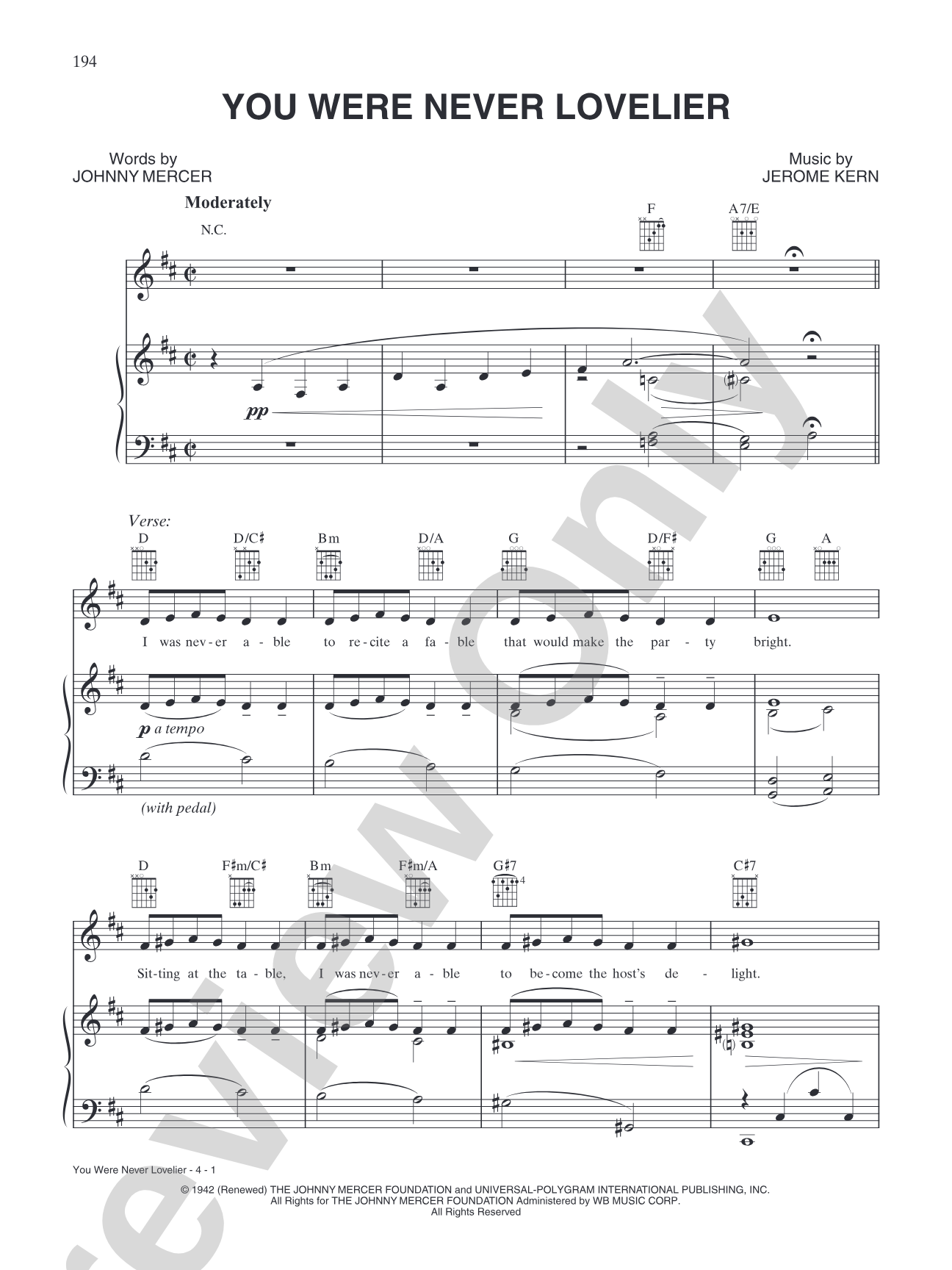

You Were Never Lovelier: Piano/Vocal/Chords
Johnny Mercer
Item: 00-XS-0000278
$4.99
One moment…
Related Items
And the Angels Sing: Piano/Vocal/Chords |
$4.99
|
View | |
Goody-Goody: Piano/Vocal/Chords |
$4.99
|
View | |
You Must Have Been a Beautiful Baby: Piano/Vocal/Chords |
$4.99
|
View | |
Jeepers Creepers: Piano/Vocal/Chords |
$4.99
|
View | |
Lazy Bones: Piano/Vocal/Chords |
$4.99
|
View | |
Day In Day Out: Piano/Vocal/Chords |
$4.99
|
View | |
Fools Rush In (Where Angels Fear to Tread): Piano/Vocal/Chords |
$4.99
|
View | |
Laura: Piano/Vocal/Chords |
$4.99
|
View | |
Dream: Piano/Vocal/Chords |
$4.99
|
View | |
G.I. Jive: Piano/Vocal/Chords |
$4.99
|
View | |
I Though About You: Piano/Vocal/Chords |
$4.99
|
View | |
I Wanna Be Around: Piano/Vocal/Chords |
$4.99
|
View | |
I'm An Old Cowhand (From the Rio Grande): Piano/Vocal/Chords |
$4.99
|
View | |
If I Had My Druthers (from "Li'l Abner"): Piano/Vocal/Chords |
$4.99
|
View | |
Namely You (from "Li'l Abner"): Piano/Vocal/Chords |
$4.99
|
View | |
Skylark: Piano/Vocal/Chords |
$4.99
|
View | |
Something's Gotta Give (from "Daddy Long Legs"): Piano/Vocal/Chords |
$4.99
|
View | |
Strip Polka: Piano/Vocal/Chords |
$4.99
|
View | |
Two of a Kind: Piano/Vocal/Chords |
$4.99
|
View | |
Emily: Piano/Vocal/Chords |
$4.99
|
View | |
Bless Yore Beautiful Hide (from "Seven Brides for Seven Brothers"): Piano/Vocal/Chords |
$4.99
|
View | |
On the Atchison, Topeka and the Santa Fe: Piano/Vocal/Chords |
$4.99
|
View | |
Charade (from "Charade"): Piano/Vocal/Chords |
$4.99
|
View | |
The Sweetheart Tree (from "The Great Race"): Piano/Vocal/Chords |
$4.99
|
View | |
Legalize My Name: Piano/Vocal/Chords |
$4.99
|
View | |
Satan's Li'l Lamb: Piano/Vocal/Chords |
$4.99
|
View | |
Too Marvelous for Words: Piano/Vocal/Chords |
$4.99
|
View | |
Hooray for Hollywood: Piano/Vocal/Chords |
$4.99
|
View | |
Blues in the Night: Piano/Vocal/Chords |
$5.99
|
View | |
Drinking Again: Piano/Vocal/Chords |
$4.99
|
View | |
Days of Wine and Roses: Piano/Vocal/Chords |
$4.99
|
View | |
Summer Wind: Piano/Vocal/Chords |
$5.99
|
View | |
Satin Doll: Piano/Vocal/Chords |
$4.99
|
View | |
The Glow Worm: Piano/Vocal/Chords |
$4.99
|
View | |
Come Rain or Come Shine: Piano/Vocal/Chords |
$4.99
|
View |
Description
Johnny Mercer (1909--1976) was not only one of America's greatest lyricists---he helped define the American South from the outside in. His words paint rich and vivid portraits of life in his native Georgia. Mercer wrote a wide variety of songs, from lush, dreamy ballads to plays on colloquial American expressions. He joined forces with some of the most talented composers of his day, including Harold Arlen, Hoagy Carmichael, and Henry Mancini, to fashion one of the most startlingly original catalogs in American popular music. This songbook commemorates the centennial of his birth with piano/vocal sheet music arrangements (including guitar chord frames) for 46 of his most famous and best-loved classics. Titles: Ac-cent-tchu-ate the Positive * And the Angels Sing * Any Place I Hang My Hat Is Home * Autumn Leaves * Bless Yore Beautiful Hide * Blues in the Night * Charade * Come Rain or Come Shine * Day In---Day Out * Days of Wine and Roses * Dream * Drinking Again * Emily * Fools Rush In (Where Angels Fear to Tread) * G.I. Jive * The Glow-Worm * Goody-Goody * Hooray for Hollywood * I Thought About You * I Wanna Be Around * If I Had My Druthers * I'm an Old Cowhand (from the Rio Grande) * I'm Old Fashioned * In the Cool, Cool, Cool of the Evening * Jeepers Creepers * Laura * Lazybones * Legalize My Name * Moon River * My Shining Hour * Namely You * On the Atchison, Topeka and the Santa Fe * One for My Baby (and One More for the Road) * Satan's Li'l Lamb * Satin Doll * Skylark * Something's Gotta Give * Strip Polka * Summer Wind * The Sweetheart Tree * That Old Black Magic * Too Marvelous for Words * Two of a Kind * When the World Was Young * You Must Have Been a Beautiful Baby * You Were Never Lovelier.


You Were Never Lovelier: Piano/Vocal/Chords isn't in MakeMusic Cloud just yet...but it could be. Let us know you'd like to see it, and you'll help shape what comes next. In the meantime, start a free trial and dive into thousands of interactive titles your students can play along with today.
Request This Title
Tell us you want it.
Start Your Free Trial
Explore everything that's ready to play right now.
Sample Audio
No sample audio found.
Sample Video
No sample videos found.
Additional Details
Publisher:
Alfred Music
Page Count:
200
SKU:
00-XS-0000278
More about this title
About the Composer: Johnny Mercer
Johnny Mercer (1909-1976) stands as one of the most prolific and inventive lyricists in American popular music. Born in Savannah, Georgia, he brought a distinctive sensibility to songwriting that blended sophisticated wit with colloquial American speech patterns, creating lyrics that feel both timeless and deeply rooted in place. His partnerships with composers including Harold Arlen, Jerome Kern, and Henry Mancini yielded some of the twentieth century's most enduring songs, from jazz standards to film classics.
Mercer's gift lay in his ability to inhabit different voices and moods. He could write tender ballads, rollicking novelty numbers, and sophisticated nightclub songs with equal ease, yet his work always carried a recognizable stamp. His lyrics reward close listening and multiple hearings, offering layers of humor, sentiment, and musical craft that have made his songs essential repertoire for singers and musicians across generations.
Why we love this
This collection captures the full range of Mercer's artistry in one resource, offering singers and pianist-accompanists immediate access to 46 standards that represent the best of American songwriting. The guitar chord frames make this practical for accompanying in a variety of settings, from voice lessons to jazz combos to informal performance. You get both the intimacy of great lyrical writing and the melodic strength of composers like Kern, allowing your students to experience how perfectly matched words and music can be.
What to expect
These songs carry the warmth and sophistication of mid-twentieth-century popular music, with melodies that linger and lyrics that reveal new meaning with each hearing. Whether you're navigating the wistful beauty of 'Moon River' or the playful swagger of 'I'm an Old Cowhand,' the music balances accessibility with genuine artistic depth, inviting performers to bring their own emotional and technical maturity to every phrase.
Who it's for
This book serves singers working through American standards repertoire, accompanists building their songbook library, and voice teachers seeking high-quality material for lessons and recitals. It is equally valuable for jazz musicians, musical theater students, and anyone exploring the American popular songbook at an intermediate level or beyond.
How to get the most out of it
- Treat the lyrics as poetry first. Mercer's rhymes, internal rhymes, and play with language reward clear diction and intentional phrasing; resist the urge to rush through verses.
- Pay attention to the harmonic movement on piano. Many of these standards contain sophisticated chord changes that an attentive accompanist can highlight to support the singer's interpretation.
- Let the accompaniment breathe. Not every moment needs full chords; sparse, well-placed voicings often serve the lyric better than dense arrangements.
- Experiment with tempo flexibility in ballads. Mercer's longer phrases invite subtle rubato that brings out the emotional weight of the lyrics.
How to use it
Build a recital program entirely around Mercer's work, pairing contrasting moods and tempos to showcase the breadth of his songwriting. Alternatively, draw from this collection to supplement a standards-based unit in voice study, using individual songs as reference material alongside lessons on phrasing, interpretation, and the relationship between lyric and melody. The guitar chords make these accessible for coffee house performances and informal recitals where you may not have a rehearsed piano accompanist.
Skills your students will build
- Interpreting sophisticated lyrical content and understanding its relationship to melodic shape
- Navigating jazz-influenced harmonic language and chord substitutions
- Accompanying singers with attention to harmonic voicing and rhythmic support
- Reading and applying guitar chord symbols in real time
- Sustaining longer vocal lines with natural phrasing and breath management
- Understanding the conventions and idioms of American popular song from 1930s-1950s