
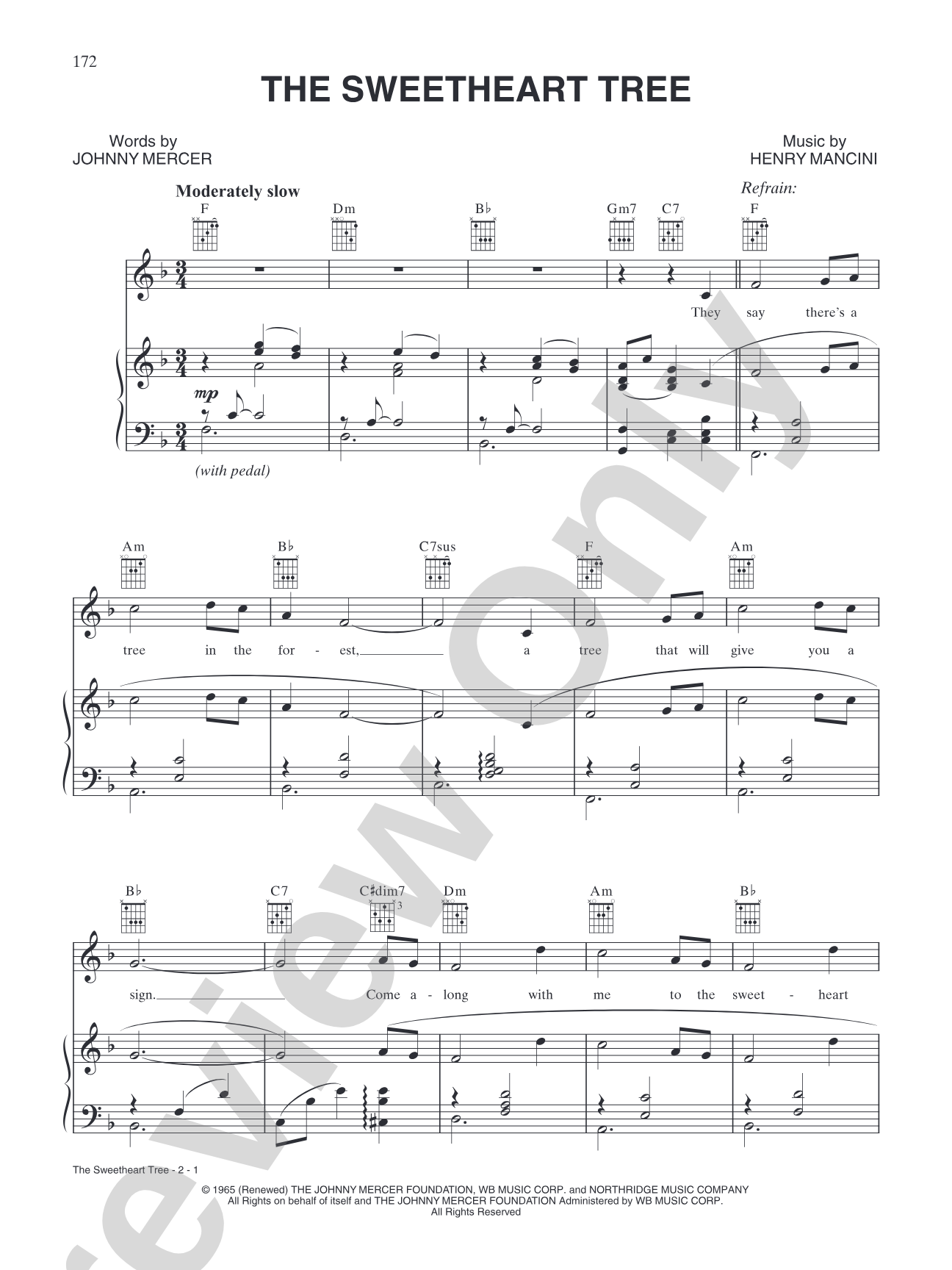

The Sweetheart Tree (from "The Great Race"): Piano/Vocal/Chords
Johnny Mercer
Item: 00-XS-0000253
$4.99
Pickup currently not available
Related Items
And the Angels Sing: Piano/Vocal/Chords |
$4.99
|
View | |
Goody-Goody: Piano/Vocal/Chords |
$4.99
|
View | |
You Must Have Been a Beautiful Baby: Piano/Vocal/Chords |
$4.99
|
View | |
Jeepers Creepers: Piano/Vocal/Chords |
$4.99
|
View | |
Lazy Bones: Piano/Vocal/Chords |
$4.99
|
View | |
Day In Day Out: Piano/Vocal/Chords |
$4.99
|
View | |
Fools Rush In (Where Angels Fear to Tread): Piano/Vocal/Chords |
$4.99
|
View | |
Laura: Piano/Vocal/Chords |
$4.99
|
View | |
Dream: Piano/Vocal/Chords |
$4.99
|
View | |
G.I. Jive: Piano/Vocal/Chords |
$4.99
|
View | |
I Though About You: Piano/Vocal/Chords |
$4.99
|
View | |
I Wanna Be Around: Piano/Vocal/Chords |
$4.99
|
View | |
I'm An Old Cowhand (From the Rio Grande): Piano/Vocal/Chords |
$4.99
|
View | |
If I Had My Druthers (from "Li'l Abner"): Piano/Vocal/Chords |
$4.99
|
View | |
Namely You (from "Li'l Abner"): Piano/Vocal/Chords |
$4.99
|
View | |
Skylark: Piano/Vocal/Chords |
$4.99
|
View | |
Something's Gotta Give (from "Daddy Long Legs"): Piano/Vocal/Chords |
$4.99
|
View | |
Strip Polka: Piano/Vocal/Chords |
$4.99
|
View | |
Two of a Kind: Piano/Vocal/Chords |
$4.99
|
View | |
Emily: Piano/Vocal/Chords |
$4.99
|
View | |
Bless Yore Beautiful Hide (from "Seven Brides for Seven Brothers"): Piano/Vocal/Chords |
$4.99
|
View | |
On the Atchison, Topeka and the Santa Fe: Piano/Vocal/Chords |
$4.99
|
View | |
Charade (from "Charade"): Piano/Vocal/Chords |
$4.99
|
View | |
Legalize My Name: Piano/Vocal/Chords |
$4.99
|
View | |
Satan's Li'l Lamb: Piano/Vocal/Chords |
$4.99
|
View | |
Too Marvelous for Words: Piano/Vocal/Chords |
$4.99
|
View | |
Hooray for Hollywood: Piano/Vocal/Chords |
$4.99
|
View | |
Blues in the Night: Piano/Vocal/Chords |
$5.99
|
View | |
Drinking Again: Piano/Vocal/Chords |
$4.99
|
View | |
Days of Wine and Roses: Piano/Vocal/Chords |
$4.99
|
View | |
Summer Wind: Piano/Vocal/Chords |
$5.99
|
View | |
Satin Doll: Piano/Vocal/Chords |
$4.99
|
View | |
The Glow Worm: Piano/Vocal/Chords |
$4.99
|
View | |
Any Place I Hang My Hat is Home: Piano/Vocal/Chords |
$4.99
|
View | |
Come Rain or Come Shine: Piano/Vocal/Chords |
$4.99
|
View | |
You Were Never Lovelier: Piano/Vocal/Chords |
$4.99
|
View |
Description
Johnny Mercer (1909--1976) was not only one of America's greatest lyricists---he helped define the American South from the outside in. His words paint rich and vivid portraits of life in his native Georgia. Mercer wrote a wide variety of songs, from lush, dreamy ballads to plays on colloquial American expressions. He joined forces with some of the most talented composers of his day, including Harold Arlen, Hoagy Carmichael, and Henry Mancini, to fashion one of the most startlingly original catalogs in American popular music. This songbook commemorates the centennial of his birth with piano/vocal sheet music arrangements (including guitar chord frames) for 46 of his most famous and best-loved classics. Titles: Ac-cent-tchu-ate the Positive * And the Angels Sing * Any Place I Hang My Hat Is Home * Autumn Leaves * Bless Yore Beautiful Hide * Blues in the Night * Charade * Come Rain or Come Shine * Day In---Day Out * Days of Wine and Roses * Dream * Drinking Again * Emily * Fools Rush In (Where Angels Fear to Tread) * G.I. Jive * The Glow-Worm * Goody-Goody * Hooray for Hollywood * I Thought About You * I Wanna Be Around * If I Had My Druthers * I'm an Old Cowhand (from the Rio Grande) * I'm Old Fashioned * In the Cool, Cool, Cool of the Evening * Jeepers Creepers * Laura * Lazybones * Legalize My Name * Moon River * My Shining Hour * Namely You * On the Atchison, Topeka and the Santa Fe * One for My Baby (and One More for the Road) * Satan's Li'l Lamb * Satin Doll * Skylark * Something's Gotta Give * Strip Polka * Summer Wind * The Sweetheart Tree * That Old Black Magic * Too Marvelous for Words * Two of a Kind * When the World Was Young * You Must Have Been a Beautiful Baby * You Were Never Lovelier.


Discover MakeMusic Cloud: thousands of interactive titles your students can play along with today.
Sample Audio
No sample audio found.
Sample Video
No sample videos found.
Additional Details
Publisher:
Alfred Music
Page Count:
200
SKU:
00-XS-0000253
More about this title
About the Composer: Johnny Mercer
Johnny Mercer (1909–1976) shaped American popular song through lyrics of extraordinary specificity and warmth. A native of Savannah, Georgia, he possessed an uncommon gift for capturing colloquial speech, regional character, and genuine emotion within formal song structure. His partnerships with composers like Henry Mancini, Harold Arlen, and Hoagy Carmichael produced some of the twentieth century's most enduring standards.
Mercer's work spanned film, Broadway, and popular recording, earning him four Academy Awards for Best Original Song. His lyrics balance sophistication with accessibility, making him essential repertoire for vocalists and pianists seeking material that demands both technical facility and interpretive maturity. His catalog remains a cornerstone of American music education.
Why we love this
This collection pairs Mercer's lyrical mastery with Henry Mancini's elegant melodic settings, giving singers and pianists access to standards that are genuinely singable while remaining harmonically rich. The guitar chord frames make these arrangements immediately useful for teaching jazz harmony and functional analysis alongside vocal interpretation.
What to expect
These songs carry the warmth of lived experience paired with the precision of craft. Mancini's accompaniments shimmer with subtle harmonic sophistication, supporting Mercer's lyrics without overwhelming them. There is elegance here, but never coldness; even the most bittersweet moments carry genuine affection for their subjects.
Who it's for
Vocalists preparing recital material, jazz and standards singers building their interpretive vocabulary, and pianists seeking sophisticated accompaniment arrangements that deepen their understanding of mid-twentieth-century harmonic language. This collection serves intermediate to advanced singers and pianists who already read fluently and are ready to engage with professional performance standards.
How to get the most out of it
- Study the relationship between Mercer's lyrical phrasing and the melodic contour; his words rarely sit awkwardly on the melody, and honoring that partnership elevates the performance from note-reading to storytelling.
- Use the chord frames to understand the harmonic movement beneath the vocal line, identifying where Mancini employs chromatic voice leading or unexpected harmonic turns that require subtle pianistic support.
- Let the text dictate your tempo and dynamic choices rather than imposing a predetermined interpretation; Mercer's specificity of language often guides the emotional arc more reliably than traditional expressive markings.
- Balance vocal prominence with sensitive piano accompaniment that respects the song's character; these are not showpiece arrangements, but intimate statements that require restraint.
How to use it
Build a recital program around individual selections from this collection to explore different moods and storytelling approaches within a unified artistic vision. These arrangements work equally well in formal recital settings and as flexible solo pieces for jazz or contemporary standards courses. Consider pairing selections thematically (ballads, rhythm songs, character pieces) to demonstrate Mercer's range as a lyricist across a single program.
Skills your students will build
- Reading and interpreting jazz chord symbols and chord frames
- Understanding lyrical phrasing and its relationship to melodic shape
- Harmonic analysis of mid-twentieth-century popular song
- Balancing vocal and pianistic roles in accompanied performance
- Developing interpretive choices grounded in textual specificity rather than convention