
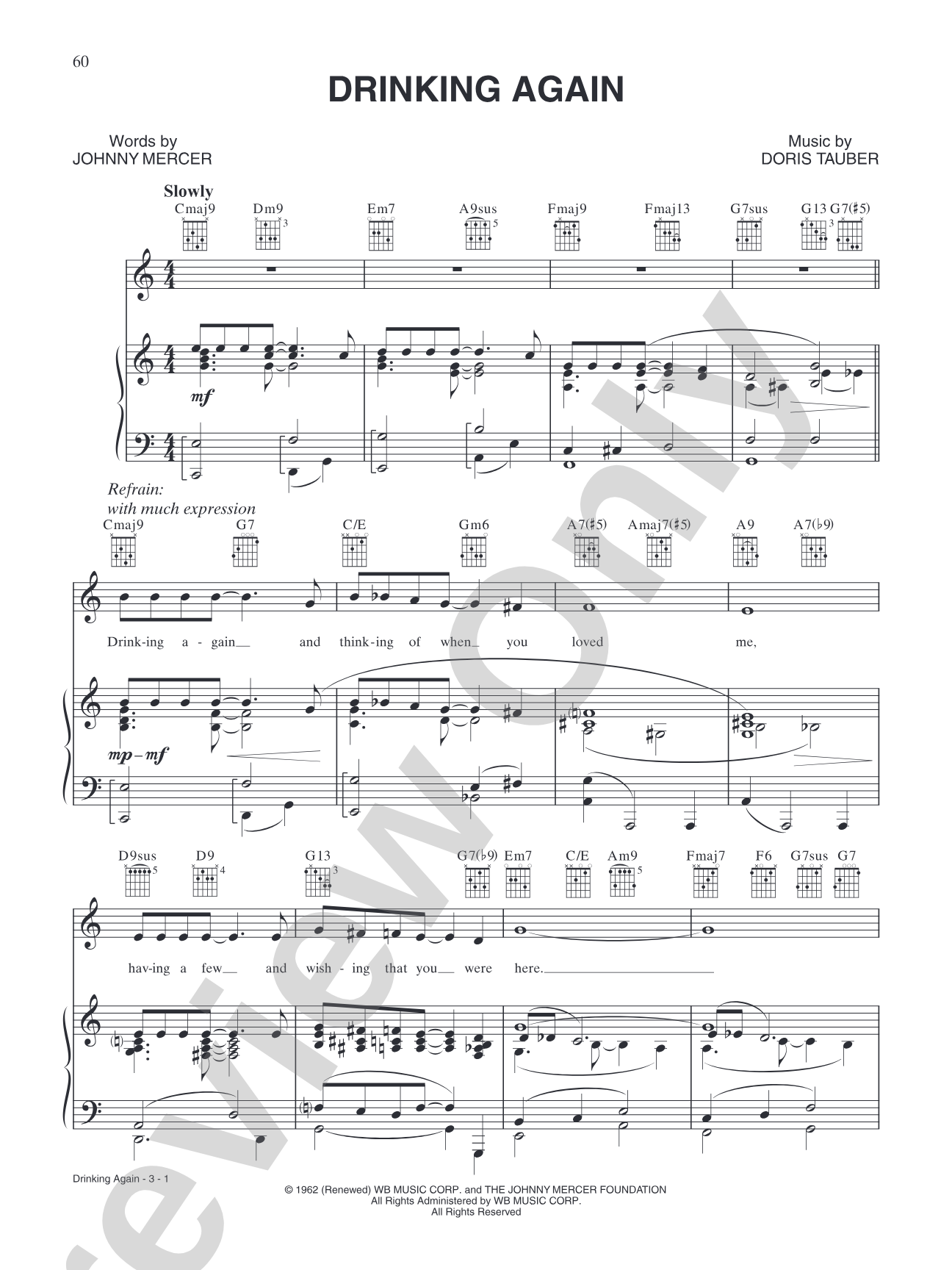

Drinking Again: Piano/Vocal/Chords
Johnny Mercer
Item: 00-XS-0000267
$4.99
One moment…
Related Items
And the Angels Sing: Piano/Vocal/Chords |
$4.99
|
View | |
Goody-Goody: Piano/Vocal/Chords |
$4.99
|
View | |
You Must Have Been a Beautiful Baby: Piano/Vocal/Chords |
$4.99
|
View | |
Jeepers Creepers: Piano/Vocal/Chords |
$4.99
|
View | |
Lazy Bones: Piano/Vocal/Chords |
$4.99
|
View | |
Day In Day Out: Piano/Vocal/Chords |
$4.99
|
View | |
Fools Rush In (Where Angels Fear to Tread): Piano/Vocal/Chords |
$4.99
|
View | |
Laura: Piano/Vocal/Chords |
$4.99
|
View | |
Dream: Piano/Vocal/Chords |
$4.99
|
View | |
G.I. Jive: Piano/Vocal/Chords |
$4.99
|
View | |
I Though About You: Piano/Vocal/Chords |
$4.99
|
View | |
I Wanna Be Around: Piano/Vocal/Chords |
$4.99
|
View | |
I'm An Old Cowhand (From the Rio Grande): Piano/Vocal/Chords |
$4.99
|
View | |
If I Had My Druthers (from "Li'l Abner"): Piano/Vocal/Chords |
$4.99
|
View | |
Namely You (from "Li'l Abner"): Piano/Vocal/Chords |
$4.99
|
View | |
Skylark: Piano/Vocal/Chords |
$4.99
|
View | |
Something's Gotta Give (from "Daddy Long Legs"): Piano/Vocal/Chords |
$4.99
|
View | |
Strip Polka: Piano/Vocal/Chords |
$4.99
|
View | |
Two of a Kind: Piano/Vocal/Chords |
$4.99
|
View | |
Emily: Piano/Vocal/Chords |
$4.99
|
View | |
Bless Yore Beautiful Hide (from "Seven Brides for Seven Brothers"): Piano/Vocal/Chords |
$4.99
|
View | |
On the Atchison, Topeka and the Santa Fe: Piano/Vocal/Chords |
$4.99
|
View | |
Charade (from "Charade"): Piano/Vocal/Chords |
$4.99
|
View | |
The Sweetheart Tree (from "The Great Race"): Piano/Vocal/Chords |
$4.99
|
View | |
Legalize My Name: Piano/Vocal/Chords |
$4.99
|
View | |
Satan's Li'l Lamb: Piano/Vocal/Chords |
$4.99
|
View | |
Too Marvelous for Words: Piano/Vocal/Chords |
$4.99
|
View | |
Hooray for Hollywood: Piano/Vocal/Chords |
$4.99
|
View | |
Blues in the Night: Piano/Vocal/Chords |
$5.99
|
View | |
Days of Wine and Roses: Piano/Vocal/Chords |
$4.99
|
View | |
Summer Wind: Piano/Vocal/Chords |
$5.99
|
View | |
Satin Doll: Piano/Vocal/Chords |
$4.99
|
View | |
The Glow Worm: Piano/Vocal/Chords |
$4.99
|
View | |
Any Place I Hang My Hat is Home: Piano/Vocal/Chords |
$4.99
|
View | |
Come Rain or Come Shine: Piano/Vocal/Chords |
$4.99
|
View | |
You Were Never Lovelier: Piano/Vocal/Chords |
$4.99
|
View |
Description
Johnny Mercer (1909--1976) was not only one of America's greatest lyricists---he helped define the American South from the outside in. His words paint rich and vivid portraits of life in his native Georgia. Mercer wrote a wide variety of songs, from lush, dreamy ballads to plays on colloquial American expressions. He joined forces with some of the most talented composers of his day, including Harold Arlen, Hoagy Carmichael, and Henry Mancini, to fashion one of the most startlingly original catalogs in American popular music. This songbook commemorates the centennial of his birth with piano/vocal sheet music arrangements (including guitar chord frames) for 46 of his most famous and best-loved classics. Titles: Ac-cent-tchu-ate the Positive * And the Angels Sing * Any Place I Hang My Hat Is Home * Autumn Leaves * Bless Yore Beautiful Hide * Blues in the Night * Charade * Come Rain or Come Shine * Day In---Day Out * Days of Wine and Roses * Dream * Drinking Again * Emily * Fools Rush In (Where Angels Fear to Tread) * G.I. Jive * The Glow-Worm * Goody-Goody * Hooray for Hollywood * I Thought About You * I Wanna Be Around * If I Had My Druthers * I'm an Old Cowhand (from the Rio Grande) * I'm Old Fashioned * In the Cool, Cool, Cool of the Evening * Jeepers Creepers * Laura * Lazybones * Legalize My Name * Moon River * My Shining Hour * Namely You * On the Atchison, Topeka and the Santa Fe * One for My Baby (and One More for the Road) * Satan's Li'l Lamb * Satin Doll * Skylark * Something's Gotta Give * Strip Polka * Summer Wind * The Sweetheart Tree * That Old Black Magic * Too Marvelous for Words * Two of a Kind * When the World Was Young * You Must Have Been a Beautiful Baby * You Were Never Lovelier.


Discover MakeMusic Cloud: thousands of interactive titles your students can play along with today.
Sample Audio
No sample audio found.
Sample Video
No sample videos found.
Additional Details
Publisher:
Alfred Music
Page Count:
200
SKU:
00-XS-0000267
More about this title
About the Composer: Johnny Mercer
Johnny Mercer (1909–1976) stands as one of the most prolific and inventive lyricists in American music history. Born in Savannah, Georgia, he brought a distinctly Southern sensibility to popular song, infusing his lyrics with regional flavor, conversational wit, and an almost poetic attention to everyday language. His collaborations with composers like Harold Arlen, Hoagy Carmichael, Henry Mancini, and Jerome Kern produced some of the twentieth century's most enduring standards, from film scores to Broadway musicals.
Mercer's gift lay in his ability to marry sophisticated harmonic settings with lyrics that felt natural and singable, never forced or overly clever. Whether writing dreamy ballads, rhythmic novelty songs, or introspective torch numbers, he demonstrated complete command of form and emotional nuance. His work shaped not only popular music but also how generations of Americans understood their own language and landscape.
Why we love this
This collection gives singers and pianists direct access to Mercer's most celebrated work in a single, practical volume. The piano arrangements support the vocal line clearly while guitar chords offer flexibility for different ensemble configurations, making these songs work equally well in a recital setting, a jazz program, or a music theater class. Mercer's lyrics reward careful attention to diction and phrasing, teaching singers how to land a story and make language sing.
What to expect
These songs capture the texture of mid-twentieth-century American popular music, from sultry torch numbers to upbeat novelty tunes to haunting romantic ballads. The collection swings between sophistication and accessibility, offering moments of genuine emotional depth alongside pure entertainment and charm.
Who it's for
Vocalists preparing recital repertoire, music theater students building a jazz and standards curriculum, and pianists seeking authentic arrangements of classic American songs. Accompanists will find clean, singable piano parts that support without overwhelming, and guitarists can use the chord frames to play alongside or independently.
How to get the most out of it
- Study the lyrics as poetry first. Mercer's wit and specificity demand that you understand every image and phrase before you sing it; this clarity transforms the performance from pleasant to compelling.
- Let the piano part guide your interpretation of tempo and rubato. Many of these songs sit between strict rhythm and ballad flexibility; the accompaniment shows you where to breathe and where to push forward.
- Balance vocal intimacy with the song's harmonic richness. These arrangements have lush chords that can easily overwhelm a small voice; aim for clarity in the melody while letting the piano frame the emotional landscape.
- Use the guitar chords as a tool for understanding the harmonic movement, even if you're performing with piano alone. Seeing the chord progression helps you shape phrases and understand which syllables land on important harmonic moments.
How to use it
Build a recital around Mercer's collaborations with specific composers, comparing his approach across different compositional voices. These songs work beautifully as a capstone to a unit on American popular song, or as audition material for music theater or jazz voice students. They also pair well with discussion of how lyrical language shapes musical interpretation.
Skills your students will build
- Interpreting American vernacular diction and maintaining clarity through jazz harmonies
- Balancing vocal line with complex piano accompaniment
- Understanding how lyrical imagery and emotional arc shape musical phrasing
- Navigating swing rhythms and syncopation in a vocal context
- Reading and applying guitar chord symbols to harmonic understanding