
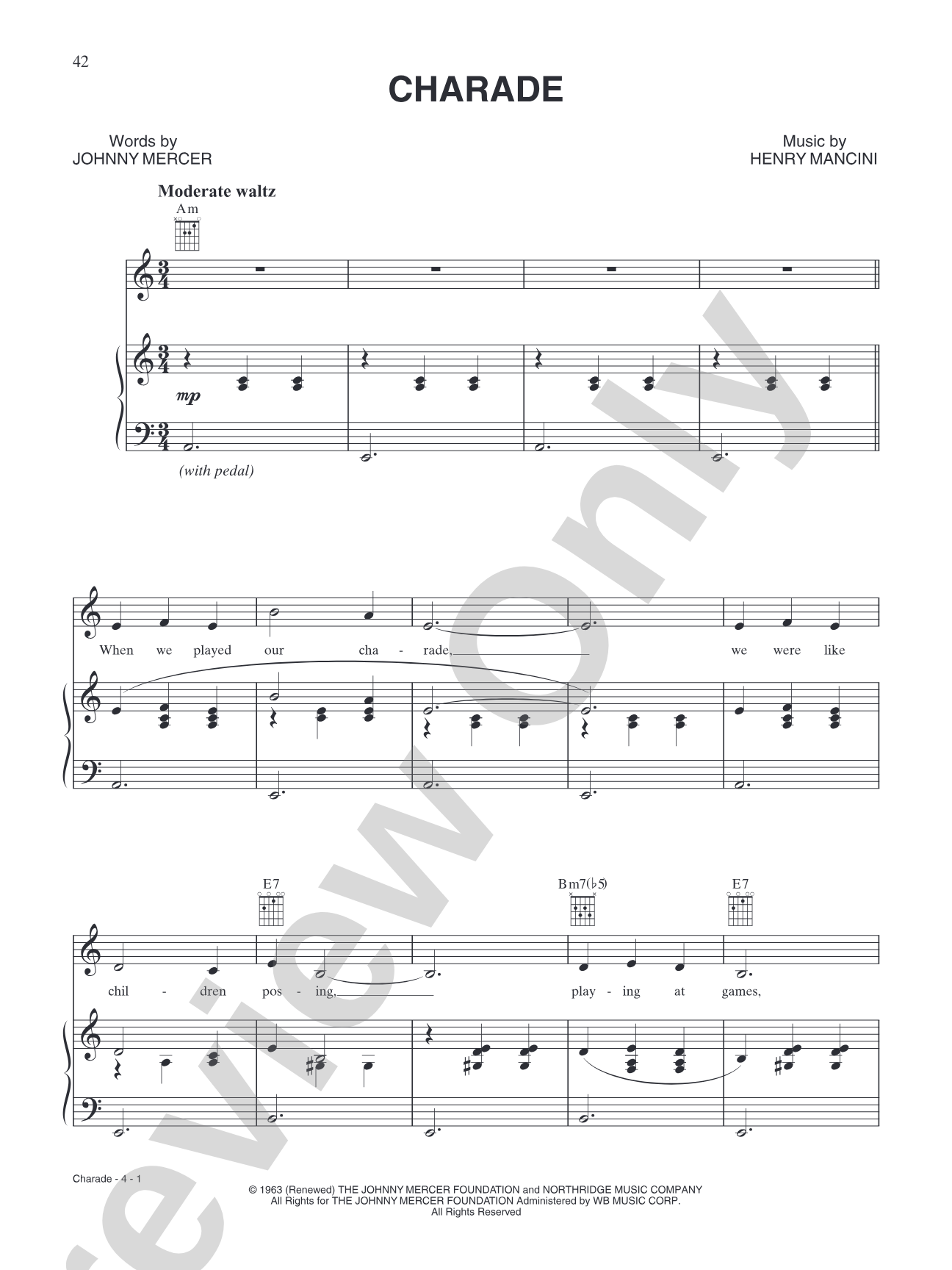

Charade (from "Charade"): Piano/Vocal/Chords
Johnny Mercer
Item: 00-XS-0000252
$4.99
One moment…
Related Items
And the Angels Sing: Piano/Vocal/Chords |
$4.99
|
View | |
Goody-Goody: Piano/Vocal/Chords |
$4.99
|
View | |
You Must Have Been a Beautiful Baby: Piano/Vocal/Chords |
$4.99
|
View | |
Jeepers Creepers: Piano/Vocal/Chords |
$4.99
|
View | |
Lazy Bones: Piano/Vocal/Chords |
$4.99
|
View | |
Day In Day Out: Piano/Vocal/Chords |
$4.99
|
View | |
Fools Rush In (Where Angels Fear to Tread): Piano/Vocal/Chords |
$4.99
|
View | |
Laura: Piano/Vocal/Chords |
$4.99
|
View | |
Dream: Piano/Vocal/Chords |
$4.99
|
View | |
G.I. Jive: Piano/Vocal/Chords |
$4.99
|
View | |
I Though About You: Piano/Vocal/Chords |
$4.99
|
View | |
I Wanna Be Around: Piano/Vocal/Chords |
$4.99
|
View | |
I'm An Old Cowhand (From the Rio Grande): Piano/Vocal/Chords |
$4.99
|
View | |
If I Had My Druthers (from "Li'l Abner"): Piano/Vocal/Chords |
$4.99
|
View | |
Namely You (from "Li'l Abner"): Piano/Vocal/Chords |
$4.99
|
View | |
Skylark: Piano/Vocal/Chords |
$4.99
|
View | |
Something's Gotta Give (from "Daddy Long Legs"): Piano/Vocal/Chords |
$4.99
|
View | |
Strip Polka: Piano/Vocal/Chords |
$4.99
|
View | |
Two of a Kind: Piano/Vocal/Chords |
$4.99
|
View | |
Emily: Piano/Vocal/Chords |
$4.99
|
View | |
Bless Yore Beautiful Hide (from "Seven Brides for Seven Brothers"): Piano/Vocal/Chords |
$4.99
|
View | |
On the Atchison, Topeka and the Santa Fe: Piano/Vocal/Chords |
$4.99
|
View | |
The Sweetheart Tree (from "The Great Race"): Piano/Vocal/Chords |
$4.99
|
View | |
Legalize My Name: Piano/Vocal/Chords |
$4.99
|
View | |
Satan's Li'l Lamb: Piano/Vocal/Chords |
$4.99
|
View | |
Too Marvelous for Words: Piano/Vocal/Chords |
$4.99
|
View | |
Hooray for Hollywood: Piano/Vocal/Chords |
$4.99
|
View | |
Blues in the Night: Piano/Vocal/Chords |
$5.99
|
View | |
Drinking Again: Piano/Vocal/Chords |
$4.99
|
View | |
Days of Wine and Roses: Piano/Vocal/Chords |
$4.99
|
View | |
Summer Wind: Piano/Vocal/Chords |
$5.99
|
View | |
Satin Doll: Piano/Vocal/Chords |
$4.99
|
View | |
The Glow Worm: Piano/Vocal/Chords |
$4.99
|
View | |
Any Place I Hang My Hat is Home: Piano/Vocal/Chords |
$4.99
|
View | |
Come Rain or Come Shine: Piano/Vocal/Chords |
$4.99
|
View | |
You Were Never Lovelier: Piano/Vocal/Chords |
$4.99
|
View |
Description
Johnny Mercer (1909--1976) was not only one of America's greatest lyricists---he helped define the American South from the outside in. His words paint rich and vivid portraits of life in his native Georgia. Mercer wrote a wide variety of songs, from lush, dreamy ballads to plays on colloquial American expressions. He joined forces with some of the most talented composers of his day, including Harold Arlen, Hoagy Carmichael, and Henry Mancini, to fashion one of the most startlingly original catalogs in American popular music. This songbook commemorates the centennial of his birth with piano/vocal sheet music arrangements (including guitar chord frames) for 46 of his most famous and best-loved classics. Titles: Ac-cent-tchu-ate the Positive * And the Angels Sing * Any Place I Hang My Hat Is Home * Autumn Leaves * Bless Yore Beautiful Hide * Blues in the Night * Charade * Come Rain or Come Shine * Day In---Day Out * Days of Wine and Roses * Dream * Drinking Again * Emily * Fools Rush In (Where Angels Fear to Tread) * G.I. Jive * The Glow-Worm * Goody-Goody * Hooray for Hollywood * I Thought About You * I Wanna Be Around * If I Had My Druthers * I'm an Old Cowhand (from the Rio Grande) * I'm Old Fashioned * In the Cool, Cool, Cool of the Evening * Jeepers Creepers * Laura * Lazybones * Legalize My Name * Moon River * My Shining Hour * Namely You * On the Atchison, Topeka and the Santa Fe * One for My Baby (and One More for the Road) * Satan's Li'l Lamb * Satin Doll * Skylark * Something's Gotta Give * Strip Polka * Summer Wind * The Sweetheart Tree * That Old Black Magic * Too Marvelous for Words * Two of a Kind * When the World Was Young * You Must Have Been a Beautiful Baby * You Were Never Lovelier.


Discover MakeMusic Cloud: thousands of interactive titles your students can play along with today.
Sample Audio
No sample audio found.
Sample Video
No sample videos found.
Additional Details
Publisher:
Alfred Music
Page Count:
200
SKU:
00-XS-0000252
More about this title
About the Composer: Johnny Mercer
Johnny Mercer (1909–1976) stands as one of the most prolific and versatile lyricists in American popular music. Born in Savannah, Georgia, Mercer brought a distinctive regional sensibility to his work, crafting lyrics that ranged from whimsical and playful to deeply introspective. His gift for colloquial language and rhythmic precision made his words instantly singable and memorable, whether paired with a jazz standard or a Hollywood film score.
Mercer's collaborations with composers like Henry Mancini, Harold Arlen, and Hoagy Carmichael produced some of the twentieth century's most enduring songs. His catalog reveals an artist equally comfortable writing sophisticated witticisms for cabaret audiences and accessible, heartfelt melodies for film and Broadway. Beyond his songwriting, Mercer was a co-founder of Capitol Records, demonstrating his deep investment in the business and craft of American music.
Why we love this
This collection captures Mercer's remarkable range in a single volume: the playful swing of 'Ac-cent-tchu-ate the Positive,' the nocturnal sophistication of 'One for My Baby,' and the aching beauty of 'Moon River' all sit alongside each other. Piano and vocal students gain access to 46 of the most teachable standards in the American songbook, each one a masterclass in how lyrical content shapes musical interpretation.
What to expect
These songs embody the spirit of mid-twentieth-century American songwriting: sophisticated yet approachable, witty yet sincere, rooted in jazz language but accessible to audiences everywhere. Whether you're playing the dreamy elegance of 'Autumn Leaves' or the swinging energy of 'G.I. Jive,' each arrangement carries the craftsmanship and warmth that Mercer brought to every lyric he wrote.
Who it's for
This book serves pianists and vocalists learning the standards repertoire, as well as guitarists seeking accessible arrangements with proper chord notation. It's equally valuable for music students building jazz and popular music literacy and for performers looking to expand their recital programs with authentic, professionally arranged versions of beloved classics.
How to get the most out of it
- Study the lyrics before diving into the melody. Mercer's words move with such precision that understanding the scansion and emotional arc of each phrase transforms how you shape the vocal line and breathe.
- Use the chord frames to explore different voicings on guitar. These standards benefit enormously from reharmonization, and the printed chords serve as a springboard rather than a limit.
- Listen to classic vocal recordings of these songs (Ella Fitzgerald, Frank Sinatra, Nat King Cole) to hear how different singers approach the same lyrical material. Each performer reveals different colors in the text.
- Balance the piano accompaniment so it supports rather than overwhelms the voice. These are singer-centered songs, and the piano should provide harmonic grounding and subtle rhythmic direction.
How to use it
Program individual selections from this collection alongside other standards to build an evening of American song, or use it as a resource for recitals spanning multiple styles and moods. Voice students can build an audition repertoire with pieces that showcase legit singing, jazz sensibility, and lyrical storytelling. For piano students, these arrangements provide bridge material between classical technique and improvisation-friendly jazz standards.
Skills your students will build
- Reading piano/vocal/guitar chord notation and sight-reading with chord frames
- Phrasing and interpretation guided by lyrical content and poetic meter
- Jazz-inflected harmony and voice-leading in popular song arrangements
- Balancing vocal and instrumental parts to center the singer in ensemble
- Understanding the relationship between conversational language and melodic rhythm in American songwriting