
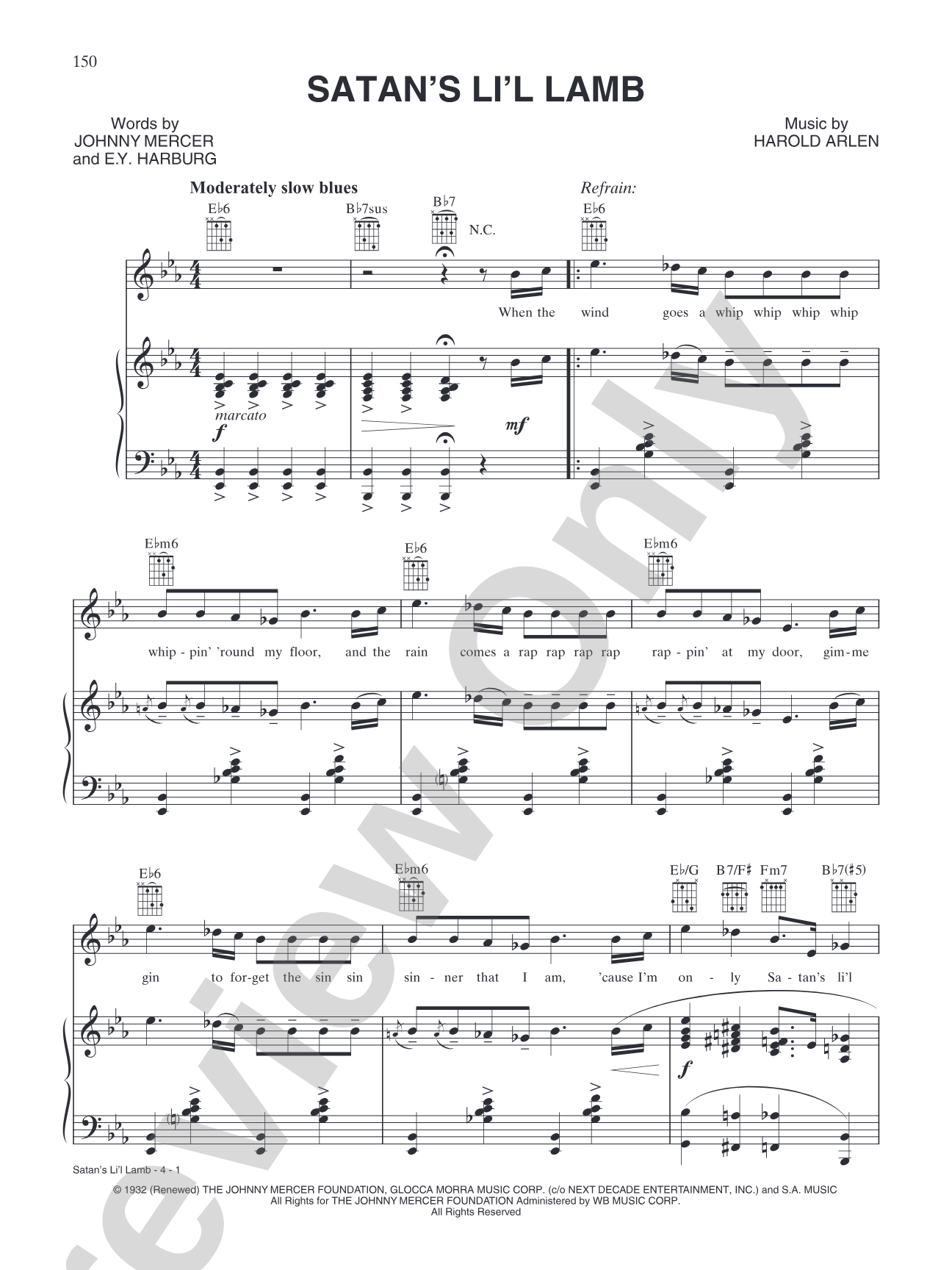

Satan's Li'l Lamb: Piano/Vocal/Chords
Johnny Mercer
Item: 00-XS-0000263
$4.99
One moment…
Related Items
And the Angels Sing: Piano/Vocal/Chords |
$4.99
|
View | |
Goody-Goody: Piano/Vocal/Chords |
$4.99
|
View | |
You Must Have Been a Beautiful Baby: Piano/Vocal/Chords |
$4.99
|
View | |
Jeepers Creepers: Piano/Vocal/Chords |
$4.99
|
View | |
Lazy Bones: Piano/Vocal/Chords |
$4.99
|
View | |
Day In Day Out: Piano/Vocal/Chords |
$4.99
|
View | |
Fools Rush In (Where Angels Fear to Tread): Piano/Vocal/Chords |
$4.99
|
View | |
Laura: Piano/Vocal/Chords |
$4.99
|
View | |
Dream: Piano/Vocal/Chords |
$4.99
|
View | |
G.I. Jive: Piano/Vocal/Chords |
$4.99
|
View | |
I Though About You: Piano/Vocal/Chords |
$4.99
|
View | |
I Wanna Be Around: Piano/Vocal/Chords |
$4.99
|
View | |
I'm An Old Cowhand (From the Rio Grande): Piano/Vocal/Chords |
$4.99
|
View | |
If I Had My Druthers (from "Li'l Abner"): Piano/Vocal/Chords |
$4.99
|
View | |
Namely You (from "Li'l Abner"): Piano/Vocal/Chords |
$4.99
|
View | |
Skylark: Piano/Vocal/Chords |
$4.99
|
View | |
Something's Gotta Give (from "Daddy Long Legs"): Piano/Vocal/Chords |
$4.99
|
View | |
Strip Polka: Piano/Vocal/Chords |
$4.99
|
View | |
Two of a Kind: Piano/Vocal/Chords |
$4.99
|
View | |
Emily: Piano/Vocal/Chords |
$4.99
|
View | |
Bless Yore Beautiful Hide (from "Seven Brides for Seven Brothers"): Piano/Vocal/Chords |
$4.99
|
View | |
On the Atchison, Topeka and the Santa Fe: Piano/Vocal/Chords |
$4.99
|
View | |
Charade (from "Charade"): Piano/Vocal/Chords |
$4.99
|
View | |
The Sweetheart Tree (from "The Great Race"): Piano/Vocal/Chords |
$4.99
|
View | |
Legalize My Name: Piano/Vocal/Chords |
$4.99
|
View | |
Too Marvelous for Words: Piano/Vocal/Chords |
$4.99
|
View | |
Hooray for Hollywood: Piano/Vocal/Chords |
$4.99
|
View | |
Blues in the Night: Piano/Vocal/Chords |
$5.99
|
View | |
Drinking Again: Piano/Vocal/Chords |
$4.99
|
View | |
Days of Wine and Roses: Piano/Vocal/Chords |
$4.99
|
View | |
Summer Wind: Piano/Vocal/Chords |
$5.99
|
View | |
Satin Doll: Piano/Vocal/Chords |
$4.99
|
View | |
The Glow Worm: Piano/Vocal/Chords |
$4.99
|
View | |
Any Place I Hang My Hat is Home: Piano/Vocal/Chords |
$4.99
|
View | |
Come Rain or Come Shine: Piano/Vocal/Chords |
$4.99
|
View | |
You Were Never Lovelier: Piano/Vocal/Chords |
$4.99
|
View |
Description
Johnny Mercer (1909--1976) was not only one of America's greatest lyricists---he helped define the American South from the outside in. His words paint rich and vivid portraits of life in his native Georgia. Mercer wrote a wide variety of songs, from lush, dreamy ballads to plays on colloquial American expressions. He joined forces with some of the most talented composers of his day, including Harold Arlen, Hoagy Carmichael, and Henry Mancini, to fashion one of the most startlingly original catalogs in American popular music. This songbook commemorates the centennial of his birth with piano/vocal sheet music arrangements (including guitar chord frames) for 46 of his most famous and best-loved classics. Titles: Ac-cent-tchu-ate the Positive * And the Angels Sing * Any Place I Hang My Hat Is Home * Autumn Leaves * Bless Yore Beautiful Hide * Blues in the Night * Charade * Come Rain or Come Shine * Day In---Day Out * Days of Wine and Roses * Dream * Drinking Again * Emily * Fools Rush In (Where Angels Fear to Tread) * G.I. Jive * The Glow-Worm * Goody-Goody * Hooray for Hollywood * I Thought About You * I Wanna Be Around * If I Had My Druthers * I'm an Old Cowhand (from the Rio Grande) * I'm Old Fashioned * In the Cool, Cool, Cool of the Evening * Jeepers Creepers * Laura * Lazybones * Legalize My Name * Moon River * My Shining Hour * Namely You * On the Atchison, Topeka and the Santa Fe * One for My Baby (and One More for the Road) * Satan's Li'l Lamb * Satin Doll * Skylark * Something's Gotta Give * Strip Polka * Summer Wind * The Sweetheart Tree * That Old Black Magic * Too Marvelous for Words * Two of a Kind * When the World Was Young * You Must Have Been a Beautiful Baby * You Were Never Lovelier.


Discover MakeMusic Cloud: thousands of interactive titles your students can play along with today.
Sample Audio
No sample audio found.
Sample Video
No sample videos found.
Additional Details
Publisher:
Alfred Music
Page Count:
200
SKU:
00-XS-0000263
More about this title
About the Composer: Johnny Mercer
Johnny Mercer (1909–1976) stands as one of the most prolific and inventive lyricists in American popular music. Born in Savannah, Georgia, Mercer brought a distinctly Southern sensibility to songs written across nearly every genre: jazz standards, film scores, Broadway shows, and pop hits. His gift lay in precise, conversational language that could shift from whimsical wordplay to genuine emotional depth within a single song. He collaborated with the era's most celebrated composers, including Harold Arlen, Henry Mancini, and Hoagy Carmichael, creating a songbook that defined American song for generations.
Mercer's influence on music education remains substantial. His lyrics reward close listening and study of prosody; they demonstrate how words and melody can lock together with absolute precision. Teachers and singers value his catalog for its clarity of storytelling, its respect for the intelligence of the listener, and its inexhaustible melodic variety. Whether teaching vocal expression, exploring the Great American Songbook, or building a foundation in jazz standards, Mercer's work offers both technical instruction and genuine pleasure.
Why we love this
This collection captures the full spectrum of Mercer's genius in a single, practical volume. The 46 selections span decades and moods, giving pianists and singers access to both signature classics and deeper cuts that reveal just how consistently inventive Mercer was as a craftsman. The inclusion of chord frames makes these arrangements immediately accessible to guitarists and pianists alike, whether you're working with a soloist or building a flexible accompaniment setup.
What to expect
These songs carry the warmth and specificity of mid-twentieth-century American vernacular. Whether the mood is melancholic ('Autumn Leaves,' 'One for My Baby'), playful ('Ac-cent-tchu-ate the Positive,' 'I'm an Old Cowhand'), or elegant ('Moon River,' 'Days of Wine and Roses'), each arrangement preserves the intimacy and clarity that made Mercer's lyrics unforgettable. There's a conversational ease to the music, as if someone is leaning in to tell you a story you actually want to hear.
Who it's for
Pianists and vocalists preparing recital repertoire, jazz standards study, or audition material will find an extensive collection of performance-ready arrangements. Music teachers exploring the Great American Songbook with advanced students benefit from having this many Mercer titles in one accessible, chord-annotated source. Accompanists supporting singers in any genre will recognize the range and depth here.
How to get the most out of it
- Study the lyric separately before learning the melody. Mercer's rhythmic precision and word stress can feel unexpected on first reading; understanding the natural speech pattern of each line clarifies the melodic contour.
- Treat the guitar chords as a foundation, not a limitation. Use them as a springboard for reharmonization or improvisation, especially in jazz-inflected pieces like 'Satin Doll' or 'One for My Baby.'
- Balance the piano part with the vocal line carefully. Many of these arrangements feature complex accompaniment figures; resist overplaying them in favor of letting the lyric remain the primary focus.
How to use it
Build a recital or concert around a Mercer theme, drawing from different moods and eras within this collection to create narrative arc and musical variety. Use individual selections as encore material or as teaching repertoire in voice lessons and jazz workshops. The breadth here makes it valuable for study of how a single lyricist's voice remains recognizable whether the composer is Arlen, Mancini, or Carmichael.
Skills your students will build
- Interpretation of lyric-driven melody and phrasing
- Sight-reading piano/vocal arrangements with guitar chord notation
- Understanding harmonic language of jazz and American songbook standards
- Stylistic flexibility across ballads, uptempo numbers, and character songs
- Accompanying techniques for singers and vocalists