
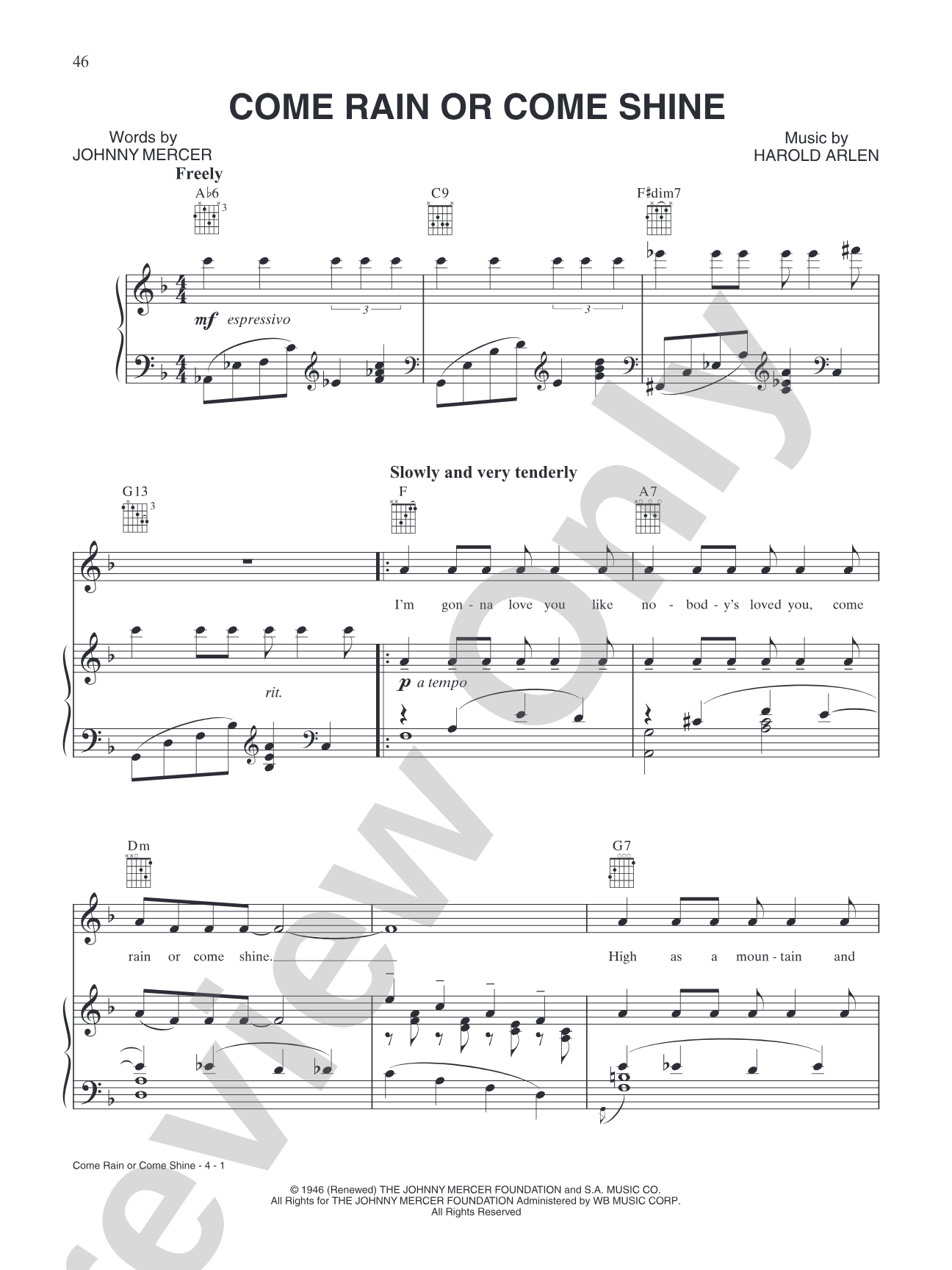

Come Rain or Come Shine: Piano/Vocal/Chords
Johnny Mercer
Item: 00-XS-0000277
$4.99
One moment…
Related Items
And the Angels Sing: Piano/Vocal/Chords |
$4.99
|
View | |
Goody-Goody: Piano/Vocal/Chords |
$4.99
|
View | |
You Must Have Been a Beautiful Baby: Piano/Vocal/Chords |
$4.99
|
View | |
Jeepers Creepers: Piano/Vocal/Chords |
$4.99
|
View | |
Lazy Bones: Piano/Vocal/Chords |
$4.99
|
View | |
Day In Day Out: Piano/Vocal/Chords |
$4.99
|
View | |
Fools Rush In (Where Angels Fear to Tread): Piano/Vocal/Chords |
$4.99
|
View | |
Laura: Piano/Vocal/Chords |
$4.99
|
View | |
Dream: Piano/Vocal/Chords |
$4.99
|
View | |
G.I. Jive: Piano/Vocal/Chords |
$4.99
|
View | |
I Though About You: Piano/Vocal/Chords |
$4.99
|
View | |
I Wanna Be Around: Piano/Vocal/Chords |
$4.99
|
View | |
I'm An Old Cowhand (From the Rio Grande): Piano/Vocal/Chords |
$4.99
|
View | |
If I Had My Druthers (from "Li'l Abner"): Piano/Vocal/Chords |
$4.99
|
View | |
Namely You (from "Li'l Abner"): Piano/Vocal/Chords |
$4.99
|
View | |
Skylark: Piano/Vocal/Chords |
$4.99
|
View | |
Something's Gotta Give (from "Daddy Long Legs"): Piano/Vocal/Chords |
$4.99
|
View | |
Strip Polka: Piano/Vocal/Chords |
$4.99
|
View | |
Two of a Kind: Piano/Vocal/Chords |
$4.99
|
View | |
Emily: Piano/Vocal/Chords |
$4.99
|
View | |
Bless Yore Beautiful Hide (from "Seven Brides for Seven Brothers"): Piano/Vocal/Chords |
$4.99
|
View | |
On the Atchison, Topeka and the Santa Fe: Piano/Vocal/Chords |
$4.99
|
View | |
Charade (from "Charade"): Piano/Vocal/Chords |
$4.99
|
View | |
The Sweetheart Tree (from "The Great Race"): Piano/Vocal/Chords |
$4.99
|
View | |
Legalize My Name: Piano/Vocal/Chords |
$4.99
|
View | |
Satan's Li'l Lamb: Piano/Vocal/Chords |
$4.99
|
View | |
Too Marvelous for Words: Piano/Vocal/Chords |
$4.99
|
View | |
Hooray for Hollywood: Piano/Vocal/Chords |
$4.99
|
View | |
Blues in the Night: Piano/Vocal/Chords |
$5.99
|
View | |
Drinking Again: Piano/Vocal/Chords |
$4.99
|
View | |
Days of Wine and Roses: Piano/Vocal/Chords |
$4.99
|
View | |
Summer Wind: Piano/Vocal/Chords |
$5.99
|
View | |
Satin Doll: Piano/Vocal/Chords |
$4.99
|
View | |
The Glow Worm: Piano/Vocal/Chords |
$4.99
|
View | |
Any Place I Hang My Hat is Home: Piano/Vocal/Chords |
$4.99
|
View | |
You Were Never Lovelier: Piano/Vocal/Chords |
$4.99
|
View |
Description
Johnny Mercer (1909--1976) was not only one of America's greatest lyricists---he helped define the American South from the outside in. His words paint rich and vivid portraits of life in his native Georgia. Mercer wrote a wide variety of songs, from lush, dreamy ballads to plays on colloquial American expressions. He joined forces with some of the most talented composers of his day, including Harold Arlen, Hoagy Carmichael, and Henry Mancini, to fashion one of the most startlingly original catalogs in American popular music. This songbook commemorates the centennial of his birth with piano/vocal sheet music arrangements (including guitar chord frames) for 46 of his most famous and best-loved classics. Titles: Ac-cent-tchu-ate the Positive * And the Angels Sing * Any Place I Hang My Hat Is Home * Autumn Leaves * Bless Yore Beautiful Hide * Blues in the Night * Charade * Come Rain or Come Shine * Day In---Day Out * Days of Wine and Roses * Dream * Drinking Again * Emily * Fools Rush In (Where Angels Fear to Tread) * G.I. Jive * The Glow-Worm * Goody-Goody * Hooray for Hollywood * I Thought About You * I Wanna Be Around * If I Had My Druthers * I'm an Old Cowhand (from the Rio Grande) * I'm Old Fashioned * In the Cool, Cool, Cool of the Evening * Jeepers Creepers * Laura * Lazybones * Legalize My Name * Moon River * My Shining Hour * Namely You * On the Atchison, Topeka and the Santa Fe * One for My Baby (and One More for the Road) * Satan's Li'l Lamb * Satin Doll * Skylark * Something's Gotta Give * Strip Polka * Summer Wind * The Sweetheart Tree * That Old Black Magic * Too Marvelous for Words * Two of a Kind * When the World Was Young * You Must Have Been a Beautiful Baby * You Were Never Lovelier.


Discover MakeMusic Cloud: thousands of interactive titles your students can play along with today.
Sample Audio
No sample audio found.
Sample Video
No sample videos found.
Additional Details
Publisher:
Alfred Music
Page Count:
200
SKU:
00-XS-0000277
More about this title
About the Composer: Johnny Mercer
Johnny Mercer (1909-1976) stands among the most prolific and inventive lyricists in American popular music history. A native of Savannah, Georgia, Mercer brought a distinctly Southern sensibility to his work, infusing his lyrics with regional idioms, vivid storytelling, and an ear for natural speech rhythms that made complex emotions feel intimate and immediate. He collaborated with some of the twentieth century's finest composers including Harold Arlen, Hoagy Carmichael, Henry Mancini, and Jerome Kern, creating a catalog that spans jazz standards, film scores, and theatrical works.
Mercer's genius lay in his ability to move fluidly between registers. He could write whimsical novelty numbers ("G.I. Jive") and achingly beautiful ballads ("Moon River") with equal mastery. His lyrics reward careful listening and repeated performance; they reveal new layers of wit, vulnerability, and musical intelligence each time a singer inhabits them. For educators and performers, Mercer's work offers an unmatched education in American song craft and the art of text-setting.
Why we love this
This collection captures a songwriter whose work defined the sound of American popular song across seven decades of film, theater, and jazz standards. Every arrangement here sits perfectly under the voice, giving singers room to inhabit Mercer's conversational wit and emotional depth without fighting the accompaniment. The breadth of styles (novelty numbers, film ballads, jazz standards, show tunes) means you can program across moods and showcase the full range of what makes this repertoire endure.
What to expect
These songs evoke the golden age of American songwriting, when lyrical cleverness and emotional honesty coexisted without contradiction. Some tracks shimmer with optimism and playfulness ("Hooray for Hollywood"); others settle into smoky, contemplative spaces ("One for My Baby"). The overall arc moves between nostalgia and immediacy, always grounded in Mercer's gift for capturing authentic human experience through deceptively simple language.
Who it's for
Pianists and vocalists preparing songs for recital, audition, or casual performance will find reliable, singable arrangements of American standards that sit well on the voice and work equally well as piano solos. Jazz singers, cabaret performers, and music theater students benefit from access to iconic repertoire in a single volume. Community and adult amateur singers building a performance songbook will appreciate the mix of recognizable classics and deeper cuts.
How to get the most out of it
- Sing the text naturally, following speech patterns rather than strict melodic phrasing. Mercer wrote words first, and the melody serves the language; let your delivery reflect that priority.
- Pay close attention to the guitar chords when accompanying yourself or working with a guitarist. These voicings are carefully chosen and often contain passing tones that add sophistication to the harmonic movement.
- Balance the vocal line with piano accompaniment by listening to how the composer-lyricist duo scored each song. Some arrangements are sparse and intimate; others are lush. Match your vocal weight to the accompaniment's texture.
- Work through the bridge or release sections of these songs with particular care. Mercer often shifts emotional tone in the second half, and the harmonic movement can be unexpected; practice these transitions deliberately.
How to use it
Program individual selections as solo recital repertoire or build a full concert around Mercer's work, pairing upbeat novelties with introspective ballads to show the full emotional and stylistic range of his catalog. These arrangements work beautifully in cabaret-style performances where the pianist is part of the storytelling. Use the collection as a primary text in a course on American popular song or twentieth-century song craft, since each piece demonstrates distinct lyrical and musical techniques.
Skills your students will build
- Interpreting conversational, speech-like text delivery in song
- Balancing melody and accompaniment in singer-pianist collaboration
- Reading and performing jazz-influenced harmonic language and chord substitutions
- Understanding voice-leading and harmonic sophistication in popular song
- Sustaining a performance across varied tempos, moods, and styles within a single program