
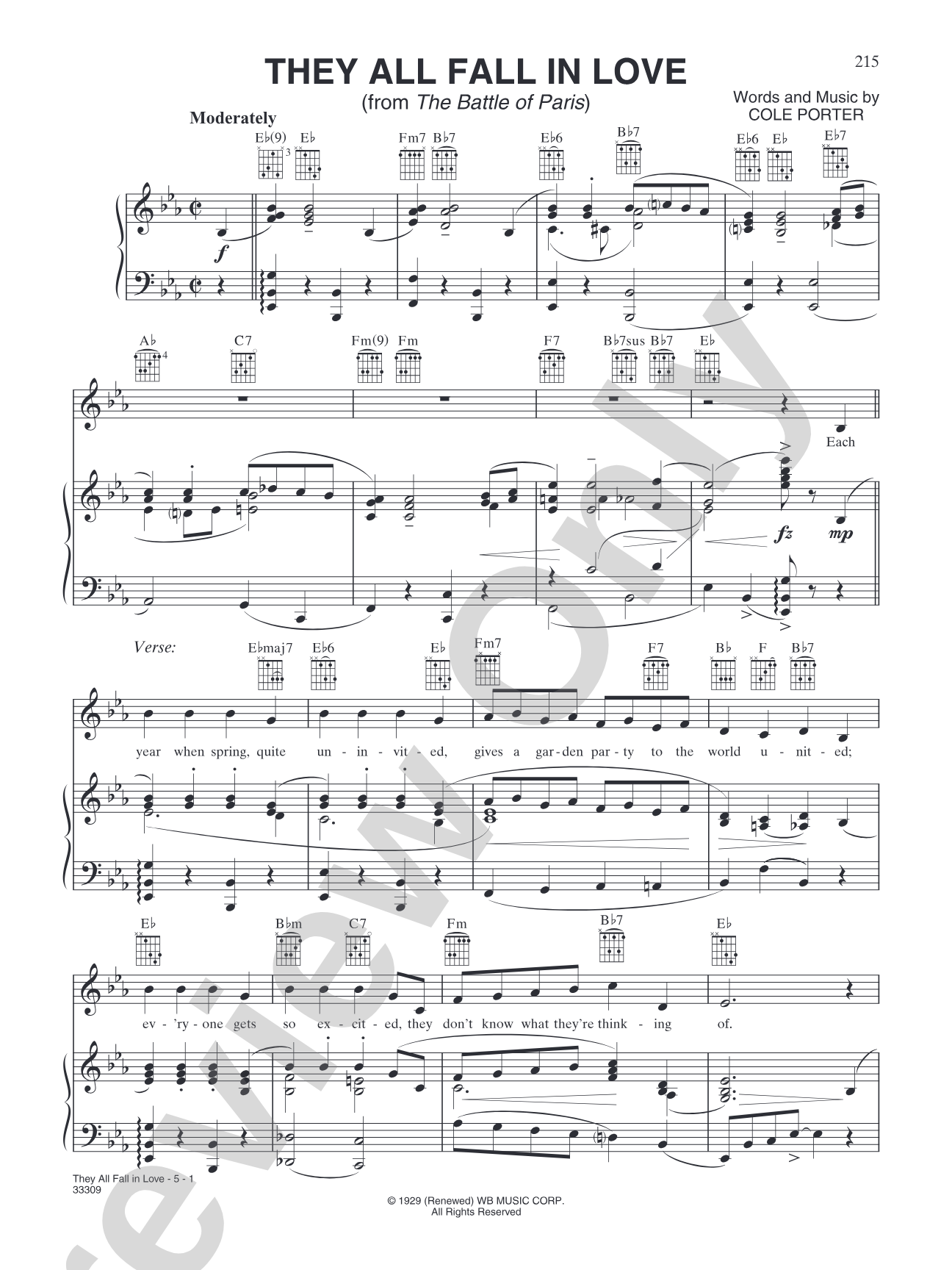

They All Fall in Love (from "The Battle of Paris"): Piano/Vocal/Chords
Cole Porter
Item: 00-PS-0003949
$4.99
One moment…
Related Items
Begin the Beguine (from "Jubilee" and "Broadway Melody of 1940"): Piano/Vocal/Chords |
$3.99
|
View | |
Ridin' High (from "Red, Hot and Blue!" and "High Society"): Piano/Vocal/Chords |
$4.99
|
View | |
I'm in Love Again (from "Greenwich Village Follies of 1924"): Piano/Vocal/Chords |
$4.99
|
View | |
I'm Unlucky at Gambling (from "Fifty Million Frenchmen"): Piano/Vocal/Chords |
$4.99
|
View | |
Let's Do It (Let's Fall in Love) (from "Paris"): Piano/Vocal/Chords |
$4.99
|
View | |
Looking at You (from "Wake Up and Dream"): Piano/Vocal/Chords |
$4.99
|
View | |
Love for Sale (from "The New Yorkers"): Piano/Vocal/Chords |
$5.99
|
View | |
Night and Day (from "Gay Divorce"): Piano/Vocal/Chords |
$4.99
|
View | |
How's Your Romance (from "Gay Divorce"): Piano/Vocal/Chords |
$5.99
|
View | |
How Could We Be Wrong (from "Nymph Errant"): Piano/Vocal/Chords |
$4.99
|
View | |
Anything Goes (from the 1987 Revival "Anything Goes"): Piano/Vocal/Chords |
$9.99
|
View | |
It's De-Lovely (from "Red, Hot and Blue!"): Piano/Vocal/Chords |
$5.99
|
View | |
Wake Up and Dream (from "Wake Up and Dream"): Piano/Vocal/Chords |
$4.99
|
View | |
I've Got You on My Mind (from "Stardust" and "Gay Divorce"): Piano/Vocal/Chords |
$4.99
|
View | |
The Great Indoors (from "The New Yorkers"): Piano/Vocal/Chords |
$4.99
|
View | |
It's Bad for Me (from "Nymph Errant"): Piano/Vocal/Chords |
$4.99
|
View | |
Which? (from "Wake Up and Dream"): Piano/Vocal/Chords |
$4.99
|
View | |
You Don't Know Paree (from "Fifty Million Frenchmen"): Piano/Vocal/Chords |
$4.99
|
View | |
Goodbye, Little Dream, Goodbye (from "O Mistress Mine"): Piano/Vocal/Chords |
$4.99
|
View | |
Let's Misbehave: Piano/Vocal/Chords |
$4.99
|
View | |
What Is This Thing Called Love? (from "Wake Up and Dream"): Piano/Vocal/Chords |
$4.99
|
View | |
You Do Something to Me (from "Fifty Million Frenchmen"): Piano/Vocal/Chords |
$4.99
|
View | |
Just One of Those Things (from "Jubilee"): Piano/Vocal/Chords |
$5.99
|
View | |
Take Me Back to Manhattan (from "The New Yorkers"): Piano/Vocal/Chords |
$4.99
|
View | |
I Happen to Like New York (from "The New Yorkers"): Piano/Vocal/Chords |
$4.99
|
View | |
All Through the Night (from "Anything Goes"): Piano/Vocal/Chords |
$5.99
|
View | |
I Get a Kick Out of You (from "Anything Goes"): Piano/Vocal/Chords |
$4.99
|
View | |
Mister and Missus Fitch (from "Gay Divorce"): Piano/Vocal/Chords |
$4.99
|
View | |
I've Got You Under My Skin (from "Born to Dance"): Piano/Vocal/Chords |
$5.99
|
View | |
Easy to Love (from "Born to Dance"): Piano/Vocal/Chords |
$4.99
|
View | |
Down in the Depths (On the Ninetieth Floor) (from "Red, Hot and Blue!"): Piano/Vocal/Chords |
$5.99
|
View | |
Longing for Dear Old Broadway (from "The Pot of Gold"): Piano/Vocal/Chords |
$4.99
|
View | |
Ours (from "Red, Hot and Blue!"): Piano/Vocal/Chords |
$4.99
|
View | |
Don't Look at Me That Way (from "Paris"): Piano/Vocal/Chords |
$4.99
|
View | |
The Laziest Gal in Town (from "Stage Fright"): Piano/Vocal/Chords |
$4.99
|
View | |
Old-Fashioned Garden (from "Hitchy-Koo"): Piano/Vocal/Chords |
$4.99
|
View | |
You've Got That Thing (from "Fifty Million Frenchmen"): Piano/Vocal/Chords |
$4.99
|
View | |
Where Have You Been? (from "The New Yorkers"): Piano/Vocal/Chords |
$4.99
|
View | |
Weren't We Fools?: Piano/Vocal/Chords |
$4.99
|
View | |
After You, Who? (from "Gay Divorce"): Piano/Vocal/Chords |
$4.99
|
View | |
Experiment (from "Nymph Errant"): Piano/Vocal/Chords |
$4.99
|
View | |
The Physician (from "Nymph Errant"): Piano/Vocal/Chords |
$4.99
|
View | |
Miss Otis Regrets (from "Hi Diddle Diddle"): Piano/Vocal/Chords |
$4.99
|
View | |
Buddie, Beware (from "Anything Goes"): Piano/Vocal/Chords |
$5.99
|
View | |
You're the Top (from "Anything Goes"): Piano/Vocal/Chords |
$4.99
|
View | |
Blow, Gabriel, Blow (from "Anything Goes"): Piano/Vocal/Chords |
$5.99
|
View | |
Why Shouldn't I? (from "Jubilee"): Piano/Vocal/Chords |
$4.99
|
View | |
The Tale of the Oyster (from "Fifty Million Frenchmen"): Piano/Vocal/Chords |
$4.99
|
View | |
I've a Shooting Box in Scotland (from "See America First"): Piano/Vocal/Chords |
$5.99
|
View |
Description
This is the first of a two-volume series presenting highlights from the career of Cole Porter. Volume one documents 50 songs from his early career, from 1912 until 1936. The book includes a song-by-song analysis, rare images of original sheet music, informal shots from Porter's scrapbooks, and publicity stills from motion pictures and Broadway. Titles: Anything Goes * Begin the Beguine * Easy to Love * I Get a Kick Out of You * It's De-Lovely * I've Got You Under My Skin * Just One of Those Things * Let's Do It (Let's Fall in Love) * Love for Sale * Miss Otis Regrets * Night and Day * What Is This Thing Called Love * You Do Something to Me * and more.


They All Fall in Love (from "The Battle of Paris"): Piano/Vocal/Chords isn't in MakeMusic Cloud just yet...but it could be. Let us know you'd like to see it, and you'll help shape what comes next. In the meantime, start a free trial and dive into thousands of interactive titles your students can play along with today.
Request This Title
Tell us you want it.
Start Your Free Trial
Explore everything that's ready to play right now.
Sample Audio
No sample audio found.
Sample Video
No sample videos found.
Additional Details
Publisher:
Alfred Music
Page Count:
260
SKU:
00-PS-0003949
More about this title
About the Composer: Cole Porter
Cole Porter (1891-1964) stands as one of the most sophisticated songwriters American musical theater has produced. His melodies combine elegant simplicity with unexpected harmonic turns, while his lyrics balance wit, wordplay, and genuine emotional depth in ways that still feel fresh decades later. Porter's influence extends across jazz standards, pop repertoire, and vocal pedagogy; his songs remain teaching staples because they reward close harmonic study and demand interpretive maturity from singers.
Porter's early career (1912-1936), documented in this volume, shows a composer finding his voice across different musical contexts. From his first published works through his breakthrough on Broadway and in Hollywood, his harmonic sophistication and rhythmic flexibility grew steadily. These songs shaped how American songwriting approached harmony and form, making them essential listening and performing material for anyone serious about vocal standards or jazz tradition.
Why we love this
This collection captures Porter at the moment he was inventing modern American song craft. Unlike a greatest-hits compilation, the contextual material (rare sheet music images, production stills, scrapbook photos) lets singers and pianists understand these songs as living creations rather than museum pieces. The breadth of styles across 50 titles means you'll find repertoire suited to diverse vocal types and interpretive approaches.
What to expect
These songs balance urbane wit with genuine vulnerability. Porter's melodies often sound effortless on first hearing, but they contain subtle surprises: harmonic leaps that startle, rhythmic twists that keep you off balance, lyrics that pivot between comedy and ache. The accompaniments sit at the intersection of jazz, classical harmony, and theater music, giving pianists rich harmonic territory to explore.
Who it's for
Singers preparing audition material, studying jazz standards, or exploring American musical theater repertoire will find 50 carefully selected songs spanning different keys, tempos, and dramatic contexts. Pianists accompanying vocalists need these arrangements as primary sources for understanding Porter's orchestration and harmonic language. Music teachers building a curriculum around Great American Songbook material can use the historical images and song-by-song analysis to deepen students' understanding of these works' cultural moment.
How to get the most out of it
- Study the harmonic movement underneath Porter's melodies. His chord progressions often move in unexpected directions; playing through the full arrangement reveals why certain notes land with such sophistication.
- Treat the rhythm with flexibility rather than rigidity. Porter's lyrics sometimes sit slightly ahead or behind the beat; allow space for natural speech rhythms to emerge within the notated time.
- Listen to multiple recorded interpretations before settling on your own approach. These songs have been recorded by jazz singers, opera singers, and theatrical performers, each bringing valid musical perspectives to tempo, phrasing, and emotional weight.
How to use it
Feature Porter songs across a vocal recital rather than clustering them together; his stylistic range means you might program an elegant ballad alongside a comedic showstopper, giving audiences a fuller picture of his range. In a jazz or standards-focused course, use the historical notes alongside performances to trace how these early works established harmonic and lyrical conventions that later songwriters built upon. A pianist preparing to accompany singers in auditions or recitals should prioritize learning the Porter standards in this collection first.
Skills your students will build
- Reading and performing jazz harmony and chord extensions in vocal settings
- Understanding Porter's relationship between lyric phrasing and melodic line
- Analyzing song form across theater and jazz contexts (AABA, ABAC, and variations)
- Accompanying vocalists with stylistic flexibility in rhythm and interpretation
- Recognizing the harmonic vocabulary that shaped American standards