
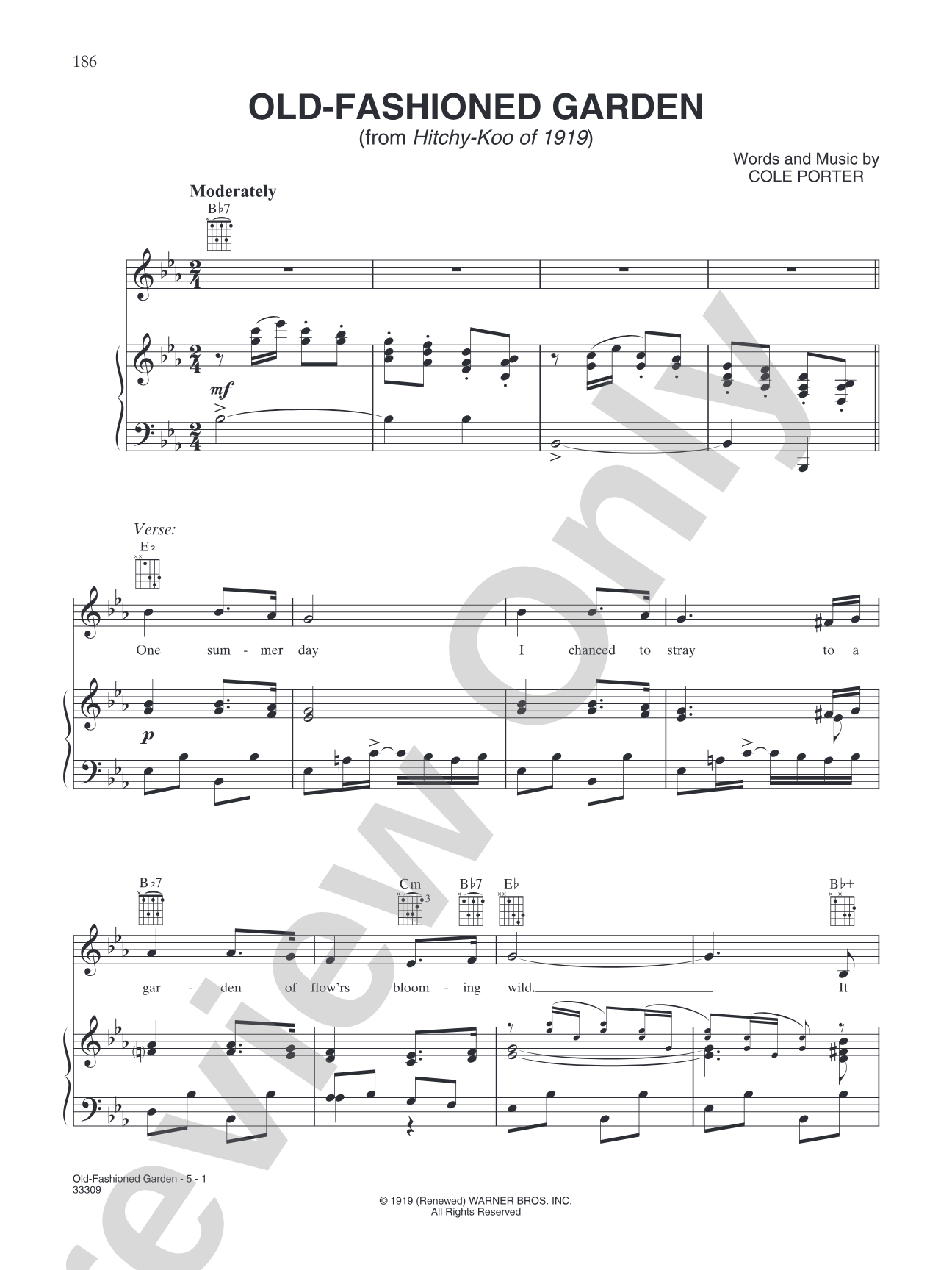

Old-Fashioned Garden (from "Hitchy-Koo"): Piano/Vocal/Chords
Cole Porter
Item: 00-PS-0011484
$4.99
One moment…
Related Items
Begin the Beguine (from "Jubilee" and "Broadway Melody of 1940"): Piano/Vocal/Chords |
$3.99
|
View | |
Ridin' High (from "Red, Hot and Blue!" and "High Society"): Piano/Vocal/Chords |
$4.99
|
View | |
I'm in Love Again (from "Greenwich Village Follies of 1924"): Piano/Vocal/Chords |
$4.99
|
View | |
I'm Unlucky at Gambling (from "Fifty Million Frenchmen"): Piano/Vocal/Chords |
$4.99
|
View | |
Let's Do It (Let's Fall in Love) (from "Paris"): Piano/Vocal/Chords |
$4.99
|
View | |
Looking at You (from "Wake Up and Dream"): Piano/Vocal/Chords |
$4.99
|
View | |
Love for Sale (from "The New Yorkers"): Piano/Vocal/Chords |
$5.99
|
View | |
Night and Day (from "Gay Divorce"): Piano/Vocal/Chords |
$4.99
|
View | |
How's Your Romance (from "Gay Divorce"): Piano/Vocal/Chords |
$5.99
|
View | |
How Could We Be Wrong (from "Nymph Errant"): Piano/Vocal/Chords |
$4.99
|
View | |
Anything Goes (from the 1987 Revival "Anything Goes"): Piano/Vocal/Chords |
$9.99
|
View | |
It's De-Lovely (from "Red, Hot and Blue!"): Piano/Vocal/Chords |
$5.99
|
View | |
Wake Up and Dream (from "Wake Up and Dream"): Piano/Vocal/Chords |
$4.99
|
View | |
I've Got You on My Mind (from "Stardust" and "Gay Divorce"): Piano/Vocal/Chords |
$4.99
|
View | |
The Great Indoors (from "The New Yorkers"): Piano/Vocal/Chords |
$4.99
|
View | |
It's Bad for Me (from "Nymph Errant"): Piano/Vocal/Chords |
$4.99
|
View | |
Which? (from "Wake Up and Dream"): Piano/Vocal/Chords |
$4.99
|
View | |
You Don't Know Paree (from "Fifty Million Frenchmen"): Piano/Vocal/Chords |
$4.99
|
View | |
They All Fall in Love (from "The Battle of Paris"): Piano/Vocal/Chords |
$4.99
|
View | |
Goodbye, Little Dream, Goodbye (from "O Mistress Mine"): Piano/Vocal/Chords |
$4.99
|
View | |
Let's Misbehave: Piano/Vocal/Chords |
$4.99
|
View | |
What Is This Thing Called Love? (from "Wake Up and Dream"): Piano/Vocal/Chords |
$4.99
|
View | |
You Do Something to Me (from "Fifty Million Frenchmen"): Piano/Vocal/Chords |
$4.99
|
View | |
Just One of Those Things (from "Jubilee"): Piano/Vocal/Chords |
$5.99
|
View | |
Take Me Back to Manhattan (from "The New Yorkers"): Piano/Vocal/Chords |
$4.99
|
View | |
I Happen to Like New York (from "The New Yorkers"): Piano/Vocal/Chords |
$4.99
|
View | |
All Through the Night (from "Anything Goes"): Piano/Vocal/Chords |
$5.99
|
View | |
I Get a Kick Out of You (from "Anything Goes"): Piano/Vocal/Chords |
$4.99
|
View | |
Mister and Missus Fitch (from "Gay Divorce"): Piano/Vocal/Chords |
$4.99
|
View | |
I've Got You Under My Skin (from "Born to Dance"): Piano/Vocal/Chords |
$5.99
|
View | |
Easy to Love (from "Born to Dance"): Piano/Vocal/Chords |
$4.99
|
View | |
Down in the Depths (On the Ninetieth Floor) (from "Red, Hot and Blue!"): Piano/Vocal/Chords |
$5.99
|
View | |
Longing for Dear Old Broadway (from "The Pot of Gold"): Piano/Vocal/Chords |
$4.99
|
View | |
Ours (from "Red, Hot and Blue!"): Piano/Vocal/Chords |
$4.99
|
View | |
Don't Look at Me That Way (from "Paris"): Piano/Vocal/Chords |
$4.99
|
View | |
The Laziest Gal in Town (from "Stage Fright"): Piano/Vocal/Chords |
$4.99
|
View | |
You've Got That Thing (from "Fifty Million Frenchmen"): Piano/Vocal/Chords |
$4.99
|
View | |
Where Have You Been? (from "The New Yorkers"): Piano/Vocal/Chords |
$4.99
|
View | |
Weren't We Fools?: Piano/Vocal/Chords |
$4.99
|
View | |
After You, Who? (from "Gay Divorce"): Piano/Vocal/Chords |
$4.99
|
View | |
Experiment (from "Nymph Errant"): Piano/Vocal/Chords |
$4.99
|
View | |
The Physician (from "Nymph Errant"): Piano/Vocal/Chords |
$4.99
|
View | |
Miss Otis Regrets (from "Hi Diddle Diddle"): Piano/Vocal/Chords |
$4.99
|
View | |
Buddie, Beware (from "Anything Goes"): Piano/Vocal/Chords |
$5.99
|
View | |
You're the Top (from "Anything Goes"): Piano/Vocal/Chords |
$4.99
|
View | |
Blow, Gabriel, Blow (from "Anything Goes"): Piano/Vocal/Chords |
$5.99
|
View | |
Why Shouldn't I? (from "Jubilee"): Piano/Vocal/Chords |
$4.99
|
View | |
The Tale of the Oyster (from "Fifty Million Frenchmen"): Piano/Vocal/Chords |
$4.99
|
View | |
I've a Shooting Box in Scotland (from "See America First"): Piano/Vocal/Chords |
$5.99
|
View |
Description
This is the first of a two-volume series presenting highlights from the career of Cole Porter. Volume one documents 50 songs from his early career, from 1912 until 1936. The book includes a song-by-song analysis, rare images of original sheet music, informal shots from Porter's scrapbooks, and publicity stills from motion pictures and Broadway. Titles: Anything Goes * Begin the Beguine * Easy to Love * I Get a Kick Out of You * It's De-Lovely * I've Got You Under My Skin * Just One of Those Things * Let's Do It (Let's Fall in Love) * Love for Sale * Miss Otis Regrets * Night and Day * What Is This Thing Called Love * You Do Something to Me * and more.


Old-Fashioned Garden (from "Hitchy-Koo"): Piano/Vocal/Chords isn't in MakeMusic Cloud just yet...but it could be. Let us know you'd like to see it, and you'll help shape what comes next. In the meantime, start a free trial and dive into thousands of interactive titles your students can play along with today.
Request This Title
Tell us you want it.
Start Your Free Trial
Explore everything that's ready to play right now.
Sample Audio
No sample audio found.
Sample Video
No sample videos found.
Additional Details
Publisher:
Alfred Music
Page Count:
260
SKU:
00-PS-0011484
More about this title
About the Composer: Cole Porter
Cole Porter (1891-1964) stands as one of Broadway's most sophisticated and prolific songwriters, crafting melodies and lyrics of remarkable wit and elegance across five decades. His early career, spanning the 1910s through 1930s, established the hallmarks that would define American musical theatre: urbane humor, jazz-influenced harmonies, intricate rhyme schemes, and an ability to write both intimate ballads and exuberant production numbers. Porter's songs became standards not because they were simple, but because their craftsmanship rewarded careful listening and repeated performance.
Why we love this
This collection captures Porter's early mastery when he was refining the techniques that would dominate Broadway for generations. The piano-vocal-chords format makes these songs immediately playable for solo performers, teachers, and ensembles working on American musical theatre repertoire. The supplementary scholarship—analysis, archival images, and original sheet music reproductions—transforms this from a songbook into a genuine educational resource about the development of American musical comedy.
What to expect
Porter's early work glows with Manhattan sophistication and urbane charm. These songs balance genuine emotional depth with clever wordplay, never sacrificing one for the other. Performing them feels like being admitted into an intelligent, witty conversation where the stakes are somehow both high and delightfully absurd.
Who it's for
Pianists and singers preparing solo recital repertoire or audition material will find reliable, well-presented scores of Porter's most celebrated songs. Music teachers and theatre directors can use individual pieces to introduce students to American musical standards and the harmonic sophistication of early Broadway composition.
How to get the most out of it
- Attend carefully to Porter's harmonic language; these are not diatonic songs, and unexpected chord changes often underscore the lyrical wit. Let the harmony guide your phrasing rather than fight against it.
- Pace the text as you would spoken dialogue. Porter's lyrics are written for comedic timing and clarity; rushing diminishes both the humor and the musical line.
- Explore the relationship between vocal melody and piano accompaniment. The accompaniment often carries as much character as the voice, and they should feel like conversation rather than voice-plus-support.
- Use rubato sparingly and intentionally. These songs sit at the intersection of jazz and theatre; too much freedom obscures the form, while too little rhythm flattens the style.
How to use it
Feature Porter selections in a recital devoted to American musical theatre standards or pair individual songs with classical and contemporary repertoire to demonstrate the breadth of American keyboard-and-voice music. Directors staging musicals or revues set during the early twentieth century will find authoritative source material and historical context invaluable for coaching performers on style and period authenticity.
Skills your students will build
- Interpreting jazz-influenced harmony and unexpected chord progressions
- Aligning text phrasing with lyrical wit and comedic timing
- Balancing written notation with stylistic conventions of early musical theatre
- Reading and performing in the piano-vocal-chords format used in professional Broadway scores