
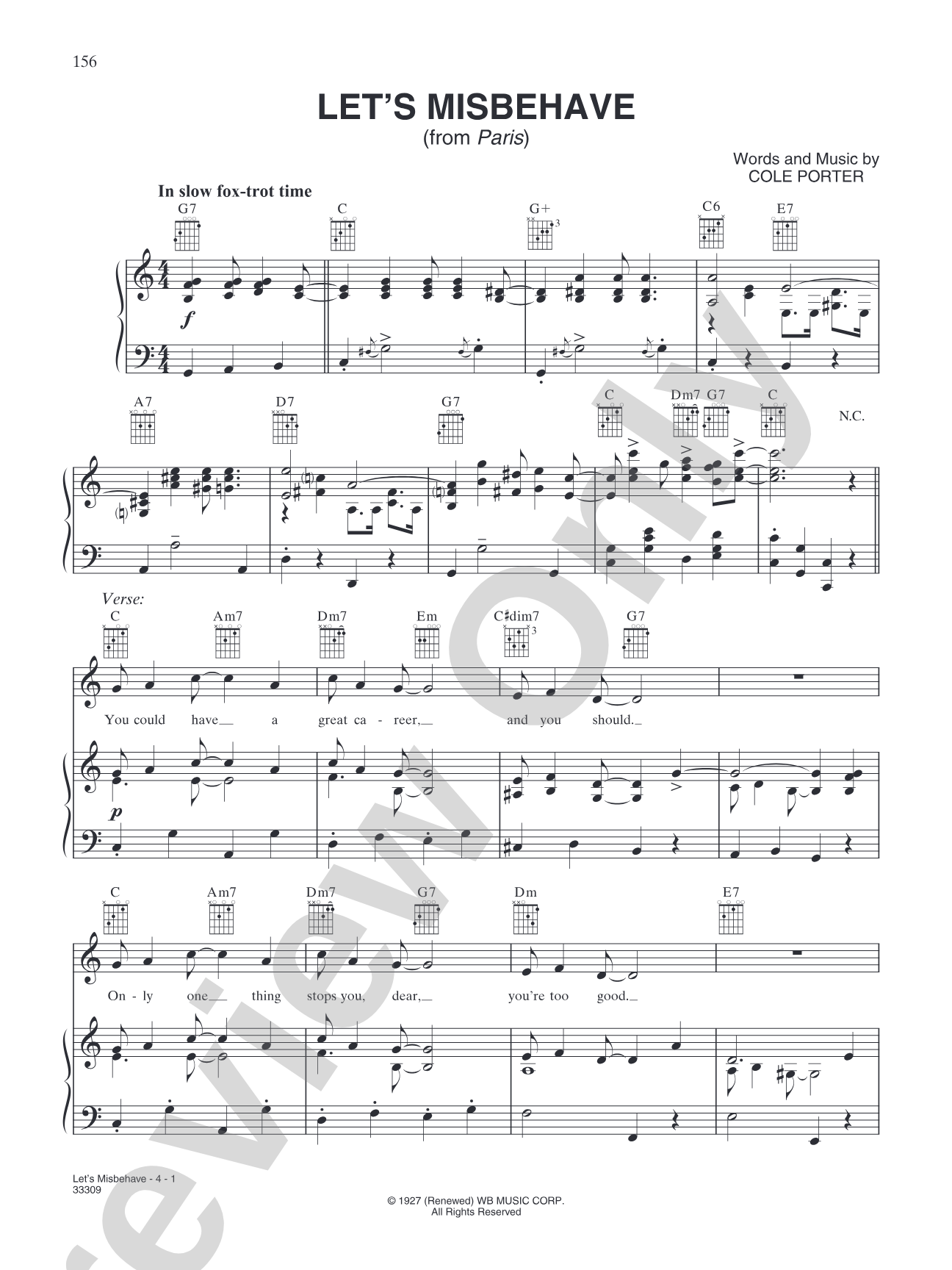

Let's Misbehave: Piano/Vocal/Chords
Cole Porter
Item: 00-PS-0005257
$4.99
One moment…
Related Items
Begin the Beguine (from "Jubilee" and "Broadway Melody of 1940"): Piano/Vocal/Chords |
$3.99
|
View | |
Ridin' High (from "Red, Hot and Blue!" and "High Society"): Piano/Vocal/Chords |
$4.99
|
View | |
I'm in Love Again (from "Greenwich Village Follies of 1924"): Piano/Vocal/Chords |
$4.99
|
View | |
I'm Unlucky at Gambling (from "Fifty Million Frenchmen"): Piano/Vocal/Chords |
$4.99
|
View | |
Let's Do It (Let's Fall in Love) (from "Paris"): Piano/Vocal/Chords |
$4.99
|
View | |
Looking at You (from "Wake Up and Dream"): Piano/Vocal/Chords |
$4.99
|
View | |
Love for Sale (from "The New Yorkers"): Piano/Vocal/Chords |
$5.99
|
View | |
Night and Day (from "Gay Divorce"): Piano/Vocal/Chords |
$4.99
|
View | |
How's Your Romance (from "Gay Divorce"): Piano/Vocal/Chords |
$5.99
|
View | |
How Could We Be Wrong (from "Nymph Errant"): Piano/Vocal/Chords |
$4.99
|
View | |
Anything Goes (from the 1987 Revival "Anything Goes"): Piano/Vocal/Chords |
$9.99
|
View | |
It's De-Lovely (from "Red, Hot and Blue!"): Piano/Vocal/Chords |
$5.99
|
View | |
Wake Up and Dream (from "Wake Up and Dream"): Piano/Vocal/Chords |
$4.99
|
View | |
I've Got You on My Mind (from "Stardust" and "Gay Divorce"): Piano/Vocal/Chords |
$4.99
|
View | |
The Great Indoors (from "The New Yorkers"): Piano/Vocal/Chords |
$4.99
|
View | |
It's Bad for Me (from "Nymph Errant"): Piano/Vocal/Chords |
$4.99
|
View | |
Which? (from "Wake Up and Dream"): Piano/Vocal/Chords |
$4.99
|
View | |
You Don't Know Paree (from "Fifty Million Frenchmen"): Piano/Vocal/Chords |
$4.99
|
View | |
They All Fall in Love (from "The Battle of Paris"): Piano/Vocal/Chords |
$4.99
|
View | |
Goodbye, Little Dream, Goodbye (from "O Mistress Mine"): Piano/Vocal/Chords |
$4.99
|
View | |
What Is This Thing Called Love? (from "Wake Up and Dream"): Piano/Vocal/Chords |
$4.99
|
View | |
You Do Something to Me (from "Fifty Million Frenchmen"): Piano/Vocal/Chords |
$4.99
|
View | |
Just One of Those Things (from "Jubilee"): Piano/Vocal/Chords |
$5.99
|
View | |
Take Me Back to Manhattan (from "The New Yorkers"): Piano/Vocal/Chords |
$4.99
|
View | |
I Happen to Like New York (from "The New Yorkers"): Piano/Vocal/Chords |
$4.99
|
View | |
All Through the Night (from "Anything Goes"): Piano/Vocal/Chords |
$5.99
|
View | |
I Get a Kick Out of You (from "Anything Goes"): Piano/Vocal/Chords |
$4.99
|
View | |
Mister and Missus Fitch (from "Gay Divorce"): Piano/Vocal/Chords |
$4.99
|
View | |
I've Got You Under My Skin (from "Born to Dance"): Piano/Vocal/Chords |
$5.99
|
View | |
Easy to Love (from "Born to Dance"): Piano/Vocal/Chords |
$4.99
|
View | |
Down in the Depths (On the Ninetieth Floor) (from "Red, Hot and Blue!"): Piano/Vocal/Chords |
$5.99
|
View | |
Longing for Dear Old Broadway (from "The Pot of Gold"): Piano/Vocal/Chords |
$4.99
|
View | |
Ours (from "Red, Hot and Blue!"): Piano/Vocal/Chords |
$4.99
|
View | |
Don't Look at Me That Way (from "Paris"): Piano/Vocal/Chords |
$4.99
|
View | |
The Laziest Gal in Town (from "Stage Fright"): Piano/Vocal/Chords |
$4.99
|
View | |
Old-Fashioned Garden (from "Hitchy-Koo"): Piano/Vocal/Chords |
$4.99
|
View | |
You've Got That Thing (from "Fifty Million Frenchmen"): Piano/Vocal/Chords |
$4.99
|
View | |
Where Have You Been? (from "The New Yorkers"): Piano/Vocal/Chords |
$4.99
|
View | |
Weren't We Fools?: Piano/Vocal/Chords |
$4.99
|
View | |
After You, Who? (from "Gay Divorce"): Piano/Vocal/Chords |
$4.99
|
View | |
Experiment (from "Nymph Errant"): Piano/Vocal/Chords |
$4.99
|
View | |
The Physician (from "Nymph Errant"): Piano/Vocal/Chords |
$4.99
|
View | |
Miss Otis Regrets (from "Hi Diddle Diddle"): Piano/Vocal/Chords |
$4.99
|
View | |
Buddie, Beware (from "Anything Goes"): Piano/Vocal/Chords |
$5.99
|
View | |
You're the Top (from "Anything Goes"): Piano/Vocal/Chords |
$4.99
|
View | |
Blow, Gabriel, Blow (from "Anything Goes"): Piano/Vocal/Chords |
$5.99
|
View | |
Why Shouldn't I? (from "Jubilee"): Piano/Vocal/Chords |
$4.99
|
View | |
The Tale of the Oyster (from "Fifty Million Frenchmen"): Piano/Vocal/Chords |
$4.99
|
View | |
I've a Shooting Box in Scotland (from "See America First"): Piano/Vocal/Chords |
$5.99
|
View |
Description
This is the first of a two-volume series presenting highlights from the career of Cole Porter. Volume one documents 50 songs from his early career, from 1912 until 1936. The book includes a song-by-song analysis, rare images of original sheet music, informal shots from Porter's scrapbooks, and publicity stills from motion pictures and Broadway. Titles: Anything Goes * Begin the Beguine * Easy to Love * I Get a Kick Out of You * It's De-Lovely * I've Got You Under My Skin * Just One of Those Things * Let's Do It (Let's Fall in Love) * Love for Sale * Miss Otis Regrets * Night and Day * What Is This Thing Called Love * You Do Something to Me * and more.


Let's Misbehave: Piano/Vocal/Chords isn't in MakeMusic Cloud just yet...but it could be. Let us know you'd like to see it, and you'll help shape what comes next. In the meantime, start a free trial and dive into thousands of interactive titles your students can play along with today.
Request This Title
Tell us you want it.
Start Your Free Trial
Explore everything that's ready to play right now.
Sample Audio
No sample audio found.
Sample Video
No sample videos found.
Additional Details
Publisher:
Alfred Music
Page Count:
260
SKU:
00-PS-0005257
More about this title
About the Composer: Cole Porter
Cole Porter (1891-1964) composed and wrote lyrics for some of the most sophisticated and enduring standards in American musical theater. His career spanned from the 1910s through the 1950s, producing iconic Broadway shows and film scores that remain central to the jazz standards repertoire. Porter's gift for witty, urbane lyrics paired with elegant melodic writing made him a singular voice in American songwriting.
Why we love this
This collection captures Porter's early mastery during the era when he was defining what a modern American standard could be. The song-by-song analysis paired with archival images and original manuscript excerpts transforms a songbook into a cultural document, giving performers and students genuine insight into how these pieces were created and received. Programming from this repertoire signals sophistication and offers vocalists material that rewards both technical command and interpretive maturity.
What to expect
These songs embody elegant urbanism and sophisticated romance. Porter's melodies are immediately singable yet harmonically complex, moving with the ease of conversation while maintaining formal grace. The mood shifts from wistful ballads to playful novelty numbers, often within a single song, creating a world where style and substance are inseparable.
Who it's for
This book serves pianists and vocalists preparing for recitals, jazz ensembles exploring the standards canon, and music history students investigating American songwriting's golden age. It's equally valuable for music teachers building a teaching library of standards with documented historical context and for performers seeking material that combines accessibility with genuine artistic substance.
How to get the most out of it
- Honor Porter's harmonic sophistication by studying the chord progression before focusing on melody; these songs often move through jazz changes that sound best when the pianist understands the underlying structure.
- Use the rare images of original sheet music to notice Porter's own performance markings and phrasing decisions; they often reveal interpretive choices that differ from later published editions.
- Balance rhythmic precision with conversational phrasing, especially in the introductions and transitions; Porter wrote with cabaret-style flexibility in mind, not metronomic regularity.
- Explore the lyrical wit as a guide to tempo and inflection; the humor and irony embedded in Porter's words should shape how you shape the melody.
How to use it
Weave individual Porter standards throughout a recital program to create thematic bridges between classical and jazz repertoire, or dedicate a full set to exploring the depth and variety within his early catalog. This collection works particularly well in concert programming that centers American song or in cabaret-style performances where the blend of music, text, and cultural history enriches the listening experience.
Skills your students will build
- Reading and performing jazz chord progressions and extensions
- Interpreting sophisticated harmonic movement with sensitivity to voice leading
- Balancing lyrical storytelling with melodic and harmonic complexity
- Understanding the relationship between American vernacular language and musical phrasing
- Developing interpretive flexibility within the standards tradition