
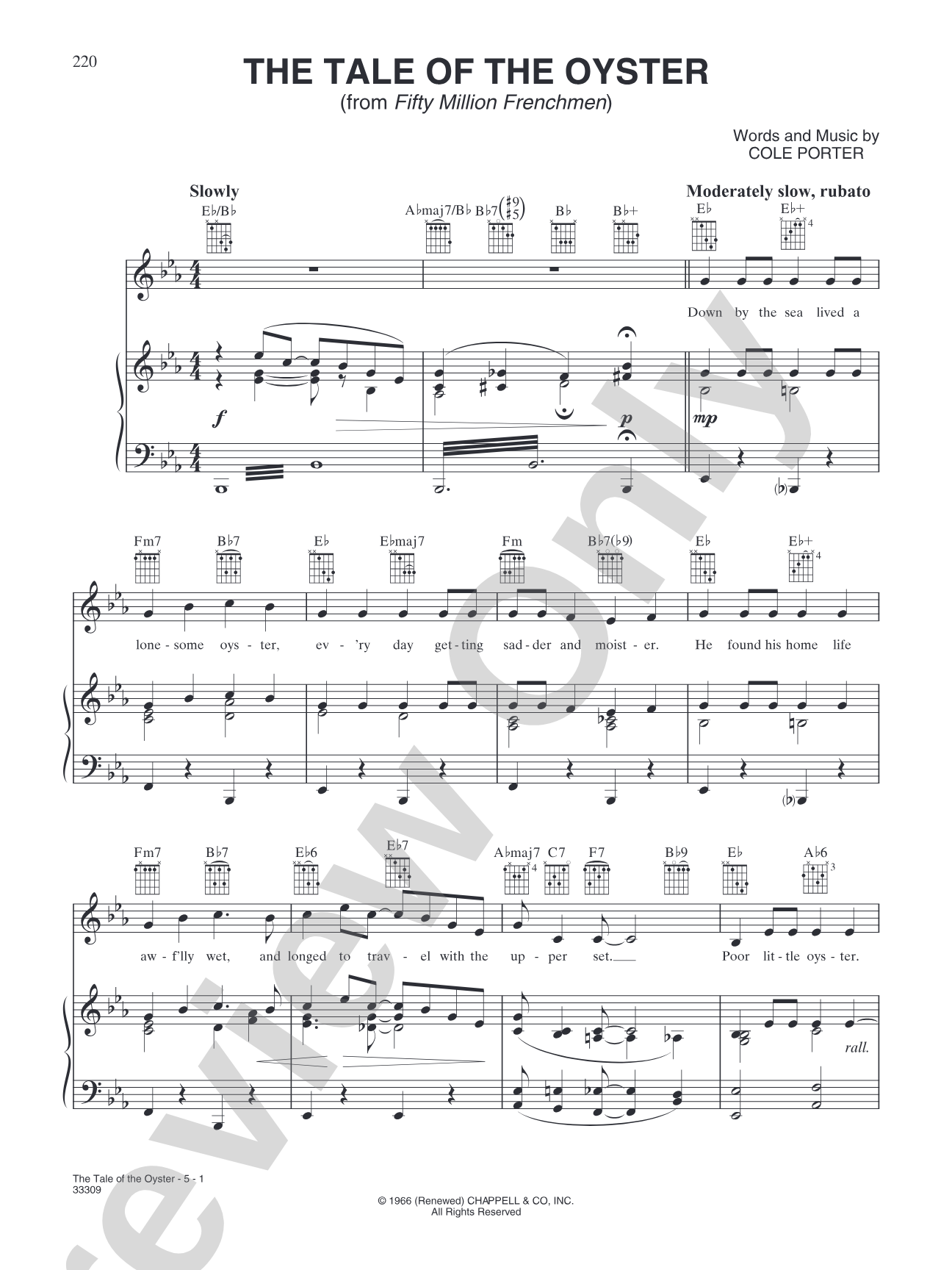

The Tale of the Oyster (from "Fifty Million Frenchmen"): Piano/Vocal/Chords
Cole Porter
Item: 00-PS-0011496
$4.99
One moment…
Related Items
Begin the Beguine (from "Jubilee" and "Broadway Melody of 1940"): Piano/Vocal/Chords |
$3.99
|
View | |
Ridin' High (from "Red, Hot and Blue!" and "High Society"): Piano/Vocal/Chords |
$4.99
|
View | |
I'm in Love Again (from "Greenwich Village Follies of 1924"): Piano/Vocal/Chords |
$4.99
|
View | |
I'm Unlucky at Gambling (from "Fifty Million Frenchmen"): Piano/Vocal/Chords |
$4.99
|
View | |
Let's Do It (Let's Fall in Love) (from "Paris"): Piano/Vocal/Chords |
$4.99
|
View | |
Looking at You (from "Wake Up and Dream"): Piano/Vocal/Chords |
$4.99
|
View | |
Love for Sale (from "The New Yorkers"): Piano/Vocal/Chords |
$5.99
|
View | |
Night and Day (from "Gay Divorce"): Piano/Vocal/Chords |
$4.99
|
View | |
How's Your Romance (from "Gay Divorce"): Piano/Vocal/Chords |
$5.99
|
View | |
How Could We Be Wrong (from "Nymph Errant"): Piano/Vocal/Chords |
$4.99
|
View | |
Anything Goes (from the 1987 Revival "Anything Goes"): Piano/Vocal/Chords |
$9.99
|
View | |
It's De-Lovely (from "Red, Hot and Blue!"): Piano/Vocal/Chords |
$5.99
|
View | |
Wake Up and Dream (from "Wake Up and Dream"): Piano/Vocal/Chords |
$4.99
|
View | |
I've Got You on My Mind (from "Stardust" and "Gay Divorce"): Piano/Vocal/Chords |
$4.99
|
View | |
The Great Indoors (from "The New Yorkers"): Piano/Vocal/Chords |
$4.99
|
View | |
It's Bad for Me (from "Nymph Errant"): Piano/Vocal/Chords |
$4.99
|
View | |
Which? (from "Wake Up and Dream"): Piano/Vocal/Chords |
$4.99
|
View | |
You Don't Know Paree (from "Fifty Million Frenchmen"): Piano/Vocal/Chords |
$4.99
|
View | |
They All Fall in Love (from "The Battle of Paris"): Piano/Vocal/Chords |
$4.99
|
View | |
Goodbye, Little Dream, Goodbye (from "O Mistress Mine"): Piano/Vocal/Chords |
$4.99
|
View | |
Let's Misbehave: Piano/Vocal/Chords |
$4.99
|
View | |
What Is This Thing Called Love? (from "Wake Up and Dream"): Piano/Vocal/Chords |
$4.99
|
View | |
You Do Something to Me (from "Fifty Million Frenchmen"): Piano/Vocal/Chords |
$4.99
|
View | |
Just One of Those Things (from "Jubilee"): Piano/Vocal/Chords |
$5.99
|
View | |
Take Me Back to Manhattan (from "The New Yorkers"): Piano/Vocal/Chords |
$4.99
|
View | |
I Happen to Like New York (from "The New Yorkers"): Piano/Vocal/Chords |
$4.99
|
View | |
All Through the Night (from "Anything Goes"): Piano/Vocal/Chords |
$5.99
|
View | |
I Get a Kick Out of You (from "Anything Goes"): Piano/Vocal/Chords |
$4.99
|
View | |
Mister and Missus Fitch (from "Gay Divorce"): Piano/Vocal/Chords |
$4.99
|
View | |
I've Got You Under My Skin (from "Born to Dance"): Piano/Vocal/Chords |
$5.99
|
View | |
Easy to Love (from "Born to Dance"): Piano/Vocal/Chords |
$4.99
|
View | |
Down in the Depths (On the Ninetieth Floor) (from "Red, Hot and Blue!"): Piano/Vocal/Chords |
$5.99
|
View | |
Longing for Dear Old Broadway (from "The Pot of Gold"): Piano/Vocal/Chords |
$4.99
|
View | |
Ours (from "Red, Hot and Blue!"): Piano/Vocal/Chords |
$4.99
|
View | |
Don't Look at Me That Way (from "Paris"): Piano/Vocal/Chords |
$4.99
|
View | |
The Laziest Gal in Town (from "Stage Fright"): Piano/Vocal/Chords |
$4.99
|
View | |
Old-Fashioned Garden (from "Hitchy-Koo"): Piano/Vocal/Chords |
$4.99
|
View | |
You've Got That Thing (from "Fifty Million Frenchmen"): Piano/Vocal/Chords |
$4.99
|
View | |
Where Have You Been? (from "The New Yorkers"): Piano/Vocal/Chords |
$4.99
|
View | |
Weren't We Fools?: Piano/Vocal/Chords |
$4.99
|
View | |
After You, Who? (from "Gay Divorce"): Piano/Vocal/Chords |
$4.99
|
View | |
Experiment (from "Nymph Errant"): Piano/Vocal/Chords |
$4.99
|
View | |
The Physician (from "Nymph Errant"): Piano/Vocal/Chords |
$4.99
|
View | |
Miss Otis Regrets (from "Hi Diddle Diddle"): Piano/Vocal/Chords |
$4.99
|
View | |
Buddie, Beware (from "Anything Goes"): Piano/Vocal/Chords |
$5.99
|
View | |
You're the Top (from "Anything Goes"): Piano/Vocal/Chords |
$4.99
|
View | |
Blow, Gabriel, Blow (from "Anything Goes"): Piano/Vocal/Chords |
$5.99
|
View | |
Why Shouldn't I? (from "Jubilee"): Piano/Vocal/Chords |
$4.99
|
View | |
I've a Shooting Box in Scotland (from "See America First"): Piano/Vocal/Chords |
$5.99
|
View |
Description
This is the first of a two-volume series presenting highlights from the career of Cole Porter. Volume one documents 50 songs from his early career, from 1912 until 1936. The book includes a song-by-song analysis, rare images of original sheet music, informal shots from Porter's scrapbooks, and publicity stills from motion pictures and Broadway. Titles: Anything Goes * Begin the Beguine * Easy to Love * I Get a Kick Out of You * It's De-Lovely * I've Got You Under My Skin * Just One of Those Things * Let's Do It (Let's Fall in Love) * Love for Sale * Miss Otis Regrets * Night and Day * What Is This Thing Called Love * You Do Something to Me * and more.


The Tale of the Oyster (from "Fifty Million Frenchmen"): Piano/Vocal/Chords isn't in MakeMusic Cloud just yet...but it could be. Let us know you'd like to see it, and you'll help shape what comes next. In the meantime, start a free trial and dive into thousands of interactive titles your students can play along with today.
Request This Title
Tell us you want it.
Start Your Free Trial
Explore everything that's ready to play right now.
Sample Audio
No sample audio found.
Sample Video
No sample videos found.
Additional Details
Publisher:
Alfred Music
Page Count:
260
SKU:
00-PS-0011496
More about this title
About the Composer: Cole Porter
Cole Porter (1891-1964) composed some of the most sophisticated and witty songs in American musical theater. His melodies balanced accessibility with harmonic complexity, and his lyrics became legendary for their clever wordplay, urbane humor, and genuine emotional depth. Porter's career spanned from the 1910s through the 1950s, making him a defining voice of the Golden Age of Broadway and Hollywood.
Porter's influence on music education extends far beyond nostalgia. His songs teach harmonic thinking through their chromaticism and unexpected chord movements. They demand rhythmic precision and interpretive maturity from singers. For pianists, his accompaniments reward careful voicing and touch control. Generations of jazz musicians, pop standards singers, and classical crossover artists have built their artistry on Porter's foundation.
Why we love this
This collection captures Porter at the height of his invention, before his later work softened into formula. The songs here represent the moment when American musical theater found its own sophisticated voice, and students who encounter them develop an ear for melody that doesn't rely on sentimentality, harmony that surprises without confusing, and lyrics that can be both frivolous and human. Programming from this era gives your singers and pianists access to material that still sounds modern because it was always ahead of its time.
What to expect
Opening these pages feels like stepping into a backstage dressing room where everything is polished, witty, and alive with confidence. The songs sparkle with urbane charm and genuine melodic beauty. There's an ease to them that masks considerable craft underneath.
Who it's for
Singer-pianists preparing recitals or jazz standards repertoire will find anchoring material here. Vocal students building a foundation in American musical theater need access to these songs in reliable editions. This collection also serves pianists studying the art song tradition, since many of Porter's compositions demand the same interpretive sophistication as classical vocal literature.
How to get the most out of it
- Shape the melody through Porter's harmonic changes rather than forcing it into predictable phrasing. Many of these songs sit in ranges and rhythmic positions that reward subtle dynamic shaping.
- Pay attention to the lyrical content even in uptempo numbers. Porter's wit depends on clarity of diction and rhythmic precision in the text setting.
- Honor the chord voicings in the piano part. Porter wrote accompaniments that are part of the song, not decoration. Rushing or simplifying them changes the character.
- Treat the standards as conversation starters about harmonic function. Porter uses chromatic movement, secondary dominants, and unexpected resolutions as compositional tools, not tricks.
How to use it
Feature individual songs in concert programs focused on American songwriting or the jazz standards tradition. Use selections for senior recitals or studio class performances when you need material that sounds substantial but is approachable for intermediate pianists accompanying singers. These songs work particularly well in themed recitals exploring early Broadway or mid-century popular song.
Skills your students will build
- Reading and executing chromatic harmonic progressions
- Interpreting rhythmic nuance in song settings with syncopation and syncopation
- Maintaining legibility and character in fast-paced, rhythmically complex accompaniments
- Understanding text-setting conventions in American musical theater
- Building expressive phrasing over longer harmonic arcs