
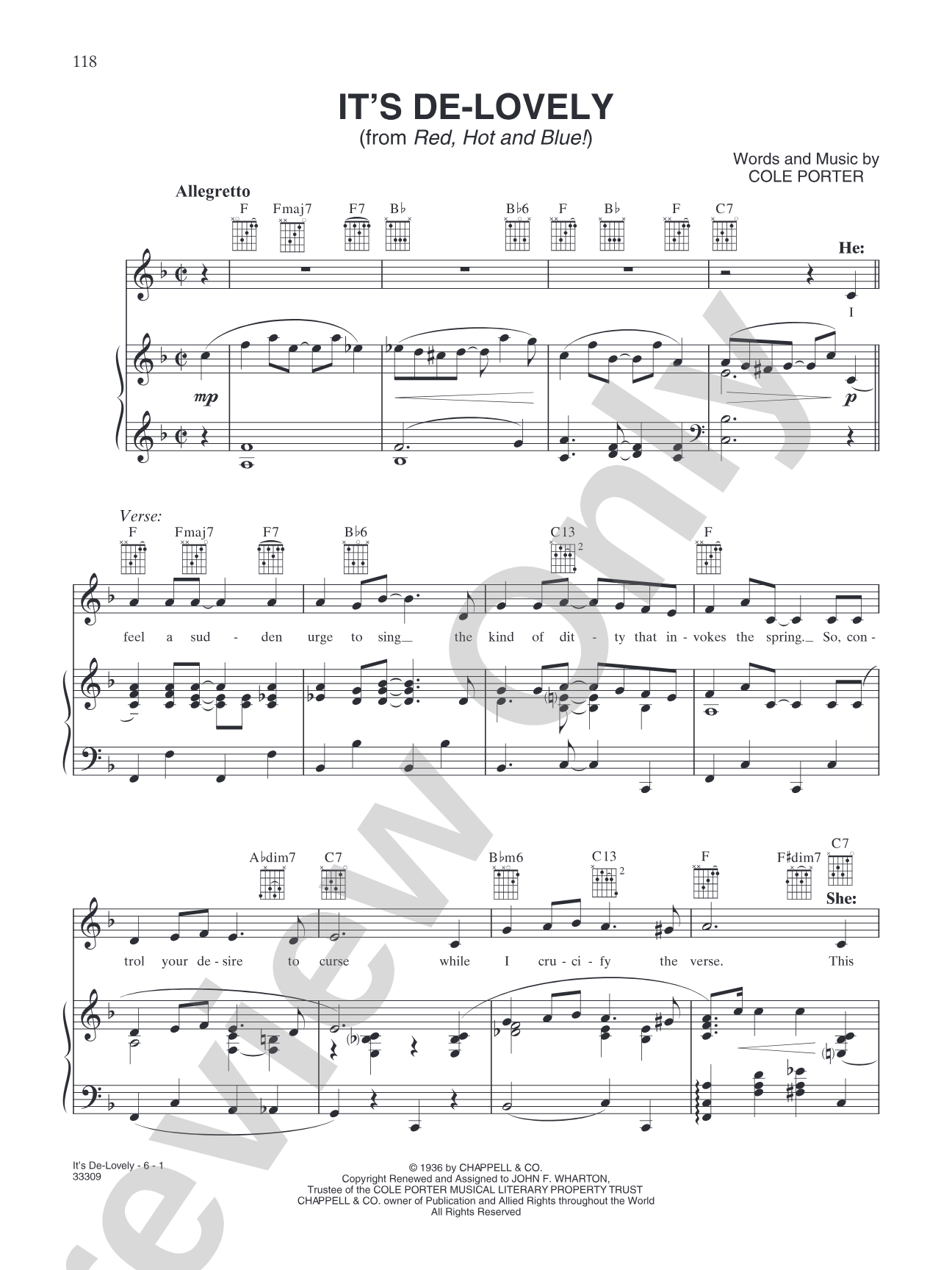
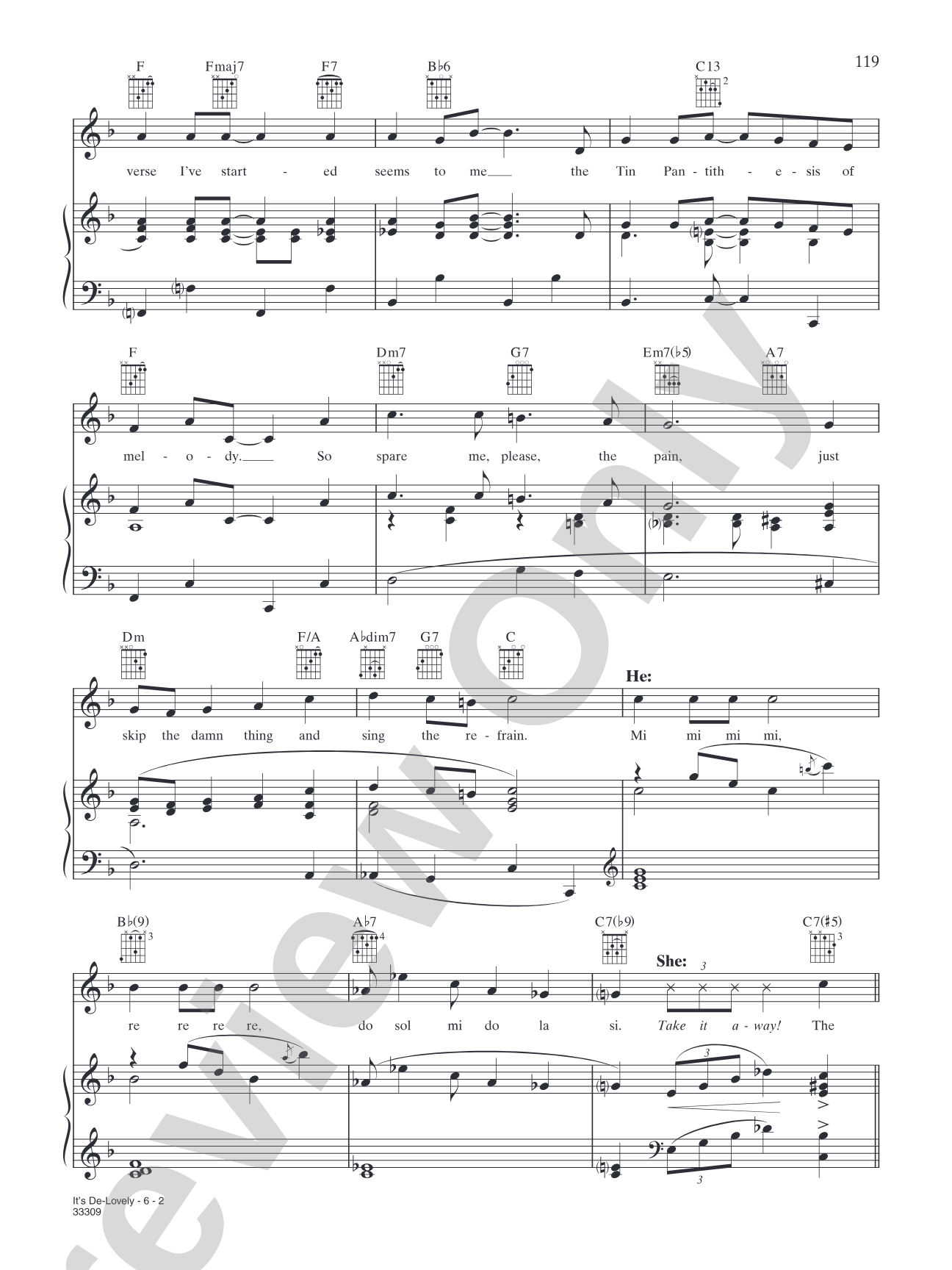

It's De-Lovely (from "Red, Hot and Blue!"): Piano/Vocal/Chords
Cole Porter
Item: 00-PS-0002715
$5.99
One moment…
Related Items
Begin the Beguine (from "Jubilee" and "Broadway Melody of 1940"): Piano/Vocal/Chords |
$3.99
|
View | |
Ridin' High (from "Red, Hot and Blue!" and "High Society"): Piano/Vocal/Chords |
$4.99
|
View | |
I'm in Love Again (from "Greenwich Village Follies of 1924"): Piano/Vocal/Chords |
$4.99
|
View | |
I'm Unlucky at Gambling (from "Fifty Million Frenchmen"): Piano/Vocal/Chords |
$4.99
|
View | |
Let's Do It (Let's Fall in Love) (from "Paris"): Piano/Vocal/Chords |
$4.99
|
View | |
Looking at You (from "Wake Up and Dream"): Piano/Vocal/Chords |
$4.99
|
View | |
Love for Sale (from "The New Yorkers"): Piano/Vocal/Chords |
$5.99
|
View | |
Night and Day (from "Gay Divorce"): Piano/Vocal/Chords |
$4.99
|
View | |
How's Your Romance (from "Gay Divorce"): Piano/Vocal/Chords |
$5.99
|
View | |
How Could We Be Wrong (from "Nymph Errant"): Piano/Vocal/Chords |
$4.99
|
View | |
Anything Goes (from the 1987 Revival "Anything Goes"): Piano/Vocal/Chords |
$9.99
|
View | |
Wake Up and Dream (from "Wake Up and Dream"): Piano/Vocal/Chords |
$4.99
|
View | |
I've Got You on My Mind (from "Stardust" and "Gay Divorce"): Piano/Vocal/Chords |
$4.99
|
View | |
The Great Indoors (from "The New Yorkers"): Piano/Vocal/Chords |
$4.99
|
View | |
It's Bad for Me (from "Nymph Errant"): Piano/Vocal/Chords |
$4.99
|
View | |
Which? (from "Wake Up and Dream"): Piano/Vocal/Chords |
$4.99
|
View | |
You Don't Know Paree (from "Fifty Million Frenchmen"): Piano/Vocal/Chords |
$4.99
|
View | |
They All Fall in Love (from "The Battle of Paris"): Piano/Vocal/Chords |
$4.99
|
View | |
Goodbye, Little Dream, Goodbye (from "O Mistress Mine"): Piano/Vocal/Chords |
$4.99
|
View | |
Let's Misbehave: Piano/Vocal/Chords |
$4.99
|
View | |
What Is This Thing Called Love? (from "Wake Up and Dream"): Piano/Vocal/Chords |
$4.99
|
View | |
You Do Something to Me (from "Fifty Million Frenchmen"): Piano/Vocal/Chords |
$4.99
|
View | |
Just One of Those Things (from "Jubilee"): Piano/Vocal/Chords |
$5.99
|
View | |
Take Me Back to Manhattan (from "The New Yorkers"): Piano/Vocal/Chords |
$4.99
|
View | |
I Happen to Like New York (from "The New Yorkers"): Piano/Vocal/Chords |
$4.99
|
View | |
All Through the Night (from "Anything Goes"): Piano/Vocal/Chords |
$5.99
|
View | |
I Get a Kick Out of You (from "Anything Goes"): Piano/Vocal/Chords |
$4.99
|
View | |
Mister and Missus Fitch (from "Gay Divorce"): Piano/Vocal/Chords |
$4.99
|
View | |
I've Got You Under My Skin (from "Born to Dance"): Piano/Vocal/Chords |
$5.99
|
View | |
Easy to Love (from "Born to Dance"): Piano/Vocal/Chords |
$4.99
|
View | |
Down in the Depths (On the Ninetieth Floor) (from "Red, Hot and Blue!"): Piano/Vocal/Chords |
$5.99
|
View | |
Longing for Dear Old Broadway (from "The Pot of Gold"): Piano/Vocal/Chords |
$4.99
|
View | |
Ours (from "Red, Hot and Blue!"): Piano/Vocal/Chords |
$4.99
|
View | |
Don't Look at Me That Way (from "Paris"): Piano/Vocal/Chords |
$4.99
|
View | |
The Laziest Gal in Town (from "Stage Fright"): Piano/Vocal/Chords |
$4.99
|
View | |
Old-Fashioned Garden (from "Hitchy-Koo"): Piano/Vocal/Chords |
$4.99
|
View | |
You've Got That Thing (from "Fifty Million Frenchmen"): Piano/Vocal/Chords |
$4.99
|
View | |
Where Have You Been? (from "The New Yorkers"): Piano/Vocal/Chords |
$4.99
|
View | |
Weren't We Fools?: Piano/Vocal/Chords |
$4.99
|
View | |
After You, Who? (from "Gay Divorce"): Piano/Vocal/Chords |
$4.99
|
View | |
Experiment (from "Nymph Errant"): Piano/Vocal/Chords |
$4.99
|
View | |
The Physician (from "Nymph Errant"): Piano/Vocal/Chords |
$4.99
|
View | |
Miss Otis Regrets (from "Hi Diddle Diddle"): Piano/Vocal/Chords |
$4.99
|
View | |
Buddie, Beware (from "Anything Goes"): Piano/Vocal/Chords |
$5.99
|
View | |
You're the Top (from "Anything Goes"): Piano/Vocal/Chords |
$4.99
|
View | |
Blow, Gabriel, Blow (from "Anything Goes"): Piano/Vocal/Chords |
$5.99
|
View | |
Why Shouldn't I? (from "Jubilee"): Piano/Vocal/Chords |
$4.99
|
View | |
The Tale of the Oyster (from "Fifty Million Frenchmen"): Piano/Vocal/Chords |
$4.99
|
View | |
I've a Shooting Box in Scotland (from "See America First"): Piano/Vocal/Chords |
$5.99
|
View |
Description
This is the first of a two-volume series presenting highlights from the career of Cole Porter. Volume one documents 50 songs from his early career, from 1912 until 1936. The book includes a song-by-song analysis, rare images of original sheet music, informal shots from Porter's scrapbooks, and publicity stills from motion pictures and Broadway. Titles: Anything Goes * Begin the Beguine * Easy to Love * I Get a Kick Out of You * It's De-Lovely * I've Got You Under My Skin * Just One of Those Things * Let's Do It (Let's Fall in Love) * Love for Sale * Miss Otis Regrets * Night and Day * What Is This Thing Called Love * You Do Something to Me * and more.


Discover MakeMusic Cloud: thousands of interactive titles your students can play along with today.
Sample Audio
No sample audio found.
Sample Video
No sample videos found.
Additional Details
Publisher:
Alfred Music
Page Count:
260
SKU:
00-PS-0002715
More about this title
About the Composer: Cole Porter
Cole Porter (1891-1964) was an American composer and lyricist who created some of the most sophisticated and witty songs in American musical theater. Born into wealth in Peru, Indiana, Porter studied at Yale and the School of Music at Harvard before moving to Paris, where he composed ballets and operettas while absorbing the aesthetics of modernism. His early Broadway successes in the late 1920s and 1930s established him as a master of elegant melody, clever rhyme schemes, and urbane humor, qualities that made songs like "Night and Day" and "I Get a Kick Out of You" standards almost immediately upon their premiere.
Porter's influence on American songwriting extended far beyond his own era. His ability to marry complex harmonic language with immediately singable melodies, and his gift for lyrics that worked on both witty and deeply romantic levels, set a standard that shaped generations of composers and performers. Though a serious accident in 1937 limited his physical mobility for the remainder of his life, he continued composing until his death, leaving behind a catalog that remains central to the repertoire of jazz singers, musical theater performers, and classical artists alike.
Why we love this
Porter's early songs are enduring masterpieces that belong in the hands of any serious vocalist or pianist working with American standards. The harmonic sophistication and rhythmic subtlety in pieces like "It's De-Lovely" reward careful study; they sound effortless when done well, but demand genuine musicianship. This collection gives you direct access to the songs that defined an era and continue to challenge and delight performers and audiences.
What to expect
Urbane and emotionally direct, these songs sparkle with wit without sacrificing genuine feeling. The melodies sit naturally in the voice, the harmonies are warm and sophisticated, and the lyrics balance clever observation with moments of real vulnerability. There's an ease and elegance throughout that reflects Porter's gift for making complex music sound conversational.
Who it's for
Vocalists preparing American standard repertoire, pianists looking to expand their classical or jazz interpretive skills, and music educators teaching the history and craft of American songwriting. This works equally well for studio teaching, recital preparation, and ensemble arrangements.
How to get the most out of it
- Pay attention to Porter's sophisticated harmony and the way he uses chromatic motion. These aren't background changes; they're essential to the song's character and deserve clarity in both vocal and piano voicings.
- Shape the lyric as carefully as the melody. Porter's wit and internal rhymes only land when you maintain crisp diction while still singing through the phrases musically.
- Experiment with different tempos and approaches to swing the rhythm. Many of these songs work beautifully at a relaxed, conversational pace that lets the sophistication of the writing shine rather than rushing the charm.
- Use the chord symbols as a springboard for reharmonization rather than a ceiling. Porter himself encouraged musicians to take liberties, and understanding his harmonic thinking opens the door to intelligent improvisation.
How to use it
Feature this song in a recital exploring American songwriters, pairing it with contrasting Porter selections from different decades to show his range. It's also ideal for jazz ensemble arrangements, cabaret programming, or as part of a larger American standards unit in a vocal techniques or music history course.
Skills your students will build
- Interpreting sophisticated harmonic language and chromatic voice-leading
- Phrasing jazz standards with proper rubato and rhythmic flexibility
- Balancing lyrical clarity with musical flow in legit vocal style
- Understanding the relationship between melodic shape and harmonic support
- Sight-reading and performing from chord symbols