
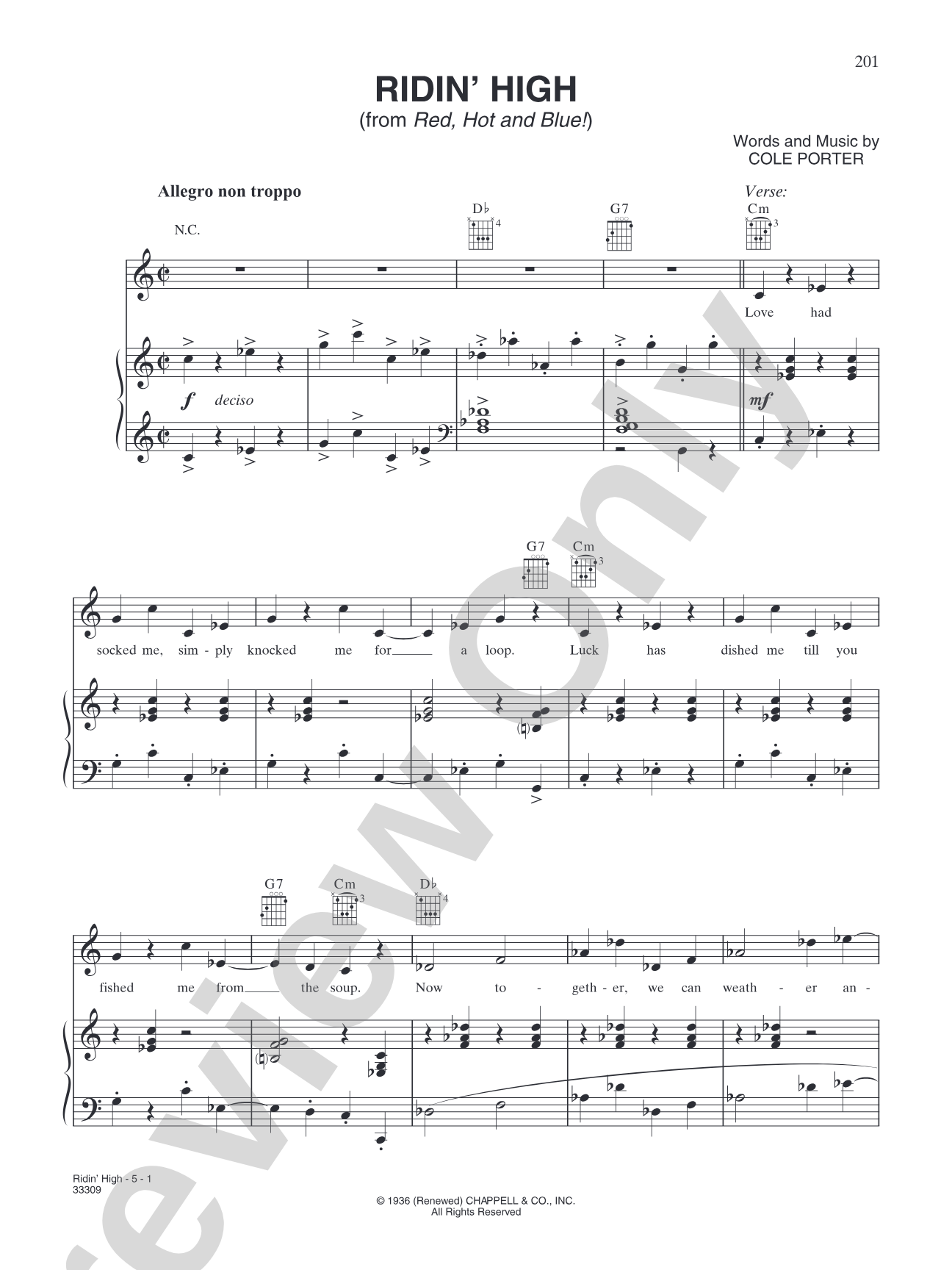

Ridin' High (from "Red, Hot and Blue!" and "High Society"): Piano/Vocal/Chords
Cole Porter
Item: 00-PS-0001161
$4.99
One moment…
Related Items
Begin the Beguine (from "Jubilee" and "Broadway Melody of 1940"): Piano/Vocal/Chords |
$3.99
|
View | |
I'm in Love Again (from "Greenwich Village Follies of 1924"): Piano/Vocal/Chords |
$4.99
|
View | |
I'm Unlucky at Gambling (from "Fifty Million Frenchmen"): Piano/Vocal/Chords |
$4.99
|
View | |
Let's Do It (Let's Fall in Love) (from "Paris"): Piano/Vocal/Chords |
$4.99
|
View | |
Looking at You (from "Wake Up and Dream"): Piano/Vocal/Chords |
$4.99
|
View | |
Love for Sale (from "The New Yorkers"): Piano/Vocal/Chords |
$5.99
|
View | |
Night and Day (from "Gay Divorce"): Piano/Vocal/Chords |
$4.99
|
View | |
How's Your Romance (from "Gay Divorce"): Piano/Vocal/Chords |
$5.99
|
View | |
How Could We Be Wrong (from "Nymph Errant"): Piano/Vocal/Chords |
$4.99
|
View | |
Anything Goes (from the 1987 Revival "Anything Goes"): Piano/Vocal/Chords |
$9.99
|
View | |
It's De-Lovely (from "Red, Hot and Blue!"): Piano/Vocal/Chords |
$5.99
|
View | |
Wake Up and Dream (from "Wake Up and Dream"): Piano/Vocal/Chords |
$4.99
|
View | |
I've Got You on My Mind (from "Stardust" and "Gay Divorce"): Piano/Vocal/Chords |
$4.99
|
View | |
The Great Indoors (from "The New Yorkers"): Piano/Vocal/Chords |
$4.99
|
View | |
It's Bad for Me (from "Nymph Errant"): Piano/Vocal/Chords |
$4.99
|
View | |
Which? (from "Wake Up and Dream"): Piano/Vocal/Chords |
$4.99
|
View | |
You Don't Know Paree (from "Fifty Million Frenchmen"): Piano/Vocal/Chords |
$4.99
|
View | |
They All Fall in Love (from "The Battle of Paris"): Piano/Vocal/Chords |
$4.99
|
View | |
Goodbye, Little Dream, Goodbye (from "O Mistress Mine"): Piano/Vocal/Chords |
$4.99
|
View | |
Let's Misbehave: Piano/Vocal/Chords |
$4.99
|
View | |
What Is This Thing Called Love? (from "Wake Up and Dream"): Piano/Vocal/Chords |
$4.99
|
View | |
You Do Something to Me (from "Fifty Million Frenchmen"): Piano/Vocal/Chords |
$4.99
|
View | |
Just One of Those Things (from "Jubilee"): Piano/Vocal/Chords |
$5.99
|
View | |
Take Me Back to Manhattan (from "The New Yorkers"): Piano/Vocal/Chords |
$4.99
|
View | |
I Happen to Like New York (from "The New Yorkers"): Piano/Vocal/Chords |
$4.99
|
View | |
All Through the Night (from "Anything Goes"): Piano/Vocal/Chords |
$5.99
|
View | |
I Get a Kick Out of You (from "Anything Goes"): Piano/Vocal/Chords |
$4.99
|
View | |
Mister and Missus Fitch (from "Gay Divorce"): Piano/Vocal/Chords |
$4.99
|
View | |
I've Got You Under My Skin (from "Born to Dance"): Piano/Vocal/Chords |
$5.99
|
View | |
Easy to Love (from "Born to Dance"): Piano/Vocal/Chords |
$4.99
|
View | |
Down in the Depths (On the Ninetieth Floor) (from "Red, Hot and Blue!"): Piano/Vocal/Chords |
$5.99
|
View | |
Longing for Dear Old Broadway (from "The Pot of Gold"): Piano/Vocal/Chords |
$4.99
|
View | |
Ours (from "Red, Hot and Blue!"): Piano/Vocal/Chords |
$4.99
|
View | |
Don't Look at Me That Way (from "Paris"): Piano/Vocal/Chords |
$4.99
|
View | |
The Laziest Gal in Town (from "Stage Fright"): Piano/Vocal/Chords |
$4.99
|
View | |
Old-Fashioned Garden (from "Hitchy-Koo"): Piano/Vocal/Chords |
$4.99
|
View | |
You've Got That Thing (from "Fifty Million Frenchmen"): Piano/Vocal/Chords |
$4.99
|
View | |
Where Have You Been? (from "The New Yorkers"): Piano/Vocal/Chords |
$4.99
|
View | |
Weren't We Fools?: Piano/Vocal/Chords |
$4.99
|
View | |
After You, Who? (from "Gay Divorce"): Piano/Vocal/Chords |
$4.99
|
View | |
Experiment (from "Nymph Errant"): Piano/Vocal/Chords |
$4.99
|
View | |
The Physician (from "Nymph Errant"): Piano/Vocal/Chords |
$4.99
|
View | |
Miss Otis Regrets (from "Hi Diddle Diddle"): Piano/Vocal/Chords |
$4.99
|
View | |
Buddie, Beware (from "Anything Goes"): Piano/Vocal/Chords |
$5.99
|
View | |
You're the Top (from "Anything Goes"): Piano/Vocal/Chords |
$4.99
|
View | |
Blow, Gabriel, Blow (from "Anything Goes"): Piano/Vocal/Chords |
$5.99
|
View | |
Why Shouldn't I? (from "Jubilee"): Piano/Vocal/Chords |
$4.99
|
View | |
The Tale of the Oyster (from "Fifty Million Frenchmen"): Piano/Vocal/Chords |
$4.99
|
View | |
I've a Shooting Box in Scotland (from "See America First"): Piano/Vocal/Chords |
$5.99
|
View |
Description
This is the first of a two-volume series presenting highlights from the career of Cole Porter. Volume one documents 50 songs from his early career, from 1912 until 1936. The book includes a song-by-song analysis, rare images of original sheet music, informal shots from Porter's scrapbooks, and publicity stills from motion pictures and Broadway. Titles: Anything Goes * Begin the Beguine * Easy to Love * I Get a Kick Out of You * It's De-Lovely * I've Got You Under My Skin * Just One of Those Things * Let's Do It (Let's Fall in Love) * Love for Sale * Miss Otis Regrets * Night and Day * What Is This Thing Called Love * You Do Something to Me * and more.


Ridin' High (from "Red, Hot and Blue!" and "High Society"): Piano/Vocal/Chords isn't in MakeMusic Cloud just yet...but it could be. Let us know you'd like to see it, and you'll help shape what comes next. In the meantime, start a free trial and dive into thousands of interactive titles your students can play along with today.
Request This Title
Tell us you want it.
Start Your Free Trial
Explore everything that's ready to play right now.
Sample Audio
No sample audio found.
Sample Video
No sample videos found.
Additional Details
Publisher:
Alfred Music
Page Count:
260
SKU:
00-PS-0001161
More about this title
About the Composer: Cole Porter
Cole Porter (1891-1964) shaped American musical theater through sophisticated harmonies, witty lyrics, and an ear for melody that made standards from standards. His career spanned from the 1910s through the 1950s, a period when he moved seamlessly between Broadway revues, operettas, and film scores. Porter's harmonic language influenced generations of composers; his use of unexpected chord progressions and chromatic movement created both accessibility and musical depth that rewards close study.
Why we love this
This collection captures Porter at his most inventive, pairing 50 essential songs with archival material that shows the evolution of his craft across nearly three decades. Teachers and performers find themselves drawn back to these pieces repeatedly; the harmonic sophistication keeps advancing musicians engaged while the melodic clarity makes them teachable at multiple levels. The historical documentation transforms a songbook into a window onto American musical theater's golden age.
What to expect
Urbane, clever, occasionally wistful. Porter's melodies have an uncanny way of feeling inevitable once you know them, yet the harmonic paths he takes to arrive there surprise you each time. These songs evoke nightclubs, Broadway theaters, and elegant evenings; they are conversational rather than grandiose, intimate rather than bombastic.
Who it's for
Pianists and singers preparing audition material or recital programs will find dependable, rewarding repertoire across a range of moods and tempos. Voice teachers and their students can draw from this collection for years; each song offers different technical or interpretive challenges. Pianists accompanying vocalists will appreciate having so many Porter standards in one resource with chord symbols for flexible performance.
How to get the most out of it
- Study the harmonic movement before focusing on interpretation. Porter's chromaticism and unexpected modulations require secure voice leading, especially in accompaniment figures that can sound muddled if the harmonic intent isn't clear.
- Resist over-romanticizing the tempo. Many of these songs swing or move with a deliberate lilt; leaning into Porter's rhythmic profile keeps the music alive rather than making it precious.
- Treat the lyrics as melody partners, not afterthoughts. Porter's lyrical rhythms are integral to phrasing; singing or playing through the text reveals where the musical architecture truly lands.
- Balance the sophistication with warmth. These pieces demand technical control, but their appeal comes from a conversational elegance. Play for the listener, not the difficulty.
How to use it
Build a recital around Porter selections from this book to show a specific era or mood. Pair lighter, faster numbers with introspective ballads to create shape and variety. These songs also serve jazz programs well; their harmonic language connects directly to the standards repertoire that jazz musicians study.
Skills your students will build
- Reading and executing chromatic harmony and unexpected chord progressions
- Phrasing vocal melody over sophisticated piano accompaniment
- Interpreting rhythmic subtlety and swing in written notation
- Understanding song form in the American standard tradition
- Accompanying singers with attention to lyrical rhythm and harmonic support