
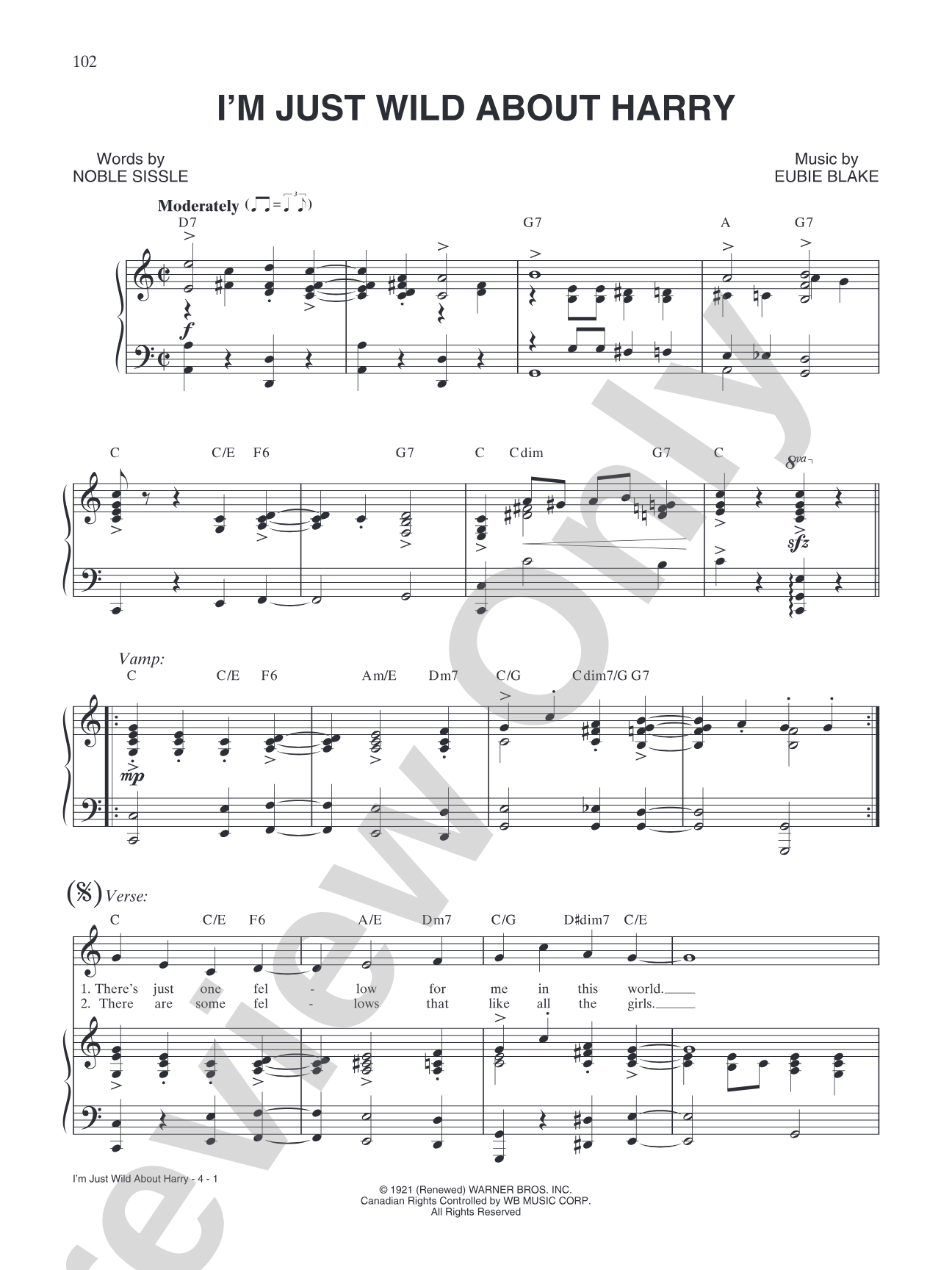

I’m Just Wild About Harry (from "Merrie Melodies & Looney Tunes"): Piano/Vocal/Chords
Merrie Melodies and Themes from Warner Brothers Cartoons
Item: 00-XS-0000176
$4.99
One moment…
Related Items
I'm Forever Blowing Bubbles (from "Merrie Melodies & Looney Tunes"): Piano/Vocal/Chords |
$4.99
|
View | |
The Gold Digger's Song (from "Merrie Melodies & Looney Tunes"): Piano/Vocal/Chords |
$4.99
|
View | |
You Must Have Been a Beautiful Baby (from "Merrie Melodies & Looney Tunes"): Piano/Vocal/Chords |
$4.99
|
View | |
Hello! Ma Baby (from "Merrie Melodies & Looney Tunes"): Piano/Vocal/Chords |
$4.99
|
View | |
A Cup of Coffee, a Sandwich, and You (from "Merrie Melodies & Looney Tunes"): Piano/Vocal/Chords |
$4.99
|
View | |
Merrily We Roll Along (from "Merrie Melodies & Looney Tunes"): Piano/Vocal/Chords |
$4.99
|
View | |
Hooray for Hollywood (from "Merrie Melodies & Looney Tunes"): Piano/Vocal/Chords |
$4.99
|
View | |
The Lady In Red (from "Merrie Melodies & Looney Tunes"): Piano/Vocal/Chords |
$5.99
|
View | |
I Love to Sing-A (from "Merrie Melodies & Looney Tunes"): Piano/Vocal/Chords |
$5.99
|
View | |
What's Up, Doc? (from "The Bugs Bunny Show"): Piano/Vocal/Chords |
$4.99
|
View | |
A Rainy Night in Rio (from "Merrie Melodies & Looney Tunes"): Piano/Vocal/Chords |
$4.99
|
View | |
Road Runner (from "Merrie Melodies & Looney Tunes"): Piano/Vocal/Chords |
$4.99
|
View | |
Ain't She Sweet (from "Merrie Melodies & Looney Tunes"): Piano/Vocal/Chords |
$4.99
|
View | |
Powerhouse (from "Merrie Melodies & Looney Tunes"): Piano |
$5.99
|
View | |
The Michigan Rag (from "Merrie Melodies & Looney Tunes"): Piano/Vocal/Chords |
$4.99
|
View | |
The Merry-Go-Round Broke Down (from "Merrie Melodies & Looney Tunes"): Piano/Vocal/Chords |
$4.99
|
View | |
The Looney Tunes Songbook: Piano/Vocal/Guitar Book |
$19.99
|
View |
Description
The Looney Tunes Songbook features music used by Carl Stalling in the scores for Warner Brothers' beloved cartoons from the 1930s through the early '60s. Included are the familiar theme songs, tunes associated with various characters, Warner Brothers pop songs used as background music, and the wacky melodies of Raymond Scott. Titles: Merrily We Roll Along * The Merry-Go-Round Broke Down * Road Runner * This Is It! * What's Up, Doc? * Dinner Music for a Pack of Hungry Cannibals * In an 18th Century Drawing Room * Powerhouse * Reckless Night on Board an Ocean Liner * The Toy Trumpet * Ain't She Sweet * A Cup of Coffee, a Sandwich, and You * The Gold Digger's Song (We're in the Money) * Hooray for Hollywood * I Love to Sing-a * I'm Forever Blowing Bubbles * The Lady in Red * A Rainy Night in Rio * You Must Have Been a Beautiful Baby * Hello, Ma Baby * I'm Just Wild About Harry * The Michigan Rag.


I’m Just Wild About Harry (from "Merrie Melodies & Looney Tunes"): Piano/Vocal/Chords isn't in MakeMusic Cloud just yet...but it could be. Let us know you'd like to see it, and you'll help shape what comes next. In the meantime, start a free trial and dive into thousands of interactive titles your students can play along with today.
Request This Title
Tell us you want it.
Start Your Free Trial
Explore everything that's ready to play right now.
Sample Audio
No sample audio found.
Sample Video
No sample videos found.
Additional Details
Publisher:
Alfred Music
Page Count:
108
SKU:
00-XS-0000176
More about this title
About the Composer: Eubie Blake
Eubie Blake (1887-1983) was a pioneering African American composer, pianist, and entertainer whose prolific career spanned nearly a century. He co-wrote some of the most enduring popular songs of the early 20th century, including "Shuffle Along" and "Runnin' Wild," and his compositions became standards in jazz, ragtime, and musical theater. Blake's melodies were instantly recognizable and perfectly suited to the visual comedy of Warner Brothers cartoons, where his work (and that of other composers arranged in this collection) became synonymous with the golden age of animation under music director Carl Stalling.
Why we love this
This arrangement captures the infectious charm that made these cartoons timeless, and "I'm Just Wild About Harry" sits perfectly within a collection that shows how sophisticated popular songwriting can be when paired with visual storytelling. Piano/vocal/guitar format gives singers, pianists, and guitarists genuine flexibility in rehearsal and performance. The material works equally well as a novelty showstopper or as a gateway into early 20th-century popular song for students who might not otherwise encounter it.
What to expect
Bright and mischievous, with the kind of infectious melody that gets stuck in your head immediately. The harmonic language is simple but smart, rooted in early 20th-century popular song style with ragtime and jazz inflections that feel both nostalgic and genuinely fun to perform.
Who it's for
Vocalists preparing novelty or cabaret material, pianist-singers looking for accessible popular standards from the early era, and guitarists wanting to brush up on jazz voicings in a familiar context. This works especially well for students exploring American popular song history and arrangers seeking authentic reference material from the golden age of animation.
How to get the most out of it
- Lean into the rhythmic bounce of the melody; this tune thrives on a light, crisp touch at the piano rather than legato phrasing.
- Use the chord symbols to explore comping variations on guitar or piano if you're accompanying a vocalist, which keeps energy fresh across multiple takes.
- Balance the vocal line so it sits naturally over the accompaniment without oversinging; the song's appeal lies in its playful simplicity.
- Reference the original recording or cartoon context if available; knowing how Stalling used these melodies in animation informs pacing and character.
How to use it
Slot this into a cabaret, variety show, or "American Songbook" concert where its cartoon origins become an asset rather than a limitation. It pairs naturally with other early popular standards and works as an excellent novelty opener or closer that audiences recognize and enjoy immediately.
Skills your students will build
- Reading piano/vocal score with chord symbols
- Interpreting early 20th-century popular song style and phrasing
- Comping from jazz chord voicings on guitar or piano
- Coordinating vocal and instrumental parts in a flexible arrangement
- Understanding how popular song structure served animation and visual comedy