
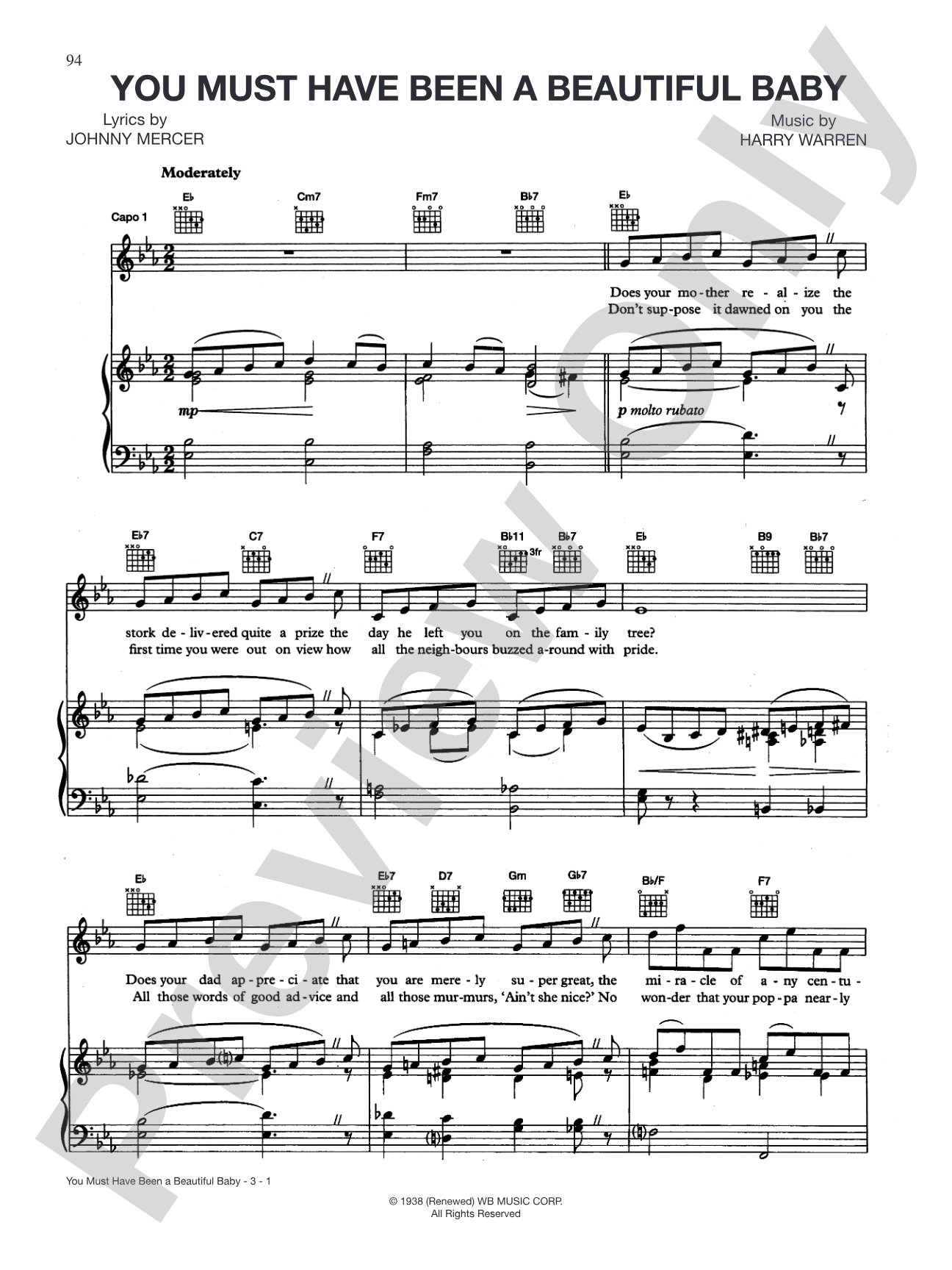

You Must Have Been a Beautiful Baby (from "Merrie Melodies & Looney Tunes"): Piano/Vocal/Chords
Merrie Melodies and Themes from Warner Brothers Cartoons
Item: 00-PS-0012996
$4.99
One moment…
Related Items
I'm Forever Blowing Bubbles (from "Merrie Melodies & Looney Tunes"): Piano/Vocal/Chords |
$4.99
|
View | |
The Gold Digger's Song (from "Merrie Melodies & Looney Tunes"): Piano/Vocal/Chords |
$4.99
|
View | |
Hello! Ma Baby (from "Merrie Melodies & Looney Tunes"): Piano/Vocal/Chords |
$4.99
|
View | |
A Cup of Coffee, a Sandwich, and You (from "Merrie Melodies & Looney Tunes"): Piano/Vocal/Chords |
$4.99
|
View | |
Merrily We Roll Along (from "Merrie Melodies & Looney Tunes"): Piano/Vocal/Chords |
$4.99
|
View | |
Hooray for Hollywood (from "Merrie Melodies & Looney Tunes"): Piano/Vocal/Chords |
$4.99
|
View | |
The Lady In Red (from "Merrie Melodies & Looney Tunes"): Piano/Vocal/Chords |
$5.99
|
View | |
I Love to Sing-A (from "Merrie Melodies & Looney Tunes"): Piano/Vocal/Chords |
$5.99
|
View | |
What's Up, Doc? (from "The Bugs Bunny Show"): Piano/Vocal/Chords |
$4.99
|
View | |
I’m Just Wild About Harry (from "Merrie Melodies & Looney Tunes"): Piano/Vocal/Chords |
$4.99
|
View | |
A Rainy Night in Rio (from "Merrie Melodies & Looney Tunes"): Piano/Vocal/Chords |
$4.99
|
View | |
Road Runner (from "Merrie Melodies & Looney Tunes"): Piano/Vocal/Chords |
$4.99
|
View | |
Ain't She Sweet (from "Merrie Melodies & Looney Tunes"): Piano/Vocal/Chords |
$4.99
|
View | |
Powerhouse (from "Merrie Melodies & Looney Tunes"): Piano |
$5.99
|
View | |
The Michigan Rag (from "Merrie Melodies & Looney Tunes"): Piano/Vocal/Chords |
$4.99
|
View | |
The Merry-Go-Round Broke Down (from "Merrie Melodies & Looney Tunes"): Piano/Vocal/Chords |
$4.99
|
View | |
The Looney Tunes Songbook: Piano/Vocal/Guitar Book |
$19.99
|
View |
Description
The Looney Tunes Songbook features music used by Carl Stalling in the scores for Warner Brothers' beloved cartoons from the 1930s through the early '60s. Included are the familiar theme songs, tunes associated with various characters, Warner Brothers pop songs used as background music, and the wacky melodies of Raymond Scott. Titles: Merrily We Roll Along * The Merry-Go-Round Broke Down * Road Runner * This Is It! * What's Up, Doc? * Dinner Music for a Pack of Hungry Cannibals * In an 18th Century Drawing Room * Powerhouse * Reckless Night on Board an Ocean Liner * The Toy Trumpet * Ain't She Sweet * A Cup of Coffee, a Sandwich, and You * The Gold Digger's Song (We're in the Money) * Hooray for Hollywood * I Love to Sing-a * I'm Forever Blowing Bubbles * The Lady in Red * A Rainy Night in Rio * You Must Have Been a Beautiful Baby * Hello, Ma Baby * I'm Just Wild About Harry * The Michigan Rag.


You Must Have Been a Beautiful Baby (from "Merrie Melodies & Looney Tunes"): Piano/Vocal/Chords isn't in MakeMusic Cloud just yet...but it could be. Let us know you'd like to see it, and you'll help shape what comes next. In the meantime, start a free trial and dive into thousands of interactive titles your students can play along with today.
Request This Title
Tell us you want it.
Start Your Free Trial
Explore everything that's ready to play right now.
Sample Audio
No sample audio found.
Sample Video
No sample videos found.
Additional Details
Publisher:
Alfred Music
Page Count:
108
SKU:
00-PS-0012996
More about this title
About the Composer: Harry Warren
Harry Warren (1893-1981) composed music for more than 800 films, making him one of Hollywood's most prolific songwriters. His melodies became the sonic backbone of Warner Brothers cartoons, where his gift for catchy, character-driven themes and rhythmic precision made him an ideal collaborator with director Carl Stalling. Warren's work in the cartoon medium showcases his ability to write memorable music that could shift genres, moods, and tempos within seconds, a skill that earned him numerous Academy Award nominations and cemented his place in American popular music.
Why we love this
This single selection captures the playful, singable quality that made these cartoons so enduring, and the piano/vocal/guitar format makes it accessible for singers preparing period-appropriate material or pianists looking for appealing arrangements that don't sacrifice musical substance. The melody sits comfortably for voices and the harmonic language is straightforward enough for students to understand without being simplistic.
What to expect
Playful and sincere at once, with a melody that bounces along like the cartoon characters it was written to accompany. The harmonic vocabulary is warm and approachable, evoking the casual elegance of 1930s popular song without demanding technical virtuosity from either vocalist or accompanist.
Who it's for
Singers preparing standards from the swing era, pianists looking for appealing accompaniment material, and guitarists wanting accessible yet musically satisfying chord charts. This work suits intermediate to advanced beginners who already have solid reading skills but benefit from repertoire that builds confidence through singability.
How to get the most out of it
- Keep the tempo upbeat but controlled; the charm of this tune lives in its conversational phrasing rather than rushing through the melody
- Pay attention to the lyrical content when shaping phrases; let the sweetness of the lyric inform your dynamic choices without oversinging
- Use the chord symbols to explore different voicings on guitar if accompanying, which adds harmonic texture without competing with the vocalist
- Resist the urge to oversell the jaunty character; understated delivery often lands more humor than deliberate mugging
How to use it
Include this in a cabaret or pops concert that explores vintage American songwriting, or use it as an accessible solo option for a singer developing their standards repertoire. It pairs well with other Warren compositions from the same era and provides a lighter moment in programs mixing art songs with popular material.
Skills your students will build
- Phrasing in the American popular song style
- Reading and interpreting chord symbols for accompaniment
- Balancing melody and harmony between voice and piano/guitar
- Understanding the relationship between lyric and musical shape