
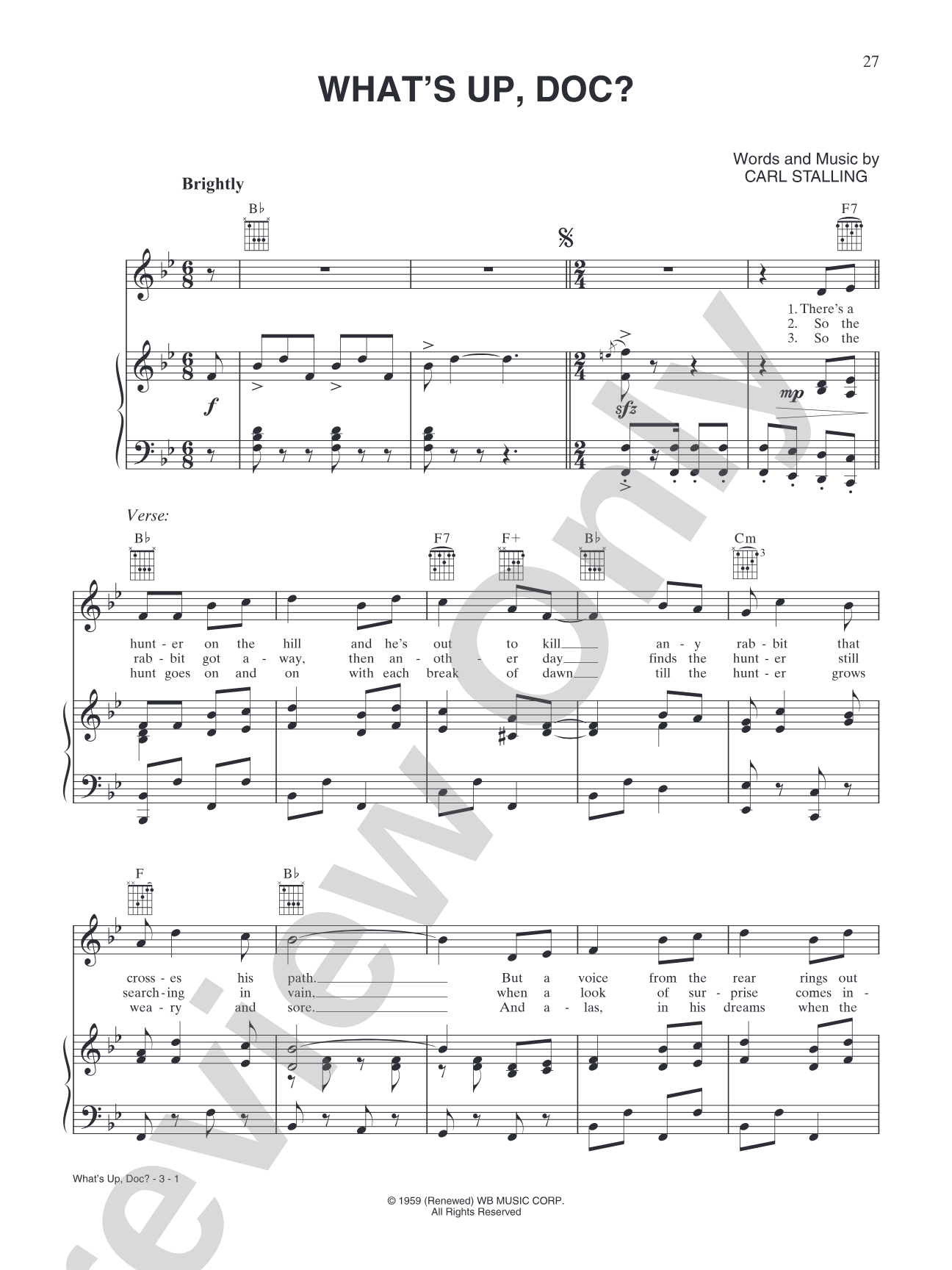

What's Up, Doc? (from "The Bugs Bunny Show"): Piano/Vocal/Chords
Merrie Melodies and Themes from Warner Brothers Cartoons
Item: 00-XS-0000175
$4.99
One moment…
Related Items
I'm Forever Blowing Bubbles (from "Merrie Melodies & Looney Tunes"): Piano/Vocal/Chords |
$4.99
|
View | |
The Gold Digger's Song (from "Merrie Melodies & Looney Tunes"): Piano/Vocal/Chords |
$4.99
|
View | |
You Must Have Been a Beautiful Baby (from "Merrie Melodies & Looney Tunes"): Piano/Vocal/Chords |
$4.99
|
View | |
Hello! Ma Baby (from "Merrie Melodies & Looney Tunes"): Piano/Vocal/Chords |
$4.99
|
View | |
A Cup of Coffee, a Sandwich, and You (from "Merrie Melodies & Looney Tunes"): Piano/Vocal/Chords |
$4.99
|
View | |
Merrily We Roll Along (from "Merrie Melodies & Looney Tunes"): Piano/Vocal/Chords |
$4.99
|
View | |
Hooray for Hollywood (from "Merrie Melodies & Looney Tunes"): Piano/Vocal/Chords |
$4.99
|
View | |
The Lady In Red (from "Merrie Melodies & Looney Tunes"): Piano/Vocal/Chords |
$5.99
|
View | |
I Love to Sing-A (from "Merrie Melodies & Looney Tunes"): Piano/Vocal/Chords |
$5.99
|
View | |
I’m Just Wild About Harry (from "Merrie Melodies & Looney Tunes"): Piano/Vocal/Chords |
$4.99
|
View | |
A Rainy Night in Rio (from "Merrie Melodies & Looney Tunes"): Piano/Vocal/Chords |
$4.99
|
View | |
Road Runner (from "Merrie Melodies & Looney Tunes"): Piano/Vocal/Chords |
$4.99
|
View | |
Ain't She Sweet (from "Merrie Melodies & Looney Tunes"): Piano/Vocal/Chords |
$4.99
|
View | |
Powerhouse (from "Merrie Melodies & Looney Tunes"): Piano |
$5.99
|
View | |
The Michigan Rag (from "Merrie Melodies & Looney Tunes"): Piano/Vocal/Chords |
$4.99
|
View | |
The Merry-Go-Round Broke Down (from "Merrie Melodies & Looney Tunes"): Piano/Vocal/Chords |
$4.99
|
View | |
The Looney Tunes Songbook: Piano/Vocal/Guitar Book |
$19.99
|
View |
Description
The Looney Tunes Songbook features music used by Carl Stalling in the scores for Warner Brothers' beloved cartoons from the 1930s through the early '60s. Included are the familiar theme songs, tunes associated with various characters, Warner Brothers pop songs used as background music, and the wacky melodies of Raymond Scott. Titles: Merrily We Roll Along * The Merry-Go-Round Broke Down * Road Runner * This Is It! * What's Up, Doc? * Dinner Music for a Pack of Hungry Cannibals * In an 18th Century Drawing Room * Powerhouse * Reckless Night on Board an Ocean Liner * The Toy Trumpet * Ain't She Sweet * A Cup of Coffee, a Sandwich, and You * The Gold Digger's Song (We're in the Money) * Hooray for Hollywood * I Love to Sing-a * I'm Forever Blowing Bubbles * The Lady in Red * A Rainy Night in Rio * You Must Have Been a Beautiful Baby * Hello, Ma Baby * I'm Just Wild About Harry * The Michigan Rag.


What's Up, Doc? (from "The Bugs Bunny Show"): Piano/Vocal/Chords isn't in MakeMusic Cloud just yet...but it could be. Let us know you'd like to see it, and you'll help shape what comes next. In the meantime, start a free trial and dive into thousands of interactive titles your students can play along with today.
Request This Title
Tell us you want it.
Start Your Free Trial
Explore everything that's ready to play right now.
Sample Audio
No sample audio found.
Sample Video
No sample videos found.
Additional Details
Publisher:
Alfred Music
Page Count:
108
SKU:
00-XS-0000175
More about this title
About the Composer: Carl Stalling
Carl Stalling (1891-1972) was the principal composer and conductor for Warner Brothers' cartoons during their golden age, creating an astonishing body of work that defined the sound of Looney Tunes and Merrie Melodies. His gift lay in matching music precisely to onscreen action, orchestrating rapid-fire gags and sight gags with split-second timing while weaving in period songs, classical references, and original themes that made each cartoon instantly memorable.
Why we love this
Stalling's themes are instantly recognizable, endlessly fun to perform, and bridge the gap between popular song and compositional craft. Every pianist, guitarist, and vocalist in your program will connect immediately with this material, and the humor embedded in these melodies makes even serious students smile while they work.
What to expect
Playful, energetic, and endlessly charming. These melodies bounce along with orchestral wit and vaudeville flair, evoking a world of slapstick comedy and theatrical exuberance where a single phrase can capture an entire character or gag.
Who it's for
Pianists, guitarists, and vocalists at intermediate levels who want engaging, accessible repertoire with genuine character. This collection works for students preparing recitals, ensemble players looking for entertainment value, and any musician interested in the intersection of popular song and compositional sophistication.
How to get the most out of it
- Lean into the comedic timing. Stalling wrote these melodies to land on specific beats for maximum impact; treat rhythmic precision as part of the comedy, not just accuracy.
- Vary your articulation and dynamics to mirror the cartoon's visual action. A sudden staccato phrase or dynamic drop can recreate the zany quality of the original animation.
- When accompanying singers or soloists, stay flexible with tempo. These pieces can breathe and shift to match the performer's phrasing and the comedic mood you're building together.
How to use it
Consider a Looney Tunes-themed recital showcasing different arrangements and voicings across the collection, or weave individual pieces into seasonal concerts when you want moments of pure entertainment and laughter. These pieces also pair beautifully with choreography, animation clips, or spoken introductions that celebrate classic cartoon humor.
Skills your students will build
- Reading lead sheet notation (melody, chord symbols, and harmonic progressions)
- Accompanying singers and soloists with flexibility and responsiveness
- Interpreting rhythmic and stylistic cues from popular song idioms
- Matching musical articulation and dynamics to dramatic or comedic intent
- Sight-reading across different clefs and ensemble textures