
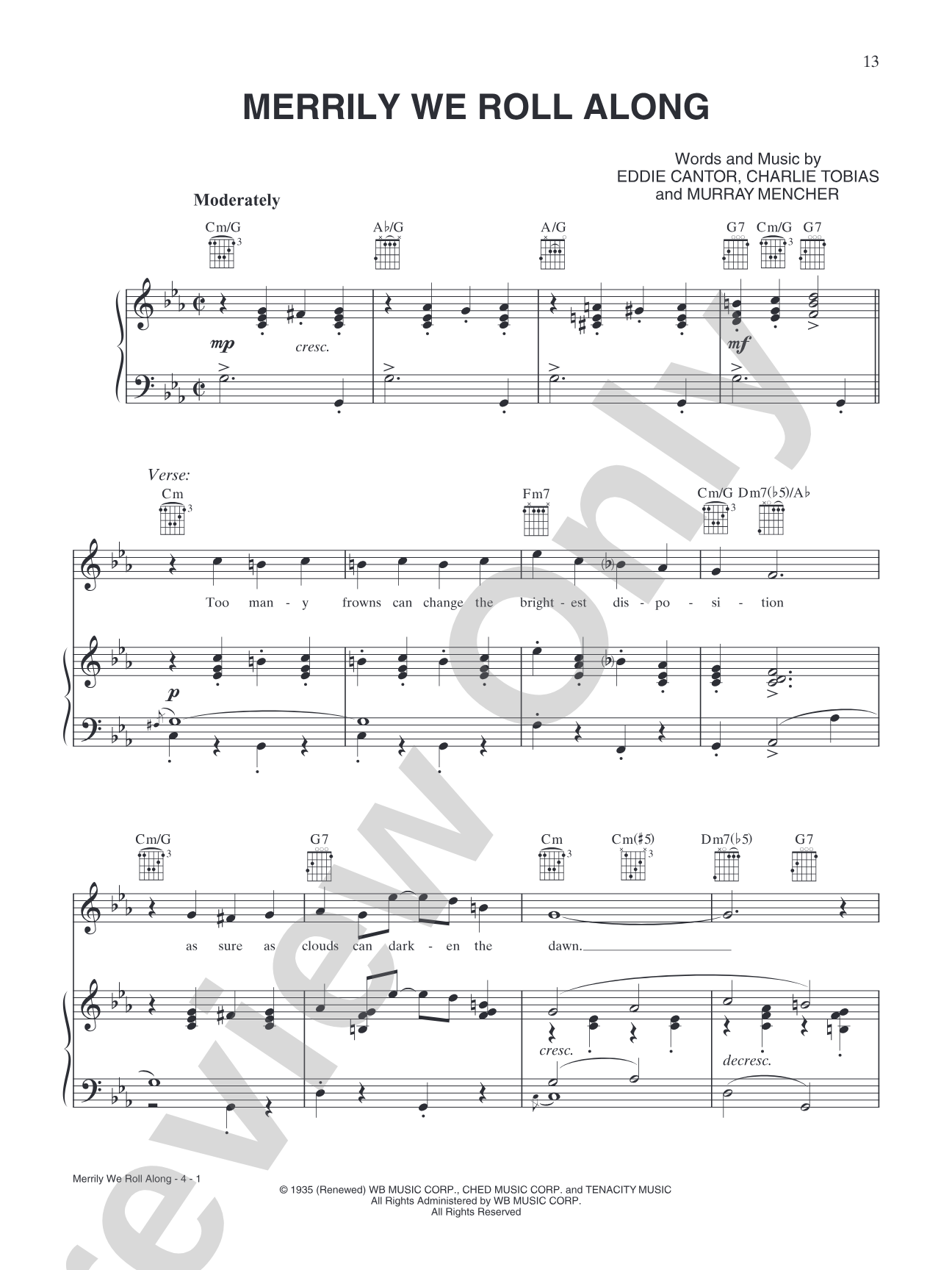

Merrily We Roll Along (from "Merrie Melodies & Looney Tunes"): Piano/Vocal/Chords
Merrie Melodies and Themes from Warner Brothers Cartoons
Item: 00-XS-0000171
$4.99
One moment…
Related Items
I'm Forever Blowing Bubbles (from "Merrie Melodies & Looney Tunes"): Piano/Vocal/Chords |
$4.99
|
View | |
The Gold Digger's Song (from "Merrie Melodies & Looney Tunes"): Piano/Vocal/Chords |
$4.99
|
View | |
You Must Have Been a Beautiful Baby (from "Merrie Melodies & Looney Tunes"): Piano/Vocal/Chords |
$4.99
|
View | |
Hello! Ma Baby (from "Merrie Melodies & Looney Tunes"): Piano/Vocal/Chords |
$4.99
|
View | |
A Cup of Coffee, a Sandwich, and You (from "Merrie Melodies & Looney Tunes"): Piano/Vocal/Chords |
$4.99
|
View | |
Hooray for Hollywood (from "Merrie Melodies & Looney Tunes"): Piano/Vocal/Chords |
$4.99
|
View | |
The Lady In Red (from "Merrie Melodies & Looney Tunes"): Piano/Vocal/Chords |
$5.99
|
View | |
I Love to Sing-A (from "Merrie Melodies & Looney Tunes"): Piano/Vocal/Chords |
$5.99
|
View | |
What's Up, Doc? (from "The Bugs Bunny Show"): Piano/Vocal/Chords |
$4.99
|
View | |
I’m Just Wild About Harry (from "Merrie Melodies & Looney Tunes"): Piano/Vocal/Chords |
$4.99
|
View | |
A Rainy Night in Rio (from "Merrie Melodies & Looney Tunes"): Piano/Vocal/Chords |
$4.99
|
View | |
Road Runner (from "Merrie Melodies & Looney Tunes"): Piano/Vocal/Chords |
$4.99
|
View | |
Ain't She Sweet (from "Merrie Melodies & Looney Tunes"): Piano/Vocal/Chords |
$4.99
|
View | |
Powerhouse (from "Merrie Melodies & Looney Tunes"): Piano |
$5.99
|
View | |
The Michigan Rag (from "Merrie Melodies & Looney Tunes"): Piano/Vocal/Chords |
$4.99
|
View | |
The Merry-Go-Round Broke Down (from "Merrie Melodies & Looney Tunes"): Piano/Vocal/Chords |
$4.99
|
View | |
The Looney Tunes Songbook: Piano/Vocal/Guitar Book |
$19.99
|
View |
Description
The Looney Tunes Songbook features music used by Carl Stalling in the scores for Warner Brothers' beloved cartoons from the 1930s through the early '60s. Included are the familiar theme songs, tunes associated with various characters, Warner Brothers pop songs used as background music, and the wacky melodies of Raymond Scott. Titles: Merrily We Roll Along * The Merry-Go-Round Broke Down * Road Runner * This Is It! * What's Up, Doc? * Dinner Music for a Pack of Hungry Cannibals * In an 18th Century Drawing Room * Powerhouse * Reckless Night on Board an Ocean Liner * The Toy Trumpet * Ain't She Sweet * A Cup of Coffee, a Sandwich, and You * The Gold Digger's Song (We're in the Money) * Hooray for Hollywood * I Love to Sing-a * I'm Forever Blowing Bubbles * The Lady in Red * A Rainy Night in Rio * You Must Have Been a Beautiful Baby * Hello, Ma Baby * I'm Just Wild About Harry * The Michigan Rag.


Merrily We Roll Along (from "Merrie Melodies & Looney Tunes"): Piano/Vocal/Chords isn't in MakeMusic Cloud just yet...but it could be. Let us know you'd like to see it, and you'll help shape what comes next. In the meantime, start a free trial and dive into thousands of interactive titles your students can play along with today.
Request This Title
Tell us you want it.
Start Your Free Trial
Explore everything that's ready to play right now.
Sample Audio
No sample audio found.
Sample Video
No sample videos found.
Additional Details
Publisher:
Alfred Music
Page Count:
108
SKU:
00-XS-0000171
More about this title
About the Composer: Eddie Cantor
Eddie Cantor (1892–1964) was a vaudeville star, radio personality, and film entertainer whose career spanned decades of American popular music. His distinctive comedic delivery and energetic performances made him a household name, and he recorded numerous novelty and comedy songs that became standards in the entertainment world.
Why we love this
This collection captures the infectious spirit of classic cartoon music in a format that works for singers, pianists, and guitarists alike. The melodies are instantly recognizable, the arrangements are straightforward enough for student musicians yet musically satisfying, and programming a Looney Tunes set offers genuine audience appeal across all ages.
What to expect
These songs pulse with the mischief and frenetic energy of slapstick comedy. Each melody bounces and zigs where you might expect it to zag, full of rhythmic surprises and moments designed to make an audience smile.
Who it's for
Vocalists preparing solo or ensemble arrangements for recital or concert programs will find immediate material here. Pianists and guitarists can use these as accompaniment scores or as repertoire for their own performance, and music teachers can draw from this collection for thematic units on American popular song and cartoon music history.
How to get the most out of it
- Treat the rhythmic punctuation and syncopation as character. These melodies thrive on comic timing and rhythmic snap; don't play them straight.
- Balance the vocal line against the accompaniment so the humor and story of each song comes through clearly.
- Use the chord changes as your harmonic roadmap if you're improvising or adapting for your ensemble; they're written to support both strict reading and flexible interpretation.
- Reference the original cartoon scores or recordings if you want to capture the wacky, unpredictable energy that made these pieces legendary.
How to use it
A concert built around Looney Tunes music works as a complete program or as a novelty section within a larger recital. Consider pairing these arrangements with animation clips, sound effects, or choreography to amplify the visual humor these melodies were born to accompany.
Skills your students will build
- Reading syncopated rhythms and comic timing markings
- Playing or singing through song forms that repeat and vary quickly
- Coordinating vocal melody with guitar or piano accompaniment
- Interpreting style cues from the arrangement (tempo changes, dynamic surprises)
- Recognizing and performing in the idiom of early-to-mid 20th-century American popular song