
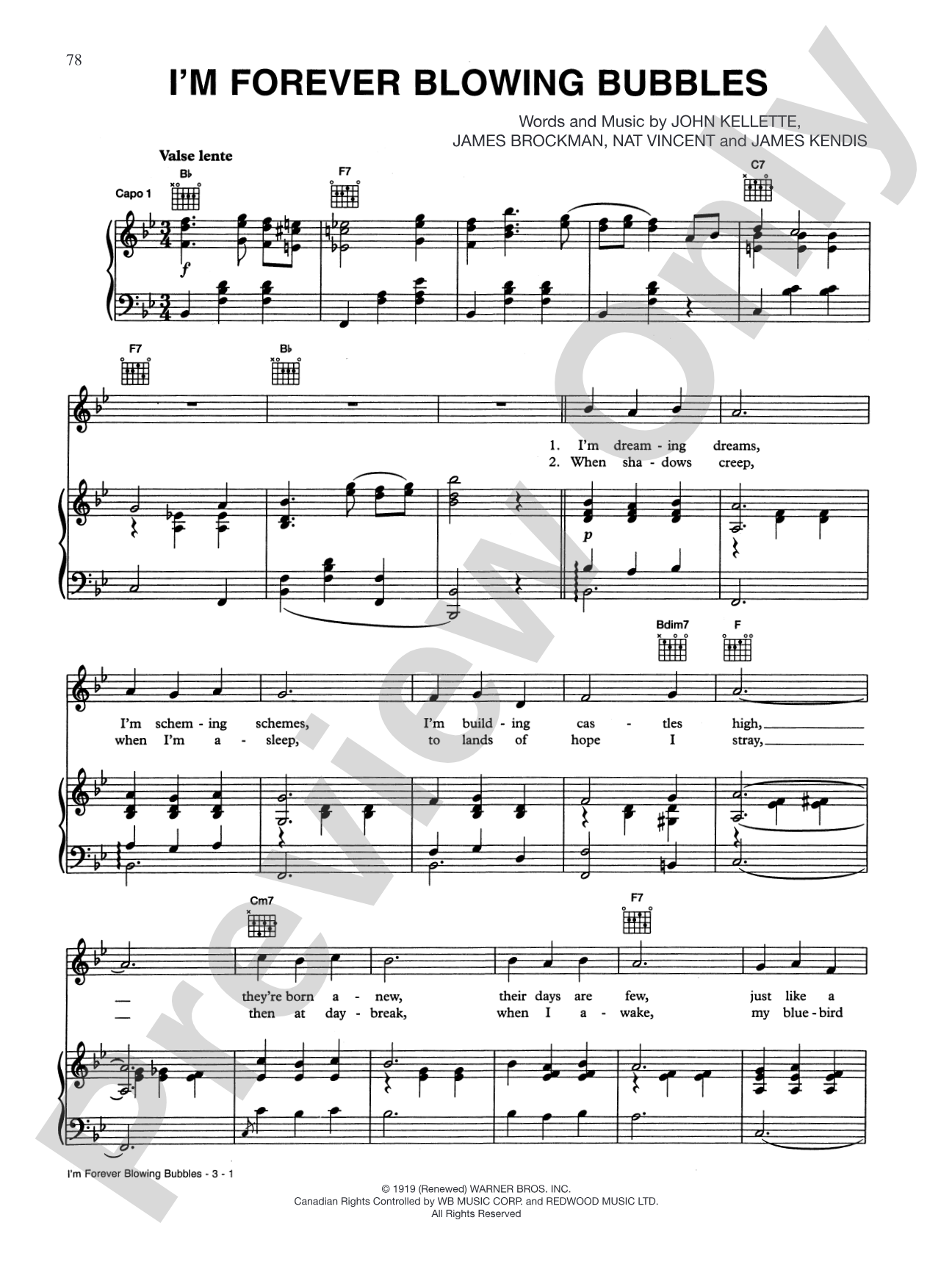

I'm Forever Blowing Bubbles (from "Merrie Melodies & Looney Tunes"): Piano/Vocal/Chords
Merrie Melodies and Themes from Warner Brothers Cartoons
Item: 00-PS-0012994
$4.99
One moment…
Related Items
The Gold Digger's Song (from "Merrie Melodies & Looney Tunes"): Piano/Vocal/Chords |
$4.99
|
View | |
You Must Have Been a Beautiful Baby (from "Merrie Melodies & Looney Tunes"): Piano/Vocal/Chords |
$4.99
|
View | |
Hello! Ma Baby (from "Merrie Melodies & Looney Tunes"): Piano/Vocal/Chords |
$4.99
|
View | |
A Cup of Coffee, a Sandwich, and You (from "Merrie Melodies & Looney Tunes"): Piano/Vocal/Chords |
$4.99
|
View | |
Merrily We Roll Along (from "Merrie Melodies & Looney Tunes"): Piano/Vocal/Chords |
$4.99
|
View | |
Hooray for Hollywood (from "Merrie Melodies & Looney Tunes"): Piano/Vocal/Chords |
$4.99
|
View | |
The Lady In Red (from "Merrie Melodies & Looney Tunes"): Piano/Vocal/Chords |
$5.99
|
View | |
I Love to Sing-A (from "Merrie Melodies & Looney Tunes"): Piano/Vocal/Chords |
$5.99
|
View | |
What's Up, Doc? (from "The Bugs Bunny Show"): Piano/Vocal/Chords |
$4.99
|
View | |
I’m Just Wild About Harry (from "Merrie Melodies & Looney Tunes"): Piano/Vocal/Chords |
$4.99
|
View | |
A Rainy Night in Rio (from "Merrie Melodies & Looney Tunes"): Piano/Vocal/Chords |
$4.99
|
View | |
Road Runner (from "Merrie Melodies & Looney Tunes"): Piano/Vocal/Chords |
$4.99
|
View | |
Ain't She Sweet (from "Merrie Melodies & Looney Tunes"): Piano/Vocal/Chords |
$4.99
|
View | |
Powerhouse (from "Merrie Melodies & Looney Tunes"): Piano |
$5.99
|
View | |
The Michigan Rag (from "Merrie Melodies & Looney Tunes"): Piano/Vocal/Chords |
$4.99
|
View | |
The Merry-Go-Round Broke Down (from "Merrie Melodies & Looney Tunes"): Piano/Vocal/Chords |
$4.99
|
View | |
The Looney Tunes Songbook: Piano/Vocal/Guitar Book |
$19.99
|
View |
Description
The Looney Tunes Songbook features music used by Carl Stalling in the scores for Warner Brothers' beloved cartoons from the 1930s through the early '60s. Included are the familiar theme songs, tunes associated with various characters, Warner Brothers pop songs used as background music, and the wacky melodies of Raymond Scott. Titles: Merrily We Roll Along * The Merry-Go-Round Broke Down * Road Runner * This Is It! * What's Up, Doc? * Dinner Music for a Pack of Hungry Cannibals * In an 18th Century Drawing Room * Powerhouse * Reckless Night on Board an Ocean Liner * The Toy Trumpet * Ain't She Sweet * A Cup of Coffee, a Sandwich, and You * The Gold Digger's Song (We're in the Money) * Hooray for Hollywood * I Love to Sing-a * I'm Forever Blowing Bubbles * The Lady in Red * A Rainy Night in Rio * You Must Have Been a Beautiful Baby * Hello, Ma Baby * I'm Just Wild About Harry * The Michigan Rag.


I'm Forever Blowing Bubbles (from "Merrie Melodies & Looney Tunes"): Piano/Vocal/Chords isn't in MakeMusic Cloud just yet...but it could be. Let us know you'd like to see it, and you'll help shape what comes next. In the meantime, start a free trial and dive into thousands of interactive titles your students can play along with today.
Request This Title
Tell us you want it.
Start Your Free Trial
Explore everything that's ready to play right now.
Sample Audio
No sample audio found.
Sample Video
No sample videos found.
Additional Details
Publisher:
Alfred Music
Page Count:
108
SKU:
00-PS-0012994
More about this title
Why we love this
This arrangement captures the infectious charm that made the original a standard, preserving the tune's buoyancy while giving pianists and vocalists genuine agency in the accompaniment. The lead sheet format lets you shape the harmonic support to match your ensemble's tempo and style, making it work equally well for a solo vocalist with piano or a guitarist leading from the chords. It's a song that lands every single time because the melody does the heavy lifting, and this edition gets out of the way and lets it shine.
What to expect
Nostalgic and playful, with a melody that seems to shimmer and drift like the bubbles it describes. The tune carries an innocent optimism that feels both lighthearted and genuinely wistful, capturing why it endured through a century of animation and revival recordings.
Who it's for
Vocalists and pianists preparing material for recitals, auditions, or informal performance contexts will find this straightforward, singable arrangement accessible and immediately usable. Students learning to accompany from lead sheets benefit from this tune's simple harmonic palette and familiar form. Teachers can assign it as a bridge piece between pop standards and classical repertoire.
How to get the most out of it
- Take the tempo with bounce rather than drag. The melody's charm depends on rhythmic lift, especially through the syncopated figures that make the bubbles seem to float upward.
- Shape the accompaniment to match the vocal phrase length. If your singer breathes between bubbles, let the piano or guitar breathe too, pulling back slightly on harmonic support to create space.
- Lean into the descending chromatic passage in the B section. This moment makes the song memorable, so let it speak clearly without rushing the harmonic movement underneath.
- Balance the melody so it sings over the chords without drowning them out. A lighter touch on the keyboard allows the vocalist's tone to carry the song's wistful character.
How to use it
Program this as a palate cleanser between weightier art songs or classical pieces, or pair it with other standards from the American songbook for a themed recital exploring familiar melodies. It works wonderfully in mixed-genre programs where you want to acknowledge popular music without stepping fully into contemporary idiom.
Skills your students will build
- Reading and interpreting lead sheet notation with chord symbols
- Balancing melody projection with harmonic accompaniment
- Maintaining steady tempo through syncopated rhythmic figures
- Phrasing across sections with different harmonic density
- Adapting arrangements across voice types and instrument combinations