
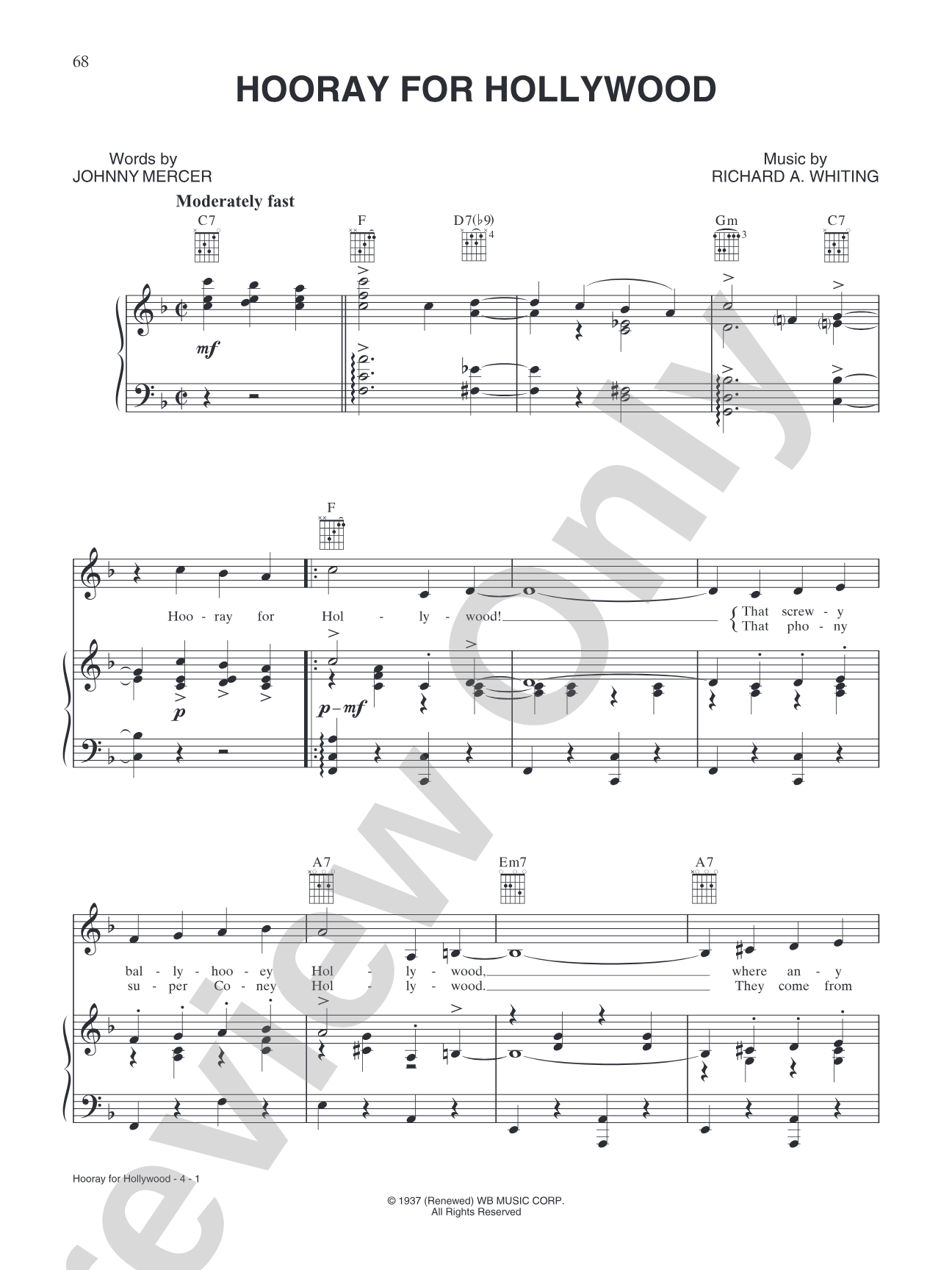

Hooray for Hollywood (from "Merrie Melodies & Looney Tunes"): Piano/Vocal/Chords
Merrie Melodies and Themes from Warner Brothers Cartoons
Item: 00-XS-0000172
$4.99
One moment…
Related Items
I'm Forever Blowing Bubbles (from "Merrie Melodies & Looney Tunes"): Piano/Vocal/Chords |
$4.99
|
View | |
The Gold Digger's Song (from "Merrie Melodies & Looney Tunes"): Piano/Vocal/Chords |
$4.99
|
View | |
You Must Have Been a Beautiful Baby (from "Merrie Melodies & Looney Tunes"): Piano/Vocal/Chords |
$4.99
|
View | |
Hello! Ma Baby (from "Merrie Melodies & Looney Tunes"): Piano/Vocal/Chords |
$4.99
|
View | |
A Cup of Coffee, a Sandwich, and You (from "Merrie Melodies & Looney Tunes"): Piano/Vocal/Chords |
$4.99
|
View | |
Merrily We Roll Along (from "Merrie Melodies & Looney Tunes"): Piano/Vocal/Chords |
$4.99
|
View | |
The Lady In Red (from "Merrie Melodies & Looney Tunes"): Piano/Vocal/Chords |
$5.99
|
View | |
I Love to Sing-A (from "Merrie Melodies & Looney Tunes"): Piano/Vocal/Chords |
$5.99
|
View | |
What's Up, Doc? (from "The Bugs Bunny Show"): Piano/Vocal/Chords |
$4.99
|
View | |
I’m Just Wild About Harry (from "Merrie Melodies & Looney Tunes"): Piano/Vocal/Chords |
$4.99
|
View | |
A Rainy Night in Rio (from "Merrie Melodies & Looney Tunes"): Piano/Vocal/Chords |
$4.99
|
View | |
Road Runner (from "Merrie Melodies & Looney Tunes"): Piano/Vocal/Chords |
$4.99
|
View | |
Ain't She Sweet (from "Merrie Melodies & Looney Tunes"): Piano/Vocal/Chords |
$4.99
|
View | |
Powerhouse (from "Merrie Melodies & Looney Tunes"): Piano |
$5.99
|
View | |
The Michigan Rag (from "Merrie Melodies & Looney Tunes"): Piano/Vocal/Chords |
$4.99
|
View | |
The Merry-Go-Round Broke Down (from "Merrie Melodies & Looney Tunes"): Piano/Vocal/Chords |
$4.99
|
View | |
The Looney Tunes Songbook: Piano/Vocal/Guitar Book |
$19.99
|
View |
Description
The Looney Tunes Songbook features music used by Carl Stalling in the scores for Warner Brothers' beloved cartoons from the 1930s through the early '60s. Included are the familiar theme songs, tunes associated with various characters, Warner Brothers pop songs used as background music, and the wacky melodies of Raymond Scott. Titles: Merrily We Roll Along * The Merry-Go-Round Broke Down * Road Runner * This Is It! * What's Up, Doc? * Dinner Music for a Pack of Hungry Cannibals * In an 18th Century Drawing Room * Powerhouse * Reckless Night on Board an Ocean Liner * The Toy Trumpet * Ain't She Sweet * A Cup of Coffee, a Sandwich, and You * The Gold Digger's Song (We're in the Money) * Hooray for Hollywood * I Love to Sing-a * I'm Forever Blowing Bubbles * The Lady in Red * A Rainy Night in Rio * You Must Have Been a Beautiful Baby * Hello, Ma Baby * I'm Just Wild About Harry * The Michigan Rag.


Hooray for Hollywood (from "Merrie Melodies & Looney Tunes"): Piano/Vocal/Chords isn't in MakeMusic Cloud just yet...but it could be. Let us know you'd like to see it, and you'll help shape what comes next. In the meantime, start a free trial and dive into thousands of interactive titles your students can play along with today.
Request This Title
Tell us you want it.
Start Your Free Trial
Explore everything that's ready to play right now.
Sample Audio
No sample audio found.
Sample Video
No sample videos found.
Additional Details
Publisher:
Alfred Music
Page Count:
108
SKU:
00-XS-0000172
More about this title
About the Composer: Richard Whiting
Richard Whiting (1891-1938) composed for Broadway, Hollywood, and Tin Pan Alley during the golden age of American songwriting. His melodies became standards of the era, performed by leading vocalists and featured prominently in early sound films. Whiting's gift for accessible, memorable lines made his work ideal for both theatrical performance and popular radio broadcast.
Johnny Mercer (1909-1976) was a prolific lyricist, composer, and vocalist who shaped American popular music across seven decades. Known for his witty, conversational lyrics and ability to capture the voice of everyday America, Mercer collaborated with virtually every major composer of his time. His work for film, radio, and stage demonstrated an uncommon gift for matching words to melody in ways that felt both sophisticated and singable.
Why we love this
This collection captures the infectious spirit that made early Warner Brothers cartoons timeless. The melodies are instantly recognizable, the vocal lines sit comfortably for singers across ranges, and the harmonic language is accessible without sacrificing sophistication. Programming selections from this folio alongside standard vocal literature gives students exposure to American song craft at its most playful and inventive.
What to expect
This music captures the optimism and playfulness of the Golden Age of Hollywood. Melodies bounce with personality, harmonies suggest sophistication without demanding virtuosity, and the emotional range spans from romantic to ridiculous. Performing these pieces feels like stepping into a cartoon yourself: bright, energetic, and genuinely entertaining.
Who it's for
Vocalists building a repertoire of American standards will find immediate, performance-ready material here. Pianists studying orchestration and arrangement can learn from how these melodies sit over accompaniment. Teachers building a unit on film music history or American songwriting will appreciate the breadth and accessibility of this collection.
How to get the most out of it
- Support the comedic timing with rhythmic precision. These melodies thrive when rhythmic gestures land cleanly and articulation is clear.
- Balance vocal expression with the character of each tune. Some pieces invite broad, vaudeville-style delivery; others work better with restraint and charm.
- Use the chord symbols to explore reharmonization options if accompanying yourself or working with an ensemble pianist.
- Notice how the accompaniment patterns change between selections. Adjust your touch and voicing to match whether a piece calls for stride piano, jazz comping, or legit theatrical writing.
How to use it
Select individual pieces to round out a recital built on American repertoire, or program a themed set of Looney Tunes selections for a lighter concert moment. These arrangements work equally well in a cabaret setting, a formal recital, or an educational concert exploring how composers write for film and animation.
Skills your students will build
- Reading piano/vocal/guitar chord charts and lead sheets
- Interpreting stylistic context clues from early film music
- Balancing legit vocal technique with comedic character
- Understanding accompanimental patterns typical of 1930s-1960s popular song
- Phrasing and timing for entertainment value