
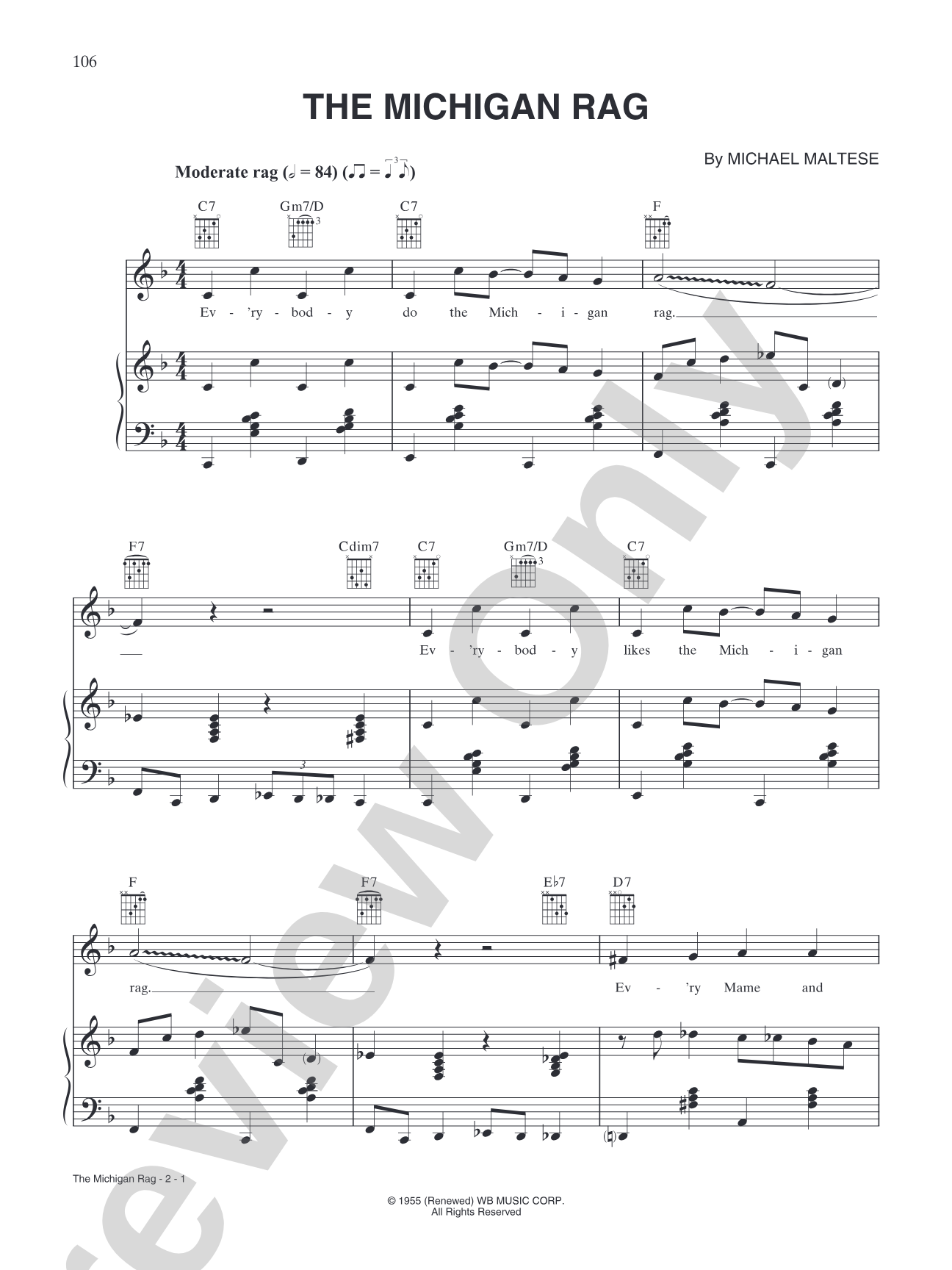

The Michigan Rag (from "Merrie Melodies & Looney Tunes"): Piano/Vocal/Chords
Merrie Melodies and Themes from Warner Brothers Cartoons
Item: 00-XS-0000187
$4.99
Pickup currently not available
Related Items
I'm Forever Blowing Bubbles (from "Merrie Melodies & Looney Tunes"): Piano/Vocal/Chords |
$4.99
|
View | |
The Gold Digger's Song (from "Merrie Melodies & Looney Tunes"): Piano/Vocal/Chords |
$4.99
|
View | |
You Must Have Been a Beautiful Baby (from "Merrie Melodies & Looney Tunes"): Piano/Vocal/Chords |
$4.99
|
View | |
Hello! Ma Baby (from "Merrie Melodies & Looney Tunes"): Piano/Vocal/Chords |
$4.99
|
View | |
A Cup of Coffee, a Sandwich, and You (from "Merrie Melodies & Looney Tunes"): Piano/Vocal/Chords |
$4.99
|
View | |
Merrily We Roll Along (from "Merrie Melodies & Looney Tunes"): Piano/Vocal/Chords |
$4.99
|
View | |
Hooray for Hollywood (from "Merrie Melodies & Looney Tunes"): Piano/Vocal/Chords |
$4.99
|
View | |
The Lady In Red (from "Merrie Melodies & Looney Tunes"): Piano/Vocal/Chords |
$5.99
|
View | |
I Love to Sing-A (from "Merrie Melodies & Looney Tunes"): Piano/Vocal/Chords |
$5.99
|
View | |
What's Up, Doc? (from "The Bugs Bunny Show"): Piano/Vocal/Chords |
$4.99
|
View | |
I’m Just Wild About Harry (from "Merrie Melodies & Looney Tunes"): Piano/Vocal/Chords |
$4.99
|
View | |
A Rainy Night in Rio (from "Merrie Melodies & Looney Tunes"): Piano/Vocal/Chords |
$4.99
|
View | |
Road Runner (from "Merrie Melodies & Looney Tunes"): Piano/Vocal/Chords |
$4.99
|
View | |
Ain't She Sweet (from "Merrie Melodies & Looney Tunes"): Piano/Vocal/Chords |
$4.99
|
View | |
Powerhouse (from "Merrie Melodies & Looney Tunes"): Piano |
$5.99
|
View | |
The Merry-Go-Round Broke Down (from "Merrie Melodies & Looney Tunes"): Piano/Vocal/Chords |
$4.99
|
View | |
The Looney Tunes Songbook: Piano/Vocal/Guitar Book |
$19.99
|
View |
Description
The Looney Tunes Songbook features music used by Carl Stalling in the scores for Warner Brothers' beloved cartoons from the 1930s through the early '60s. Included are the familiar theme songs, tunes associated with various characters, Warner Brothers pop songs used as background music, and the wacky melodies of Raymond Scott. Titles: Merrily We Roll Along * The Merry-Go-Round Broke Down * Road Runner * This Is It! * What's Up, Doc? * Dinner Music for a Pack of Hungry Cannibals * In an 18th Century Drawing Room * Powerhouse * Reckless Night on Board an Ocean Liner * The Toy Trumpet * Ain't She Sweet * A Cup of Coffee, a Sandwich, and You * The Gold Digger's Song (We're in the Money) * Hooray for Hollywood * I Love to Sing-a * I'm Forever Blowing Bubbles * The Lady in Red * A Rainy Night in Rio * You Must Have Been a Beautiful Baby * Hello, Ma Baby * I'm Just Wild About Harry * The Michigan Rag.


The Michigan Rag (from "Merrie Melodies & Looney Tunes"): Piano/Vocal/Chords isn't in MakeMusic Cloud just yet...but it could be. Let us know you'd like to see it, and you'll help shape what comes next. In the meantime, start a free trial and dive into thousands of interactive titles your students can play along with today.
Request This Title
Tell us you want it.
Start Your Free Trial
Explore everything that's ready to play right now.
Sample Audio
No sample audio found.
Sample Video
No sample videos found.
Additional Details
Publisher:
Alfred Music
Page Count:
108
SKU:
00-XS-0000187
More about this title
About the Composer: Michael Maltese
Michael Maltese was a legendary cartoonist and composer who shaped the sound of Warner Brothers' golden age. Working alongside director Bob Clampett and composer Carl Stalling, Maltese created the gags, dialogue, and musical concepts that defined Looney Tunes and Merrie Melodies from the 1940s through the 1960s. His ability to synchronize absurdist humor with dynamic orchestration influenced generations of animators and musicians.
While Maltese is best known for his animation writing, his contributions to the musical identity of these cartoons were essential. He understood how melody, rhythm, and orchestration could amplify physical comedy and surprise, principles that remain central to contemporary film scoring and musical theater.
Why we love this
This folio captures lightning in a bottle: music written for split-second timing and maximum character that translates beautifully to the piano. The pieces range from sprightly character themes to full-throated standards, giving pianists and singers genuine variety within a cohesive package. Programming repertoire from this songbook signals to audiences that you understand how to balance sophistication with sheer joy.
What to expect
Playful and purposeful. These melodies skip, bounce, and occasionally soar, with harmonic twists that feel both vintage and timeless. There's sophistication beneath the whimsy; even the most comedic themes hold genuine melodic substance. The result is music that sparkles on the page and sounds equally bright in performance.
Who it's for
Pianists and singers with intermediate skills who want to explore repertoire beyond the standard classical canon. Music students and teachers preparing recital programs that appeal to audiences across generations. Anyone drawn to the intersection of musical theater, film scoring, and American popular song.
How to get the most out of it
- Lean into rhythmic precision with the piano part; these melodies were composed to lock with visual gags, so clarity in the accompaniment matters more than rubato.
- Let the harmony breathe in the slower pieces like 'A Rainy Night in Rio.' The chord voicings carry the emotional weight.
- When accompanying singers, use the vocal line as your anchor and shape the piano part around it rather than competing for attention.
- Pay attention to the instrumentation cues in the original orchestrations (Raymond Scott's syncopation, Stalling's quirky transitions) and find ways to suggest them at the keyboard.
How to use it
Slot individual selections into recitals to provide contrast with heavier classical works or to open a program with immediate audience warmth. Pair pieces thematically: group the character themes together, or create a 'standards' set with 'Hooray for Hollywood,' 'I Love to Sing-a,' and 'The Gold Digger's Song.' These pieces work especially well in educational settings where students benefit from learning repertoire with clear melodic identity and harmonic logic.
Skills your students will build
- Reading and executing syncopated rhythms and jazz-inflected phrasing
- Balancing melody and accompaniment in piano/vocal arrangements
- Interpreting period-appropriate style (1930s-1960s popular song conventions)
- Coordinating ensemble rhythm and timing when accompanying singers or other musicians
- Understanding how harmonic color and orchestration cues shape musical character