
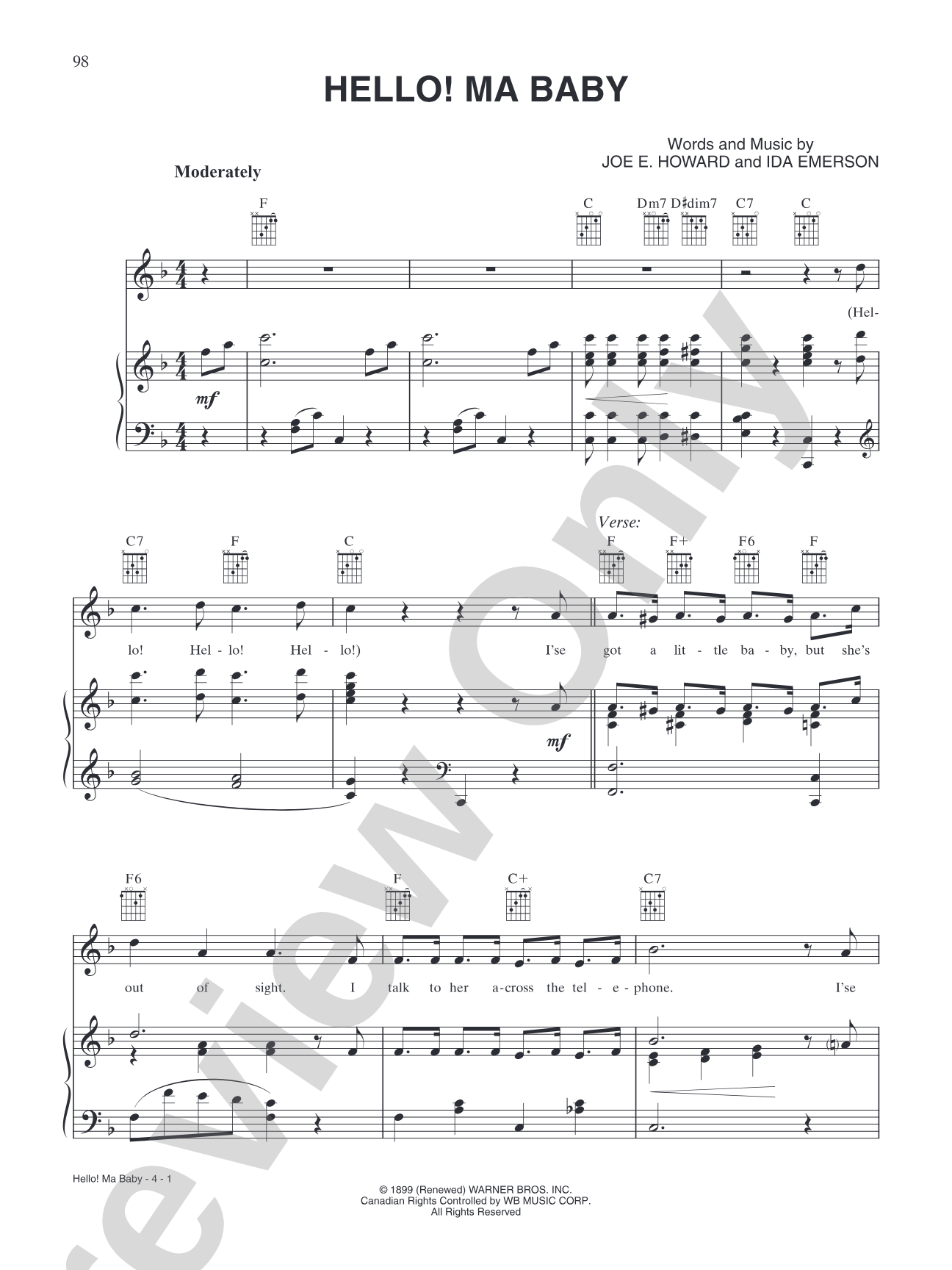

Hello! Ma Baby (from "Merrie Melodies & Looney Tunes"): Piano/Vocal/Chords
Merrie Melodies and Themes from Warner Brothers Cartoons
Item: 00-XS-0000169
$4.99
One moment…
Related Items
I'm Forever Blowing Bubbles (from "Merrie Melodies & Looney Tunes"): Piano/Vocal/Chords |
$4.99
|
View | |
The Gold Digger's Song (from "Merrie Melodies & Looney Tunes"): Piano/Vocal/Chords |
$4.99
|
View | |
You Must Have Been a Beautiful Baby (from "Merrie Melodies & Looney Tunes"): Piano/Vocal/Chords |
$4.99
|
View | |
A Cup of Coffee, a Sandwich, and You (from "Merrie Melodies & Looney Tunes"): Piano/Vocal/Chords |
$4.99
|
View | |
Merrily We Roll Along (from "Merrie Melodies & Looney Tunes"): Piano/Vocal/Chords |
$4.99
|
View | |
Hooray for Hollywood (from "Merrie Melodies & Looney Tunes"): Piano/Vocal/Chords |
$4.99
|
View | |
The Lady In Red (from "Merrie Melodies & Looney Tunes"): Piano/Vocal/Chords |
$5.99
|
View | |
I Love to Sing-A (from "Merrie Melodies & Looney Tunes"): Piano/Vocal/Chords |
$5.99
|
View | |
What's Up, Doc? (from "The Bugs Bunny Show"): Piano/Vocal/Chords |
$4.99
|
View | |
I’m Just Wild About Harry (from "Merrie Melodies & Looney Tunes"): Piano/Vocal/Chords |
$4.99
|
View | |
A Rainy Night in Rio (from "Merrie Melodies & Looney Tunes"): Piano/Vocal/Chords |
$4.99
|
View | |
Road Runner (from "Merrie Melodies & Looney Tunes"): Piano/Vocal/Chords |
$4.99
|
View | |
Ain't She Sweet (from "Merrie Melodies & Looney Tunes"): Piano/Vocal/Chords |
$4.99
|
View | |
Powerhouse (from "Merrie Melodies & Looney Tunes"): Piano |
$5.99
|
View | |
The Michigan Rag (from "Merrie Melodies & Looney Tunes"): Piano/Vocal/Chords |
$4.99
|
View | |
The Merry-Go-Round Broke Down (from "Merrie Melodies & Looney Tunes"): Piano/Vocal/Chords |
$4.99
|
View | |
The Looney Tunes Songbook: Piano/Vocal/Guitar Book |
$19.99
|
View |
Description
The Looney Tunes Songbook features music used by Carl Stalling in the scores for Warner Brothers' beloved cartoons from the 1930s through the early '60s. Included are the familiar theme songs, tunes associated with various characters, Warner Brothers pop songs used as background music, and the wacky melodies of Raymond Scott. Titles: Merrily We Roll Along * The Merry-Go-Round Broke Down * Road Runner * This Is It! * What's Up, Doc? * Dinner Music for a Pack of Hungry Cannibals * In an 18th Century Drawing Room * Powerhouse * Reckless Night on Board an Ocean Liner * The Toy Trumpet * Ain't She Sweet * A Cup of Coffee, a Sandwich, and You * The Gold Digger's Song (We're in the Money) * Hooray for Hollywood * I Love to Sing-a * I'm Forever Blowing Bubbles * The Lady in Red * A Rainy Night in Rio * You Must Have Been a Beautiful Baby * Hello, Ma Baby * I'm Just Wild About Harry * The Michigan Rag.


Hello! Ma Baby (from "Merrie Melodies & Looney Tunes"): Piano/Vocal/Chords isn't in MakeMusic Cloud just yet...but it could be. Let us know you'd like to see it, and you'll help shape what comes next. In the meantime, start a free trial and dive into thousands of interactive titles your students can play along with today.
Request This Title
Tell us you want it.
Start Your Free Trial
Explore everything that's ready to play right now.
Sample Audio
No sample audio found.
Sample Video
No sample videos found.
Additional Details
Publisher:
Alfred Music
Page Count:
108
SKU:
00-XS-0000169
More about this title
About the Composer: Joe E.Howard
Joe E. Howard was a prolific songwriter and performer in the early 20th century, writing songs that became standards of American popular music. His compositions, including the ragtime classic "Hello, Ma Baby," captured the spirit of the Tin Pan Alley era and found their way into countless performances, broadcasts, and cartoons throughout the 1930s and beyond.
Howard's melodies are characterized by their infectious rhythms, straightforward harmonic structures, and immediate memorability. These qualities made his work ideal for Carl Stalling's cartoon underscore work, where clarity and instant character recognition were essential to comedic timing.
Why we love this
"Hello, Ma Baby" bridges the gap between American popular song history and genuine entertainment value. The melody is so direct and singable that it works equally well as a novelty opener at a school concert, a piano recital piece, or a warm-up that genuinely delights singers and players alike. Its connection to Looney Tunes cartoons gives it cultural weight that resonates across generations.
What to expect
Cheerful and straightforward, with the kind of infectious simplicity that made it perfect for cartoon soundtracks. The melody bounces along with ragtime energy, supported by accessible harmonic movement that feels both warm and genuinely fun to perform.
Who it's for
Singers and pianists preparing repertoire for variety concerts, recitals, or programs celebrating American popular song. It's equally suited to young vocalists discovering standards and experienced musicians looking for a crowd-pleasing encore that requires confidence and personality rather than vocal range.
How to get the most out of it
- Keep the vocal line conversational and playful rather than formal; the character of the piece lives in its light, almost spoken quality.
- Sync the accompaniment rhythm tightly with the vocal phrasing to capture the bouncy, comic timing the melody requires.
- Use the chord symbols to explore guitar interpretations if you're working with a mixed ensemble; fingerpicking patterns can add texture without overwhelming the vocal line.
How to use it
Program this as a palate-cleanser between heavier vocal selections or as the opening number for a concert celebrating American song and humor. Its short duration and immediate appeal make it ideal for variety shows or multimedia presentations pairing live performance with cartoon clips.
Skills your students will build
- Singing with rhythmic precision and comedic timing
- Interpreting chord symbols for keyboard accompaniment
- Balancing melody with simple harmonic support
- Connecting melodic phrasing to lyrical meaning in popular song