
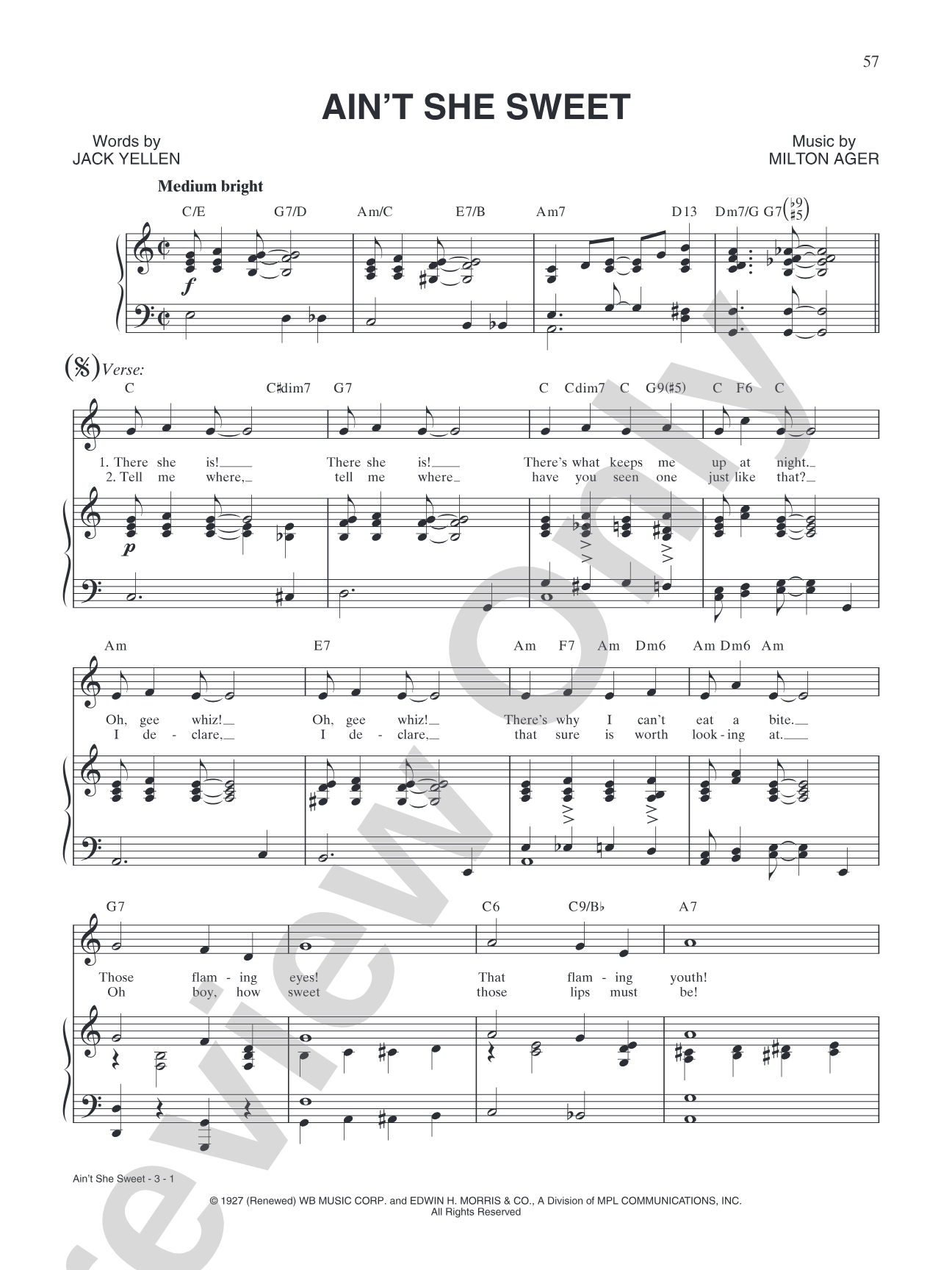

Ain't She Sweet (from "Merrie Melodies & Looney Tunes"): Piano/Vocal/Chords
Merrie Melodies and Themes from Warner Brothers Cartoons
Item: 00-XS-0000179
$4.99
One moment…
Related Items
I'm Forever Blowing Bubbles (from "Merrie Melodies & Looney Tunes"): Piano/Vocal/Chords |
$4.99
|
View | |
The Gold Digger's Song (from "Merrie Melodies & Looney Tunes"): Piano/Vocal/Chords |
$4.99
|
View | |
You Must Have Been a Beautiful Baby (from "Merrie Melodies & Looney Tunes"): Piano/Vocal/Chords |
$4.99
|
View | |
Hello! Ma Baby (from "Merrie Melodies & Looney Tunes"): Piano/Vocal/Chords |
$4.99
|
View | |
A Cup of Coffee, a Sandwich, and You (from "Merrie Melodies & Looney Tunes"): Piano/Vocal/Chords |
$4.99
|
View | |
Merrily We Roll Along (from "Merrie Melodies & Looney Tunes"): Piano/Vocal/Chords |
$4.99
|
View | |
Hooray for Hollywood (from "Merrie Melodies & Looney Tunes"): Piano/Vocal/Chords |
$4.99
|
View | |
The Lady In Red (from "Merrie Melodies & Looney Tunes"): Piano/Vocal/Chords |
$5.99
|
View | |
I Love to Sing-A (from "Merrie Melodies & Looney Tunes"): Piano/Vocal/Chords |
$5.99
|
View | |
What's Up, Doc? (from "The Bugs Bunny Show"): Piano/Vocal/Chords |
$4.99
|
View | |
I’m Just Wild About Harry (from "Merrie Melodies & Looney Tunes"): Piano/Vocal/Chords |
$4.99
|
View | |
A Rainy Night in Rio (from "Merrie Melodies & Looney Tunes"): Piano/Vocal/Chords |
$4.99
|
View | |
Road Runner (from "Merrie Melodies & Looney Tunes"): Piano/Vocal/Chords |
$4.99
|
View | |
Powerhouse (from "Merrie Melodies & Looney Tunes"): Piano |
$5.99
|
View | |
The Michigan Rag (from "Merrie Melodies & Looney Tunes"): Piano/Vocal/Chords |
$4.99
|
View | |
The Merry-Go-Round Broke Down (from "Merrie Melodies & Looney Tunes"): Piano/Vocal/Chords |
$4.99
|
View | |
The Looney Tunes Songbook: Piano/Vocal/Guitar Book |
$19.99
|
View |
Description
The Looney Tunes Songbook features music used by Carl Stalling in the scores for Warner Brothers' beloved cartoons from the 1930s through the early '60s. Included are the familiar theme songs, tunes associated with various characters, Warner Brothers pop songs used as background music, and the wacky melodies of Raymond Scott. Titles: Merrily We Roll Along * The Merry-Go-Round Broke Down * Road Runner * This Is It! * What's Up, Doc? * Dinner Music for a Pack of Hungry Cannibals * In an 18th Century Drawing Room * Powerhouse * Reckless Night on Board an Ocean Liner * The Toy Trumpet * Ain't She Sweet * A Cup of Coffee, a Sandwich, and You * The Gold Digger's Song (We're in the Money) * Hooray for Hollywood * I Love to Sing-a * I'm Forever Blowing Bubbles * The Lady in Red * A Rainy Night in Rio * You Must Have Been a Beautiful Baby * Hello, Ma Baby * I'm Just Wild About Harry * The Michigan Rag.


Ain't She Sweet (from "Merrie Melodies & Looney Tunes"): Piano/Vocal/Chords isn't in MakeMusic Cloud just yet...but it could be. Let us know you'd like to see it, and you'll help shape what comes next. In the meantime, start a free trial and dive into thousands of interactive titles your students can play along with today.
Request This Title
Tell us you want it.
Start Your Free Trial
Explore everything that's ready to play right now.
Sample Audio
No sample audio found.
Sample Video
No sample videos found.
Additional Details
Publisher:
Alfred Music
Page Count:
108
SKU:
00-XS-0000179
More about this title
About the Composer: Milton Ager
Milton Ager (1893-1979) was a prolific composer and lyricist who wrote some of early American popular music's most enduring melodies. His songwriting career spanned vaudeville, Broadway, and motion pictures, making him a bridge between the Jazz Age and the Golden Age of Hollywood. Ager's gift for crafting instantly memorable tunes with singable melodies made his work ideal for the animated screen; his compositions became inseparable from the visual gags and character voices that defined Warner Brothers' cartoon universe.
Why we love this
This folio captures the infectious spirit of classic cartoon scoring in a format singers and pianists can actually perform together. The melodies are designed to be memorable and fun, making them natural choices for recitals, casual performances, or educational settings where you want music that listeners recognize and enjoy immediately. Ager's harmonies are straightforward enough for accompanists without oversimplifying the material.
What to expect
These are songs designed to make people smile. Whether bouncy and syncopated or sweet and nostalgic, each melody carries the lightness and wit of its cartoon origins. The arrangements stay true to their source while remaining singable and playable, capturing the era's blend of sophistication and playfulness.
Who it's for
Pianists and guitarists accompanying singers in recital, music theater programs, or casual performance settings will find immediate value here. Singers looking for accessible, recognizable standards with built-in charm and humor fit the collection well. This material also works for music teachers introducing students to American songwriting from the early-to-mid 20th century.
How to get the most out of it
- Lean into the syncopation and rhythmic clarity of these melodies; cartoon scores were written to punch through orchestral backgrounds, so articulation matters.
- Use the chord symbols to guide improvisation or reharmonization if you want to add character or adjust for your singers' ranges.
- Let the text and character associations breathe; these songs work best when you commit to their playful or sentimental moods rather than treating them as generic pop standards.
How to use it
Build a thematic recital around Warner Brothers cartoons or classic American animation, mixing several selections from this folio to tell a story of cartoon music. These pieces work equally well as standalone concert selections or as palate cleansers between more serious art songs and arias. Voice studios and accompanist classes benefit from having this repertoire on hand for the appeal it holds for both performers and audiences.
Skills your students will build
- Reading lead sheets with chord symbols for improvisation or accompaniment
- Interpreting syncopated rhythms common to early jazz-influenced popular song
- Accompanying singers with clear harmonic support and rhythmic coordination
- Understanding the melodic requirements of vocal performance within a popular songwriting tradition